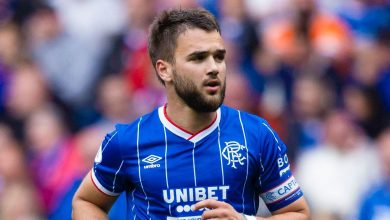
Youssef Chermiti shares when he expects to be running again in Rangers injury update

The news in the headline is modest on its face. Youssef Chermiti hopes to be running again in about six weeks. For a footballer seriously injured at the start of August, though, that milestone matters far more than it sounds, and it opens up a broader picture of a player’s recovery, a striker’s value to his club and a team that has coped without him better than anyone expected. It is a good moment to take stock of all three.
Begin with what Chermiti actually said, because it is more candid than most injury updates. Speaking to Rangers TV for the first time since the setback, he described the moment he knew something was badly wrong. He felt a pain in his knee unlike anything he had experienced before, asked the physio whether he could try to carry on, and found he could not even lift his leg. That is a vivid image, and it explains why a player who initially clung to hope eventually had to accept the truth. He told the same interviewer that everyone around him said he would probably be fine and he stayed positive for the rest of the day, but that the night before the scan he could no longer lie to himself. Anyone who has watched a player go down knows the pattern. The first reaction is denial, the second is bargaining with the medical staff, and the third is a quiet recognition that the next year of his life has just changed.
The diagnosis, as reported, is an ACL injury, which is among the most feared in football. The damage was also worse than first thought. Scans later showed the injury to his knee was more severe than the club’s medical staff initially anticipated. That detail helps explain why the recovery period has been long and why caution has been the watchword. The injury happened in early August, and he has since had surgery. He has been sidelined for around three months and is now targeting a return to running in six weeks. Counting forward, that puts the start of running work somewhere around the turn of the year, though the exact date depends on how the next stage of rehabilitation goes.
It is worth being precise about what running means in this context, because it can sound more significant than it is. In a typical ACL recovery, a player progresses through a series of stages. The first weeks are about controlling swelling, regaining range of motion and rebuilding the strength of the surrounding muscles. Then comes work in the gym, with progressively heavier loads, followed by work in the pool or on a specialised machine. Running on a surface is a milestone because it is the first time the repaired knee is asked to absorb impact in a repeated, rhythmic way. After that come changes of direction, then ball work, then contact, then training with the squad, and finally match fitness. Each step can take weeks, and setbacks are common. Chermiti himself acknowledged the gradual nature of this process when he said that it is about slowly getting back to how he was before. The six-week target is therefore the beginning of the late phase of recovery, not the end.
Importantly, nobody is putting a date on his return to competitive football. The Daily Record notes that the Portugal youth international cannot put a timeline on when supporters will see him in action again. This is wise. Players returning from this injury are frequently told that nine to twelve months is the norm, and many take longer to feel fully confident. I should be clear that this is general background about the injury and not something reported about Chermiti specifically. What the reports say is that he has no set return date, and the broader pattern suggests that a comeback is more likely late in the season or even into the next campaign than in the winter months. The Sports Mole team news from earlier this week supports this reading, noting that he was the only one among Rangers’ absentees expected to remain on the sidelines into 2027.
Chermiti’s own attitude is the most encouraging part of the update. He said he does not look too far ahead, preferring to take things day by day. He described his target as starting to run and then, when he first touches the grass and the ball, it will be a great feeling. That is the right mindset for a long rehabilitation. Players who fixate on a return date often push too hard, and the history of ACL recoveries is full of cases where an eager comeback ended in a second injury. A player who sets small, concrete targets, such as running, then the ball, then the grass, is more likely to avoid the mental trap of counting days. He has also been able to introduce new exercises into his gym programme, which is a sign that the early stage is behind him.
To appreciate why his absence matters so much to Rangers, it helps to recall what he achieved last season. He arrived on September 1, 2025, from Everton, signing a contract that runs to 2029 for a reported fee of around £8m, and his first full season at Ibrox was a revelation. He finished as Rangers’ top scorer in the league and across all competitions with 15 goals. Those numbers understate the impact of some of the goals. On January 3, 2026, he scored twice as Rangers came back from a goal down to beat Celtic 3-1 at Celtic Park, a result that, according to his profile, brought them level on points with their rivals after having been thirteen points behind earlier in the season. He also scored a hat-trick on the final day of the season, his second of the campaign. A striker who delivers in the biggest matches and finishes the season with a flourish is a striker whose absence is felt.
His value had also been recognised from outside. By summer, interest had arrived in the form of a substantial offer. It was widely reported on August 9 that Rangers had turned down a bid of £22 million for him. The profile I can see cuts off before naming the club that made it, so I will not guess at the identity. What matters is that a bid of that size, from a club prepared to pay almost three times what Rangers had spent, indicates how highly he was rated, and that Rangers regarded him as a core part of their plans. Within a couple of weeks of that rejection came the injury. The timing is cruel, because a player who has just been the subject of a major bid is exactly the player a club hopes to see in peak form.
The commercial dimension is worth pausing on. A serious knee injury changes a player’s market value, at least in the short term. Clubs weigh the risk that a player will return less explosive or more prone to further problems, and a bid that might have been higher before the injury will be reassessed. Rangers, for their part, benefit from the fact that his contract extends to 2029. They are not under pressure to sell him while he recovers, and they can wait to see how he looks when he returns before deciding on any future offer. That kind of contractual security is one of the quieter advantages of having signed him on a long deal. It does mean, however, that the club is carrying the cost of a key player who is not contributing on the pitch, and that cost has to be weighed against the potential reward of keeping a high-value asset.
The team, meanwhile, has carried on. Without Chermiti, Rangers have built an extended unbeaten run, as earlier discussions in this conversation noted, and the responsibility for goals has been shared among others. Rangers News’s predicted lineup against Motherwell had Ryan Naderi and Kevin Kelsy as the strike pairing. That arrangement has worked well enough that Derek McInnes has been happy to keep it, and it is a reminder that even the best striker can be replaced in the short term if the system is sound. The question for the longer term is whether the pairing can keep scoring through the winter and whether the club will need reinforcements, a question that bears directly on the January window.
That brings us to an interesting tension. Rangers have been described as expecting a quiet January, and yet the club has been linked with at least one attacking addition, a winger, and has been reported to be looking at options in midfield. A striker with a long-term injury is the sort of absence that can prompt a club to reconsider. If Naderi or Kelsy were to pick up a knock, the squad would have little cover in the central attacking positions, and Lawrence Shankland, who is another absentee, has only recently returned to running after a hamstring problem. Cammy Devlin and Lawrence Shankland are back running after hamstring injuries, while Chermiti remains out for the long term. That is a useful snapshot of the squad’s physical state. It suggests that the immediate pressure on the forward line is easing, but that the margin for error remains thin.
There is a human side to all of this that the reports capture well. Long injuries are lonely. A player who has been part of a daily routine, with teammates, training and matchday adrenaline, is suddenly working alone in a gym with a physiotherapist. He watches games from the stand or on television, sees his teammates succeed without him and has to cope with the fear that his place in the team will be taken. Chermiti has been honest about the emotional dimension, and the way he described the night before the scan suggests a player who has thought hard about what the injury means. That honesty is a good sign. Players who talk openly about their struggles tend to cope better with the psychological demands of rehabilitation, and the club’s medical and sports science staff will be aware of the importance of keeping him engaged and motivated.
It is also worth acknowledging the role of the people around him. Chermiti mentioned the physio, Kevin Bain, by first name, which is a telling detail. Over months of rehabilitation, a player spends more time with his physio than with almost anyone else at the club, and the relationship can be decisive. A good physio does more than manage exercises. He reads the player’s mood, adjusts the workload when confidence dips and tells the manager when a player is ready or is not. Whatever else is true about Chermiti’s recovery, the fact that he trusts the medical staff enough to speak warmly of them is a positive indicator.
Looking ahead, there are a few markers that will tell supporters how things are going. The first is the six-week target itself. If he does begin running in early January, as hoped, it will show that the recovery is on schedule. If it slips, that is not a disaster, because slippage is normal, but it would suggest that the return might be pushed into the following season. The second is whether he starts to appear in club photographs and videos, working on the grass at the training ground. Clubs often share small clips of injured players returning to the pitch, and these are a reliable sign of progress. The third is any comment from McInnes about his expected return. Managers tend to be cautious about giving dates, but a hint that a player is ahead of schedule is usually the first public acknowledgement of a good recovery.
It would be wise for supporters to temper their expectations. The excitement of seeing a favourite player on the training pitch can lead to unrealistic talk of an imminent return, and the pressure that comes with it is not helpful. The most successful recoveries tend to be those in which the club resists the temptation to rush the player back for a crucial fixture. Rangers have a clear incentive to be patient. Chermiti is under contract for years, is only 22, and has already shown that he can score in the biggest matches. A player who returns fully fit and confident is worth far more to the club than one who comes back early and breaks down again.
There is also a broader point about the psychology of returning from an ACL injury. Studies of athletes in many sports have found that the physical recovery is often complete before the mental one. Players can be anxious about the knee, hesitant in challenges and reluctant to turn sharply, even when the scans say the ligament is sound. The return to match action is therefore a delicate process, and clubs commonly use reserve matches or a staged increase in minutes to rebuild confidence. A striker’s game depends heavily on instinct, on the willingness to throw a body into a challenge or to turn quickly in the box, and any hesitation can blunt his effectiveness. Chermiti will need time to rediscover that instinct, and the first few matches after his return may not show him at his best.
None of that should obscure the fact that the underlying story is a positive one. A player who suffered a serious injury three months ago is now in the later phases of rehabilitation, has a defined next milestone and is speaking with realism and optimism. The surgery went as planned, the early stages have passed, and he has the support of a club that values him highly. That is a better position than many players find themselves in at this point, and it is the product of good medical care and a sensible attitude.
For Rangers, the lesson is also about depth and planning. A club that relies on one striker for most of its goals is vulnerable, and the way Rangers have handled Chermiti’s absence suggests a squad that has learned to share the load. The challenge now is to ensure that the load can be sustained through a demanding winter. If the unbeaten run continues and the title race remains close, the injuries to key players could become a decisive factor, and the manager will have to balance caution with the need to field his strongest side. The January window, whatever its scale, will be the moment to address any gaps.
In the end, the headline is a small piece of news about a long process. Chermiti hopes to start running in six weeks, which means he is making progress, but a return to match action is probably months away. The reports do not give a date, and nobody inside the club is pretending otherwise. What they do show is a player who understands the road ahead and is willing to take it at the right pace, and a club that has the patience to let him. If everything goes to plan, the sight of him back on the grass, and eventually back in the number nine shirt, will be one of the most welcome moments of the season. Until then, the best thing supporters can do is follow the small signs of progress, resist the urge to ask for a date and trust that the work being done in the gym will pay off when it matters.