BAJRAMI’S IBROX CHAPTER CLOSES AS RANGERS SEAL SAUDI CASH WINDFALL AMID SUMMER OF UPHEAVAL

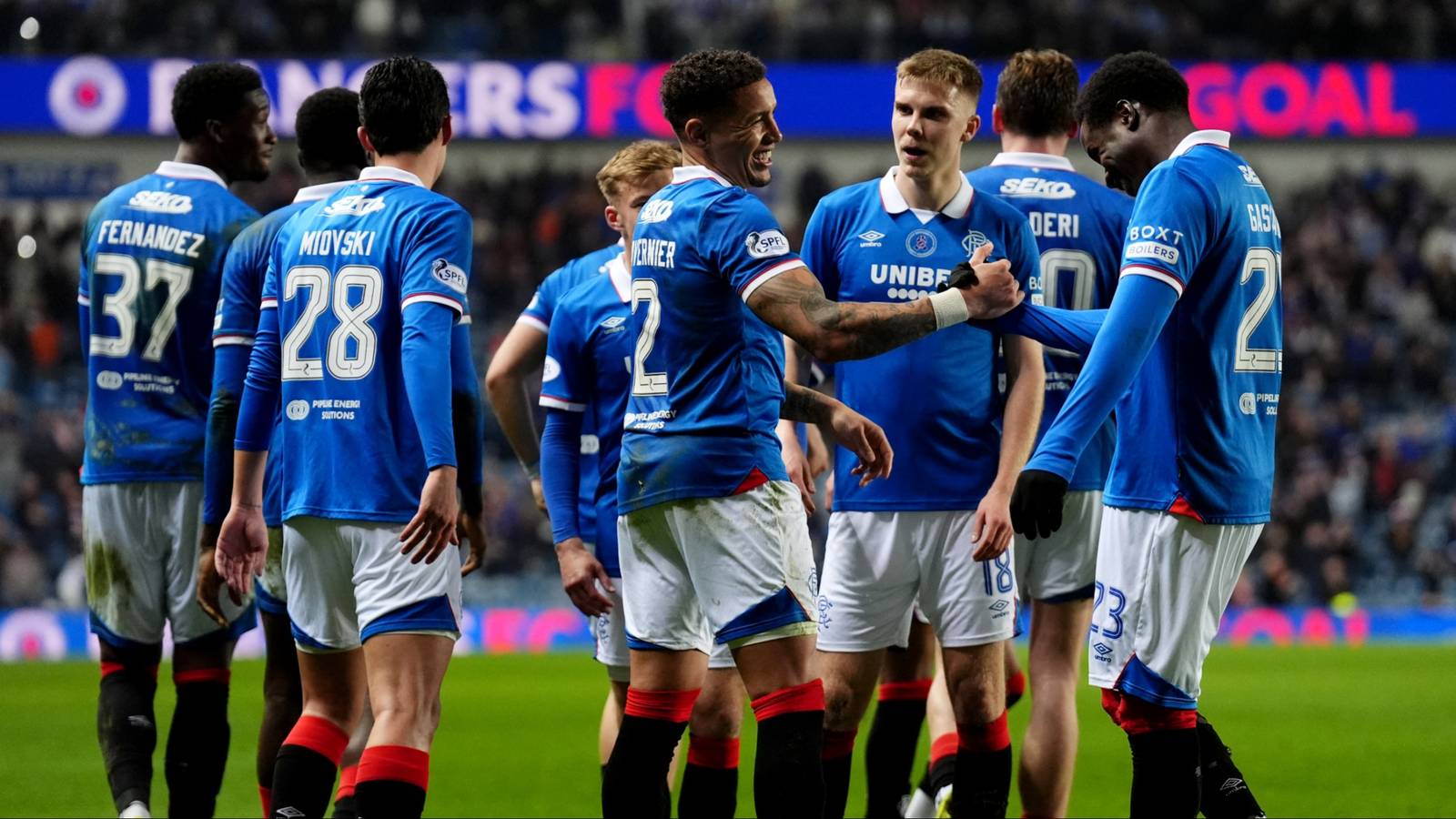
Nedim Bajrami’s time at Rangers has finally reached its conclusion, with the Albanian international completing a move to Saudi Pro League outfit Al-Taawoun in a deal that brings the curtain down on a spell at Ibrox that never quite delivered on its early promise. The 27-year-old arrives at the Buraidah-based club having become the latest name to depart Glasgow this summer as Derek McInnes continues the process of reshaping a squad he inherited from Danny Rohl, and while the fee involved is unlikely to set pulses racing, the sale represents a tidy piece of business for a Rangers hierarchy determined to balance the books as they continue to reinforce elsewhere in the window.
For a player who arrived at Ibrox with genuine excitement attached to his name, Bajrami’s Rangers career ultimately became a story of fleeting moments rather than sustained influence. He joined from Sassuolo in the summer of 2024 off the back of a breakout European Championship campaign with Albania, a tournament in which he etched his name into the record books by scoring the fastest goal in the competition’s history, finding the net after just twenty-three seconds against Italy. That moment alone was enough to convince Rangers of his quality, and under then-manager Philippe Clement, who signed him and remained his most consistent advocate during his time at the club, Bajrami looked for a period as though he might establish himself as a mainstay of the Ibrox midfield. His attacking instincts, comfort operating either centrally or from the flank, and eye for a telling contribution made him a popular figure during the early months of his Rangers career, and few will forget his contribution in the 2024 League Cup final against Celtic, a goal that remains among his most cherished moments in light blue.
Yet football has a habit of moving quickly, and managerial change has a way of altering a player’s fortunes almost overnight. Once Clement departed Ibrox and Danny Rohl took the reins, Bajrami’s opportunities began to dry up in a manner that proved difficult to reverse. Where he had once been a regular feature of matchday squads, he increasingly found himself on the periphery, a player whose technical ability was rarely in question but whose role within the team’s evolving structure became harder to define. By the time Derek McInnes arrived to take charge ahead of the new campaign, the writing appeared to be on the wall. The new manager made an early assessment that Bajrami would not feature prominently in his plans, and the player was left out of the matchday squad entirely for the season’s opening fixture against Dundee United, a decision that signalled in no uncertain terms that his Ibrox future had reached its natural end point.
Across his two years in Scotland, Bajrami made 63 appearances for Rangers, contributing seven goals along the way, including that memorable League Cup final strike against Celtic that will likely stand as the defining highlight of his time at the club. It is a record that tells the story of a player who offered moments of genuine quality without ever fully cementing himself as a first-choice performer, and one whose statistical output, while respectable, fell short of matching the expectations that accompanied his high-profile arrival from Serie A. There is a certain symmetry to how his Rangers career unwound: a player signed on the back of a viral, headline-grabbing moment on the European stage, whose Ibrox legacy will itself be distilled down to a handful of standout contributions rather than a body of consistent, week-in-week-out influence.
Interest from Saudi Arabia emerged relatively early in the summer window, with reports suggesting that Al-Taawoun had identified Bajrami as a target capable of strengthening their attacking options as they look to build on a sixth-place finish in last season’s Saudi Pro League. What followed was a protracted period of negotiation between the two clubs, with Rangers making clear from the outset that their preference was for an outright permanent sale rather than the loan-with-an-option-to-buy structure that Al-Taawoun initially proposed. That stance proved significant in shaping the eventual terms of the deal, with Ibrox officials standing firm even as reports of interest from elsewhere, including Bajrami’s former club Sassuolo and other suitors in Italy and Turkey, added a layer of competition to proceedings. Ultimately, it was the Saudi side who prevailed, helped in no small part by a behind-the-scenes connection that smoothed the path to an agreement: Bajrami and Al-Taawoun boss Zarko Lazetic share the same representation, a relationship that provided an efficient and direct channel of communication between player and club throughout the negotiation.
The financial terms of the move have been reported consistently across multiple outlets, with the fee understood to sit in the region of £2.5million, translating to a figure of around three million euros as cited by respected transfer insider Nicolo Schira. That represents a shortfall of roughly £1million against the fee Rangers originally paid Sassuolo to sign Bajrami two years ago, a modest loss but one that will nonetheless be viewed pragmatically within Ibrox given the player’s diminishing role and the two years still remaining on his contract at the time of his departure. Reports also indicate that Bajrami has agreed a contract with Al-Taawoun running through until the summer of 2029, underlining the scale of commitment the Saudi club are prepared to make to a player they clearly view as an asset capable of contributing significantly to their squad over the medium term, even if his final months in Scotland told a rather different story.
Bajrami’s departure fits into a wider pattern that has come to define Rangers’ summer under McInnes, a window in which the new manager has moved swiftly and decisively to trim a squad he judged to be imbalanced and, in places, short of the required standard. The Albanian becomes the fourth notable first-team departure of the window, following captain James Tavernier, goalkeeper Jack Butland, and forward Oliver Antman, who completed his own move to Anderlecht in Belgium earlier in the summer. Each of those exits tells its own story, but collectively they paint a picture of a manager unafraid to make bold calls early in his tenure, prioritising a leaner, more clearly defined squad over simply retaining experienced or previously well-regarded names for the sake of continuity. It is a approach that will not be universally popular among supporters attached to certain individuals, but one that McInnes appears convinced is necessary if Rangers are to build a cohesive unit capable of matching his tactical demands from the very start of the campaign.
There is also a defensive dimension to the ongoing squad reshuffle, with Scotland international John Souttar similarly expected to depart Ibrox this summer after McInnes confirmed the defender would be allowed to leave in search of regular first-team football elsewhere. Reports have linked Souttar with interest from both Swansea City and Leicester City, two clubs who could offer him the consistent game time that has become harder to guarantee at Ibrox given the competition for places in central defence. Taken together with Bajrami’s exit and the uncertainty still surrounding one or two further fringe figures, it is clear that McInnes is intent on conducting a thorough audit of the squad he inherited, moving on players who do not fit his immediate plans regardless of reputation or previous standing within the dressing room.
From a purely footballing perspective, the money recouped from Bajrami’s sale is likely to feed directly back into Rangers’ ongoing recruitment efforts as the transfer window edges toward its climax. McInnes has already overseen a significant volume of incoming activity this summer, but there remains a clear appetite within Ibrox to add further reinforcements before the deadline arrives, with quality options in wide areas and further defensive cover understood to remain priorities. The logic within the club appears straightforward: funds generated from moving on players who no longer feature in the manager’s plans should be reinvested promptly into targets capable of making an immediate first-team impact, rather than being left to accumulate on the balance sheet while the current squad continues to search for consistency on the pitch. Rangers’ opening-day performance, a 1-1 draw away at Dundee United, will only have sharpened that sense of urgency, with observers noting that the team looked in need of further quality and depth if it is to sustain a genuine challenge across multiple competitions this season.
It is also worth considering Bajrami’s exit within the broader context of how Rangers have approached player trading under the new regime. There is a pragmatic recognition at boardroom level that not every high-profile signing of recent years has worked out as hoped, and that a willingness to cut losses on underperforming assets, even at a financial deficit, can ultimately serve the club’s longer-term interests far better than allowing a player to drift on the periphery of the squad indefinitely. Bajrami’s situation is a case in point: a talented performer who arrived with a genuine reputation and produced flashes of real quality, but whose overall contribution never matched the level required to justify a regular starting berth under three different managers in as many years. Recycling that value into a fresh assessment of what the current squad needs, rather than persisting with square pegs in round holes, appears to be a defining feature of how McInnes intends to operate during his time at the helm.
For Bajrami personally, the move to Saudi Arabia represents both a fresh start and a significant financial opportunity, with Saudi Pro League clubs continuing to offer wages well beyond what most European sides outside the traditional superleagues can realistically match. Al-Taawoun’s ambitions to strengthen their attacking options following a sixth-place finish last season suggest the Albanian could find himself with a genuine platform to rebuild his career and reputation away from the intense scrutiny that comes with playing for a club of Rangers’ size and history. Whether he can rediscover the form and confidence that made him such an exciting proposition during his final months in Italy remains to be seen, but a change of scenery, regular football, and a lucrative long-term contract running through to 2029 will give him every opportunity to do so.
There is also value in examining Bajrami’s footballing journey prior to Rangers, since it helps explain why the club moved for him with such conviction back in 2024. Born and raised in Switzerland to Albanian parents, Bajrami began his senior career with Grasshoppers in the Swiss Super League before making the switch to Italian football, initially on loan at Empoli in Serie B. That loan spell proved to be the making of him: he established himself as a regular starter, made more than thirty appearances, and contributed five goals as Empoli pushed for promotion. His performances were sufficiently convincing that Empoli exercised their option to sign him permanently, and the following campaign he was central to the club’s title-winning push, contributing five goals and eight assists as Empoli secured promotion back to Serie A. His importance to that promotion campaign was underlined when he scored in a resounding win over Cosenza that confirmed the club’s return to Italy’s top flight, a goal that remains one of the defining moments of his career in Italian football.
From there, Bajrami’s stock continued to rise. He moved on to Sassuolo, initially on loan with an obligation to buy that was reported to be worth in the region of seven million euros, and made an instant impact by scoring the winning goal in stoppage time on his debut against Cremonese. He went on to make more than twenty league appearances during his first season at the club, and the switch to Sassuolo was made permanent once the mandatory purchase clause was triggered. It was during his time in Serie A that Bajrami built the reputation which eventually caught Rangers’ attention, developing into a versatile attacking midfielder capable of playing centrally or from wide areas, someone whose technical ability and eye for goal made him a regular topic of transfer speculation even before his headline-grabbing exploits at the European Championship sealed his move to Scotland.
That underlying career arc, one of steady progression through Swiss and Italian football before arriving in Scotland with genuine continental pedigree, is precisely why his struggles at Ibrox will be viewed by many as a case of circumstance rather than a reflection of any decline in his underlying ability. Players who have proven themselves capable of performing at a reasonably high level in Serie A do not typically lose that quality overnight, and Bajrami’s difficulties in nailing down a consistent role at Rangers appear to owe far more to a lack of managerial continuity and shifting tactical priorities than to any drop-off in his own standard of play. It is a pattern familiar to many players who move to a new league with high expectations attached, only to find that fit and timing can matter just as much as raw ability when it comes to succeeding at a new club.
The identity of his new employers also deserves some context. Al-Taawoun, based in the city of Buraidah in Saudi Arabia’s Al-Qassim region, finished sixth in the Saudi Pro League last season, a respectable if unspectacular return for a club that has increasingly sought to strengthen its squad with experienced European talent as the Saudi top flight continues its rapid rise in profile and financial firepower. The Saudi Pro League has, over the past several years, transformed itself into a genuine destination for established professionals from across Europe, offering financial packages that few clubs outside the very elite of the continental game can hope to match. For a club like Al-Taawoun, sitting outside the traditional powerhouses of Saudi football such as Al-Hilal, Al-Nassr and Al-Ittihad, targeted signings like Bajrami represent an opportunity to bridge the gap and add genuine quality to a squad aiming to push further up the table in the season ahead.
That broader Saudi context also helps explain why Rangers found themselves able to negotiate from a position of relative strength despite Bajrami’s disrupted final season at Ibrox. With the Saudi Pro League continuing to attract sustained investment and clubs there increasingly willing to meet the valuations set by selling clubs, Rangers were able to hold out for the permanent sale they wanted rather than accepting the initial loan-with-option structure that Al-Taawoun had proposed. That negotiating stance, insisting on certainty over the fee rather than settling for a conditional arrangement, reflects a pragmatic approach from the Ibrox hierarchy: better to secure a guaranteed return now on a player whose long-term future at the club was already effectively settled than to leave the door open to a scenario in which Bajrami might eventually return to Scotland having failed to make the desired impact in Saudi Arabia.
Looking back on his time in Scotland, it would be unfair to characterise Bajrami’s Rangers career purely in negative terms. His technical quality was never seriously questioned by those who worked with him, and his contribution during the early stages of his Ibrox career, particularly under Clement, offered genuine reasons for optimism that he could develop into an important player for the club. The League Cup final goal against Celtic will remain a cherished memory for supporters who were present or watching on, a reminder that even amid a spell that ultimately did not work out as hoped, there were moments of real quality and significance along the way. Football, though, is an unforgiving business, and managerial changes have a habit of leaving certain players stranded on the wrong side of a tactical reshuffle through no fault of their own. Bajrami’s story at Ibrox is, in many ways, a case study in exactly that dynamic: a talented player whose circumstances shifted dramatically not because his ability diminished, but because the environment around him changed in ways that no longer suited his particular strengths.
As Rangers turn the page on this particular chapter, attention will inevitably shift toward how the funds generated from Bajrami’s sale are reinvested and whether further departures follow before the transfer window closes. McInnes has made clear through his actions this summer that he is prepared to make difficult calls when he judges them necessary, and the swift, business-like manner in which the Bajrami deal was concluded, moving from initial contact to a near-complete agreement within a matter of weeks, suggests a management team operating with clarity and purpose rather than sentiment. For a Rangers support eager to see tangible progress under the new manager, the hope will be that this latest piece of squad rationalisation translates into further quality arriving through the door before the window shuts, continuing the broader project of assembling a group capable of competing seriously on multiple fronts throughout the season ahead. Bajrami, meanwhile, departs with the club’s best wishes for the next stage of his career, taking with him the memories of a League Cup final goal against Celtic and a European Championship moment that will forever be part of his own footballing story, even as his time at Ibrox draws to a close sooner than many might once have anticipated.
The wider picture at Ibrox this summer continues to be one of significant transition, with arrivals and departures moving almost in parallel as McInnes works to stamp his own identity on the squad. Where Bajrami’s exit closes one chapter, the club’s ongoing pursuit of further additions in wide areas and at the back keeps the door open on what could yet prove to be one of the more transformative windows in recent Ibrox history. Supporters watching the numbers tick by on incomings and outgoings will recognise the pattern by now: assess, act decisively, and reinvest, with little room left for players who do not fit the manager’s evolving vision. Bajrami’s Saudi move, modest in financial terms but significant in what it represents about the club’s current direction, fits neatly into that pattern, another data point in a summer that has already reshaped substantial portions of the Rangers first team and shows little sign of slowing as the window approaches its final weeks.