Carabao Cup final referee is banned from officiating games involving Arsenal and Man City rival

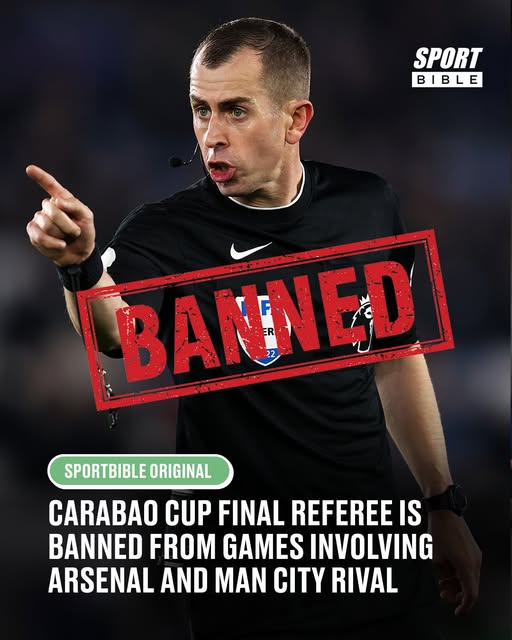
The appointment of a referee for a major cup final is always a topic that sparks debate, discussion, and sometimes controversy among fans. This was no different ahead of the Carabao Cup final between Arsenal and Manchester City, where the spotlight was not only on the players and managers but also on the man tasked with maintaining order on the pitch—Peter Bankes.
As two of England’s most dominant clubs prepared to face off at Wembley Stadium, attention quickly turned to the officiating team selected for the occasion. Bankes, an experienced Premier League referee, was chosen to take charge of what promised to be a high-stakes encounter. However, an interesting detail surrounding his eligibility added another layer of intrigue to the build-up.
If Liverpool had reached the final, Bankes would not have been allowed to officiate the match.
This revelation surprised many fans and highlighted one of the lesser-known but important rules governing refereeing in English football. Officials are required to declare their affiliations, including any connections to specific clubs or regional football associations. These declarations are designed to prevent any potential conflicts of interest and to maintain the integrity of the game.
In Bankes’ case, his association with the Liverpool County Football Association means that he is barred from officiating matches involving both Liverpool and their city rivals, Everton. This restriction ensures that there is no perception of bias, even if none exists in reality.
Such rules are taken seriously by the Premier League and other governing bodies. Referees are expected to remain neutral at all times, and even the slightest suggestion of favoritism can undermine confidence in the fairness of a match. By implementing these guidelines, football authorities aim to protect the credibility of competitions at all levels.
Fortunately for Bankes, Liverpool’s early exit from the Carabao Cup cleared the way for his appointment. The Merseyside club was eliminated in the fourth round after a surprising 3-0 defeat to Crystal Palace at Anfield back in October. That result not only ended Liverpool’s hopes of lifting the trophy but also indirectly opened the door for Bankes to officiate the final.
While Bankes may have been disappointed to see a club from his region fall short, the opportunity to referee a major domestic final represents a significant milestone in any official’s career. Matches of this magnitude are reserved for referees who have demonstrated consistency, professionalism, and the ability to handle pressure at the highest level.
The Carabao Cup final between Arsenal and Manchester City was exactly that kind of occasion. Both teams entered the match with a great deal at stake. Not only was the trophy itself on the line, but the result also had the potential to influence the broader narrative of the season.
At the time, Arsenal and Manchester City were deeply involved in the Premier League title race. A victory at Wembley could provide a psychological boost, strengthening belief and momentum heading into the crucial final months of the campaign. Conversely, defeat could serve as a setback, testing the resilience of the players and coaching staff.
This context only increased the importance of having a capable and composed referee in charge. Bankes’ experience in the Premier League made him a logical choice. Over the course of the season, he had officiated 22 league matches, during which he awarded six penalties and issued four red cards. These statistics reflect a referee who is willing to make decisive calls when necessary, an essential quality in high-pressure fixtures.
Bankes was not alone in his duties. He was supported by a team of experienced officials, including assistant referees Neil Davies and Steve Meredith. Marc Perry was named as the reserve assistant referee, while Tom Bramall took on the role of fourth official. Together, this group formed a well-prepared officiating unit tasked with ensuring that the match ran smoothly.
In addition, Video Assistant Referee (VAR) technology was in place for the final. John Brooks and Dan Robathan were stationed in the VAR booth, ready to assist with key decisions such as goals, penalties, red cards, and cases of mistaken identity. The use of VAR has become a standard feature in major competitions, providing an additional layer of scrutiny and helping to reduce the likelihood of critical errors.
Despite the presence of technology, the responsibility still ultimately rests with the referee on the pitch. Bankes needed to maintain control of the game, manage player behavior, and make split-second decisions under intense pressure. In a match featuring top-level talent from both sides, this was no small task.
Bankes was no stranger to either team. Throughout his refereeing career, he had overseen 14 matches involving Arsenal. Among these was a notable Carabao Cup semi-final second leg against Chelsea, a fixture that required careful handling given the rivalry and stakes involved.
He had also officiated 12 matches involving Manchester City, including a memorable encounter in which City suffered a heavy 5-1 defeat to Arsenal the previous season. Experiences like these would have provided Bankes with valuable insight into the playing styles, key players, and tactical approaches of both teams.
As the final approached, anticipation continued to build. Wembley Stadium, the iconic venue for English football’s biggest occasions, was set to host a clash between two sides known for their attacking quality and tactical sophistication. Fans from both clubs eagerly awaited the showdown, hoping to see their team lift the first major trophy of the season.
The significance of the match extended beyond the silverware itself. For Arsenal, it represented an opportunity to take a major step forward under their current project. For Manchester City, it was another chance to reinforce their dominance and add yet another trophy to their already impressive collection under Pep Guardiola.
Amid all this excitement, the role of the referee remained crucial. Every decision—from awarding free kicks to managing confrontations between players—had the potential to influence the outcome of the match. In such a high-profile game, even the smallest call could be scrutinized by millions of viewers around the world.
This is why the selection process for referees is so meticulous. Officials are evaluated based on their performances, consistency, and ability to handle pressure. They must also adhere to strict guidelines regarding potential conflicts of interest, as seen in Bankes’ situation.
The rule preventing referees from officiating matches involving certain teams may seem restrictive, but it serves an important purpose. Football is a sport driven by passion, and fans are deeply invested in their clubs. Ensuring that referees are free from any perceived bias helps maintain trust in the fairness of the competition.
In Bankes’ case, his connection to the Liverpool FA meant that he could not officiate games involving Liverpool or Everton. This is a standard precaution, applied to referees across the country based on their affiliations. While it may limit the matches they can oversee, it ultimately strengthens the integrity of the game.
With Liverpool out of the picture, Bankes was free to take charge of the Carabao Cup final. It was a moment of recognition for his work throughout the season and an opportunity to demonstrate his capabilities on one of the biggest stages in English football.
As kickoff approached, all eyes were on Wembley. Players, managers, and fans alike understood the importance of the occasion. For the referee, it was another challenge—one that required focus, composure, and a deep understanding of the game.
The Carabao Cup final is often seen as a stepping stone to further success. Winning it can set the tone for the rest of the season, while losing it can serve as a harsh lesson. In such a context, the margin for error is minimal, and the pressure is immense.
For Bankes and his team, the goal was simple: to officiate the match fairly and effectively, allowing the players to decide the outcome. While referees rarely receive praise for their performances, their contribution is essential to the smooth running of the game.
In the end, the story of the Carabao Cup final is shaped by many factors—the tactics, the goals, the moments of brilliance, and the drama on the pitch. But behind all of this is the work of the officials, ensuring that the game is played within the rules and that the competition remains fair.
Peter Bankes’ appointment serves as a reminder of the complexity and responsibility involved in refereeing at the highest level. From managing conflicts of interest to making crucial decisions under pressure, referees play a vital role in the world of football.
As Arsenal and Manchester City battled for glory, Bankes stood at the center of it all, tasked with maintaining order in a match that carried immense significance. It was a challenge he had earned the right to face—and one that highlighted the often-overlooked importance of officiating in the beautiful game.