He’s reviewed the footage and he’s convinced the officials came to the wrong decision

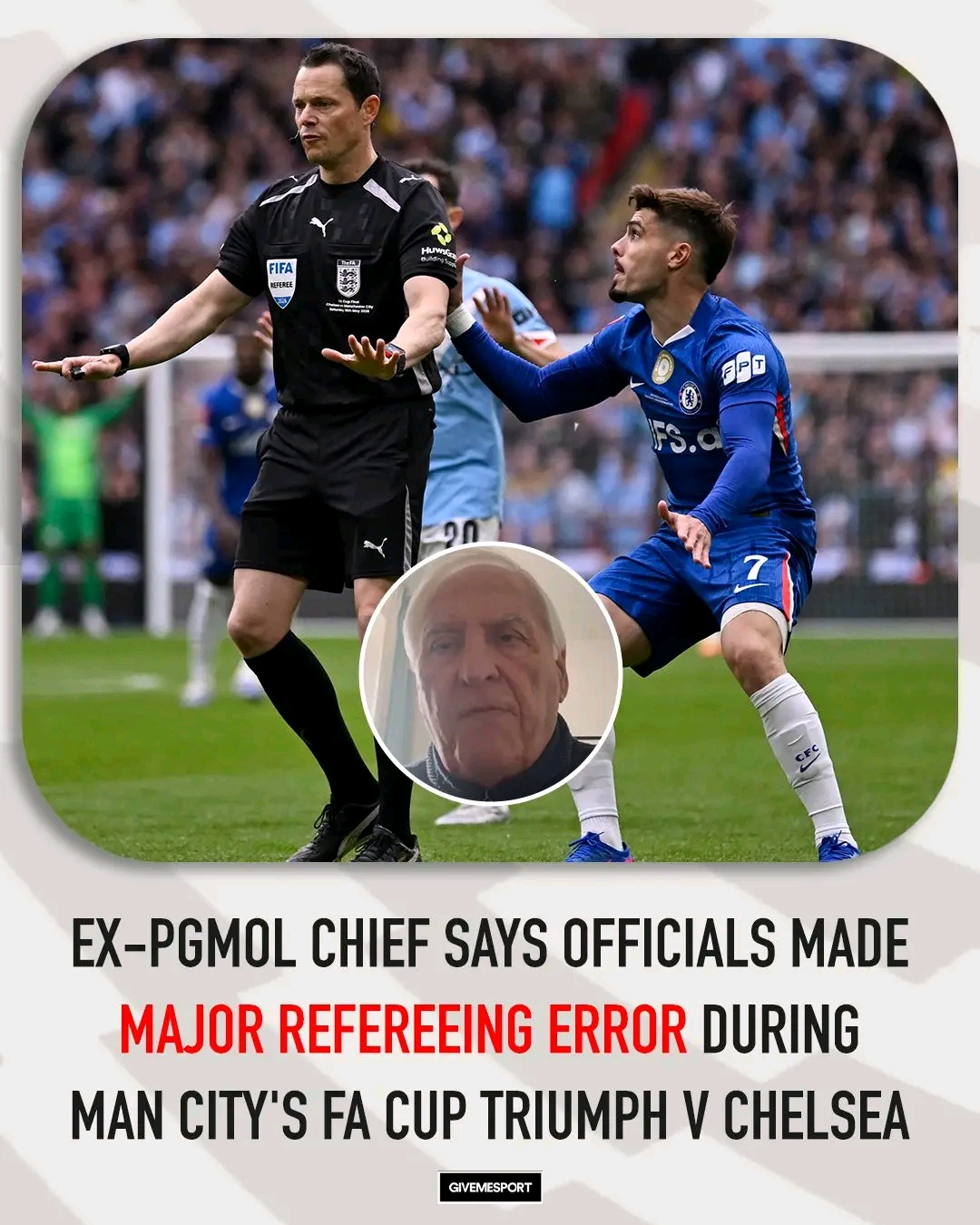
The fallout from the FA Cup final between Manchester City and Chelsea has not stopped growing, even after the final whistle and the trophy celebrations at Wembley Stadium. What was already a tightly contested match decided by a single goal has now turned into a wider debate about refereeing standards, VAR decisions, and whether key moments were handled correctly on the biggest stage of English football.
Manchester City’s 1-0 win over Chelsea, secured by Antoine Semenyo’s second-half strike, gave Pep Guardiola’s side another major trophy and further strengthened their dominance in domestic cup competitions. But while City fans celebrated another historic triumph, Chelsea supporters were left frustrated, pointing to several incidents during the match that they believe went against them at crucial moments.
Now, former PGMOL chief Keith Hackett has added fuel to the fire by claiming that officials made a “major error” during the game, specifically pointing to one first-half incident involving Chelsea midfielder Enzo Fernández that he believes should have resulted in a red card.
The match itself was tense from the opening whistle. Both sides approached the final with caution, knowing how much was at stake. Manchester City, chasing yet another piece of silverware under Pep Guardiola, controlled possession in spells but struggled to break down a disciplined Chelsea defensive structure. Chelsea, on the other hand, looked dangerous on the counter and tried to use pace and physicality to unsettle City’s rhythm.
For long periods, it felt like the match could swing either way. The first half saw several key duels in midfield, with tackles flying in and tempers beginning to rise. The intensity of a Wembley final was clear, with neither team willing to give an inch.
However, it was one particular moment involving Enzo Fernández that has now become the centre of discussion after the game. The Chelsea midfielder was involved in a heavy challenge on Bernardo Silva, an incident that was checked by VAR but ultimately resulted in only a yellow card. Referee Darren England decided to keep Fernández on the pitch, and VAR backed the on-field decision.
At the time, the decision did not cause an immediate major reaction from the stadium, but replays quickly circulated after the match, sparking debate among fans and pundits. Some believed it was a mistimed challenge that warranted a booking, while others felt it crossed the line into dangerous play.
Keith Hackett, speaking after reviewing the incident, has taken a strong stance. The former FIFA referee and ex-PGMOL chief insisted that the challenge met the criteria for serious foul play and should have resulted in a red card.
According to Hackett, the key issue lies in the nature of the tackle itself. He explained that under the Laws of the Game, serious foul play involves excessive force or actions that endanger the safety of an opponent. In his view, Fernández’s challenge clearly fell into that category.
He argued that the midfielder lunged into the tackle with excessive force, putting Bernardo Silva at risk of injury. While the referee on the pitch may have seen it as reckless or borderline, Hackett believes the correct interpretation of the rules should have led to a dismissal.
This interpretation has reignited debate over how VAR is being used in high-pressure matches. Supporters of the technology argue that it is meant to correct clear and obvious errors, but critics say its application is inconsistent and often fails to intervene in moments that significantly affect games.
Chelsea fans, in particular, have been vocal since the final whistle. Many believe that if Fernández had been sent off, the entire dynamic of the match would have changed. Playing a major final with ten men against a team like Manchester City is widely considered a near-impossible task, and some argue that such a decision could have altered the outcome entirely.
On the other side, Manchester City supporters maintain that these types of incidents are part of the game and that referees must make split-second decisions in real time. They point out that Chelsea also had moments where they could have capitalised but failed to convert chances into goals.
Beyond the Fernández incident, there were also other controversial moments that Chelsea felt went unnoticed. One of them involved a penalty appeal when João Pedro went down under pressure inside the box. Chelsea players immediately appealed, but the referee waved play on, and VAR did not intervene.
That decision added to growing frustration on the Chelsea bench, with several players visibly expressing their disagreement. However, as with many incidents in modern football, interpretations varied depending on which angle was being viewed.
Manchester City, meanwhile, stayed focused on their task. Pep Guardiola’s side showed patience throughout the match, circulating the ball and waiting for the right moment to strike. That moment eventually came in the 71st minute when Antoine Semenyo produced a clever finish to break the deadlock.
The goal itself was a moment of quality rather than controversy. Semenyo found space inside the box and executed a composed finish that left Chelsea goalkeeper Robert Sánchez with no chance. It was a goal that reflected City’s persistence and ability to punish small defensive gaps at the highest level.
After going behind, Chelsea pushed forward in search of an equaliser. They increased their intensity, making substitutions and attempting to stretch City’s defensive structure. However, Manchester City’s experience in controlling big matches became clear in the closing stages.
Despite Chelsea’s pressure, City held firm and saw out the game professionally. When the final whistle blew, celebrations erupted among the City players and staff, with another FA Cup title added to their already impressive trophy collection under Pep Guardiola.
For Chelsea, the defeat marked another painful chapter in their recent history of near misses in major finals. While there were positives in their performance, the result once again highlighted the fine margins that separate success and failure at the top level.
In the aftermath of the match, attention quickly shifted away from the scoreline and towards the refereeing decisions. This is something that has become increasingly common in modern football, where VAR scrutiny often continues long after the final whistle.
Keith Hackett’s comments have ensured that this particular incident will remain part of the post-match conversation for days, if not weeks. His authority as a former senior referee adds weight to his opinion, even if not everyone agrees with his assessment.
For the Premier League and officiating bodies, incidents like this add pressure to continue improving consistency and transparency in decision-making. Every major final is now analysed in extreme detail, and even small moments can become major talking points in the media and among fans.
At the same time, football remains a game of interpretation. Referees are required to make judgment calls in real time, often in situations where the speed of play makes perfect clarity difficult. VAR was introduced to reduce mistakes, but it has also introduced new layers of debate about what should or should not be overturned.
As for Chelsea and Manchester City, both teams now move forward with different emotions. City continue their pursuit of dominance in English football, adding yet another trophy to their collection. Chelsea, meanwhile, are left to reflect on what might have been, especially with the controversial moments still fresh in their minds.
In the end, the FA Cup final will be remembered not just for Semenyo’s winning goal or Guardiola’s latest triumph, but also for the refereeing controversy that has once again placed VAR and match officiating under the spotlight.
And as long as debates like this continue, football’s biggest matches will always be about more than just the scoreline on the night.