Joško Gvardiol “HAD ENOUGH” AS Manchester City FUTURE CLOUDED Shock reports claim Gvardiol is feeling increasingly undervalued at City, with suggestions of growing frustration over his role and standing within the squad, sparking speculation he could reassess his long-term future at the Etihad if the situation doesn’t improve soon. 👉 Read on as insiders reveal what triggered

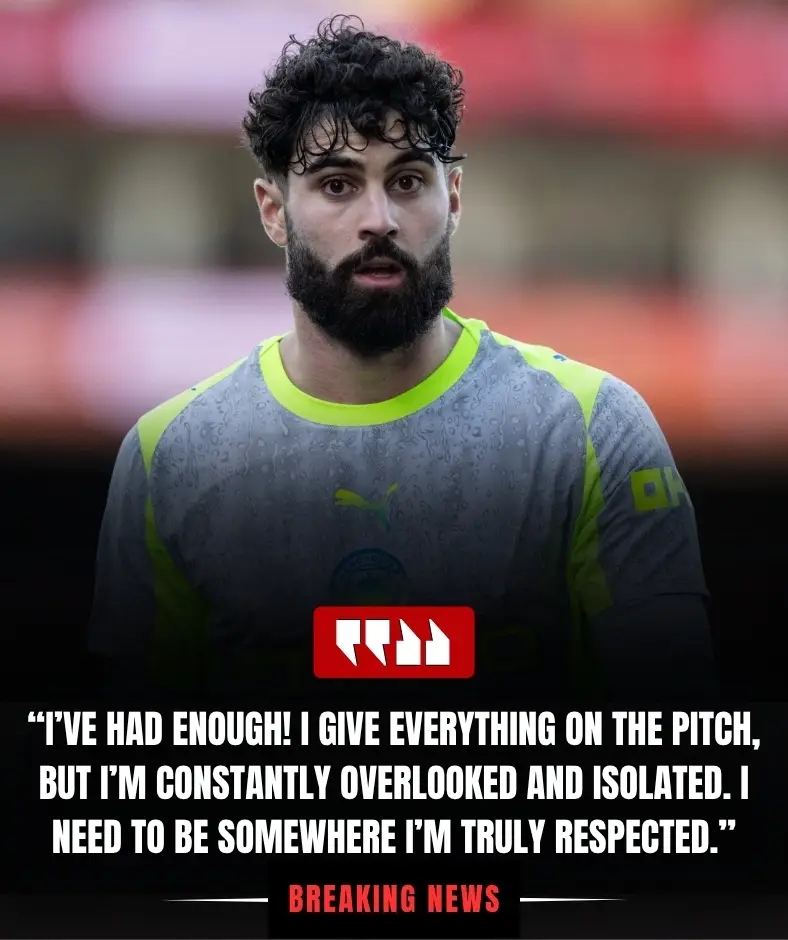
The noise started quietly, almost too quietly for something that would soon explode into one of the most talked-about stories surrounding Manchester City.
At first, it was just another report buried among the endless stream of football updates. But then one line stood out, sharp and emotional, impossible to ignore.
“I’ve had enough.”
Those words, reportedly linked to Joško Gvardiol, quickly spread across media platforms, fan pages, and football discussions around the world. And just like that, a new narrative was born — one that suggested tension, frustration, and uncertainty inside one of the most successful teams in modern football.
For Manchester City fans, the idea felt strange.
Gvardiol arrived at the club as one of the most exciting defenders in world football. Young, confident, technically gifted, and tactically intelligent. A player seen not just as a signing for the present, but as a cornerstone for the future.
So how did things go from promise to frustration?
That is the question at the centre of this growing storm.
According to the reports, the issue is not about one single moment. It is about a feeling — a growing sense of being undervalued within the squad. Not necessarily ignored, not completely sidelined, but not fully recognised in the way the player expected.
And in elite football, those small differences in perception can become very big problems.
At a club like Manchester City, competition is constant.
Every position is filled with world-class players. Every training session is intense. Every selection decision is analysed. There are no guaranteed roles, no permanent starting spots, and no room for comfort.
For some players, that environment is motivating.
For others, it can be frustrating.
Gvardiol, known for his confidence and strong personality on the pitch, is not the type of player who is comfortable feeling secondary. He is used to responsibility. Used to being central to the team’s defensive structure. Used to playing a key role in big matches.
So when reports suggest he feels undervalued, it points to something deeper than just minutes played.
It suggests a disconnect between expectation and reality.
The rumours became even more intense when claims emerged about his relationship with Pep Guardiola. Not direct conflict, not open disagreement, but a subtle tension. A feeling that communication may not be as strong as it needs to be.
In Guardiola’s system, defenders are not just defenders.
They are playmakers.
They are positional thinkers.
They are expected to adapt constantly, to move into midfield, to build attacks, to understand space in ways that go beyond traditional defensive roles.
For some players, this is an exciting challenge.
For others, it can feel restrictive if their natural strengths are not fully utilised.
Gvardiol’s style is aggressive, front-foot defending combined with composure on the ball. But in a system that demands constant positional discipline and tactical precision, individual expression can sometimes feel limited.
That balance — between structure and freedom — is where many elite players either thrive or struggle.
And according to these reports, Gvardiol may currently be struggling with that balance.
Another part of the story points to dressing room dynamics.
Again, not open conflict, but subtle isolation.
At top clubs, dressing rooms are complex environments. There are established leaders, long-term players, and new arrivals all competing for influence and recognition. Integration takes time, and not every player settles in the same way.
If a player begins to feel disconnected — even slightly — it can affect confidence, performance, and overall satisfaction.
The claim that Gvardiol feels “isolated” is difficult to verify, but it adds emotional weight to the narrative.
Because isolation is not about numbers.
It is about feeling.
And feelings, in football, often shape decisions as much as performance does.
As the story spread, fans reacted in different ways.
Some dismissed it immediately, seeing it as another exaggerated report designed to create drama around a successful club.
Others took it more seriously.
They pointed to moments during the season where Gvardiol’s role seemed unclear. Matches where he was used in different positions. Games where he was not starting regularly. Situations where his influence appeared reduced compared to expectations.
For those fans, the rumours did not come from nowhere.
They saw small signs and connected them to the bigger story.
Then came the biggest question of all.
Could he actually leave?
That is where speculation becomes reality in football.
A player feeling unhappy is one thing.
A player considering exit is something else entirely.
According to the reports, Gvardiol could reassess his long-term future at Manchester City if the situation does not improve. That does not mean immediate departure. It does not mean transfer requests or confirmed negotiations.
It means uncertainty.
And uncertainty is powerful.
Because once a player begins to question their future, every decision becomes more significant. Every conversation matters more. Every match becomes a statement.
At the same time, Manchester City are not a club that reacts emotionally to rumours.
Their structure is built on long-term planning. Their decisions are calculated. Their communication, especially internally, is controlled and deliberate.
If there is an issue, it is likely being managed quietly rather than publicly.
That is how elite clubs operate.
But silence from the club does not stop the noise outside.
Media outlets continue to analyse. Fans continue to debate. Social media continues to amplify every detail, real or imagined.
The story grows, evolves, and sometimes changes direction entirely.
Some reports suggest that Guardiola still sees Gvardiol as an important part of the team’s future. That his versatility is valued. That his development is part of a long-term plan rather than immediate expectation.
Others suggest that if the player’s dissatisfaction continues, opportunities could emerge elsewhere.
Top clubs are always watching.
Always monitoring situations.
Always ready to act if a world-class player becomes available.
That is the nature of modern football.
But again, there is a difference between possibility and reality.
Right now, there is no official confirmation of conflict, no confirmed transfer request, and no clear indication that an exit is imminent.
What exists is tension in narrative form.
A story built from reports, interpretations, and emotional reactions.
Still, it would be wrong to ignore it completely.
Because even rumours often begin with something real.
Not necessarily as dramatic as headlines suggest, but rooted in genuine moments — conversations, frustrations, adjustments that have not gone perfectly.
Football careers are not smooth journeys.
They include adaptation, challenge, and sometimes discomfort.
Gvardiol is still young. Still learning. Still adjusting to one of the most demanding systems in world football.
That process is not always easy.
And when expectations are high, patience becomes difficult.
For Guardiola, managing personalities is as important as managing tactics.
He has worked with world-class players throughout his career. Some thrived immediately. Others needed time. A few struggled to fully adapt.
Each situation is different.
Each player responds differently.
So where does this leave the current situation?
Somewhere between concern and exaggeration.
There may be frustration.
There may be adjustment issues.
There may be internal conversations about roles, expectations, and development.
But the idea of a dramatic breakdown — of complete isolation, of inevitable exit — remains unconfirmed.
For now, Gvardiol is still a Manchester City player.
Still part of a squad competing at the highest level.
Still working under one of the most demanding managers in football.
And still, most importantly, in a position where his future can be shaped by what happens next.
Because in football, situations change quickly.
A run of strong performances can shift perception instantly.
A tactical adjustment can redefine a player’s role.
A conversation can resolve tension.
Or, if things do not improve, uncertainty can grow into decision.
That is the reality.
That is the tension.
And that is why this story continues to capture attention.
Because it sits at the edge of possibility — not confirmed, not dismissed, but open.
For Manchester City, the focus remains on performance, results, and maintaining their position at the top.
For Gvardiol, the focus is likely on proving his value, finding his place, and turning expectation into impact.
And for everyone watching from the outside, the question remains the same.
Is this just another football rumour that will fade with time?
Or is it the beginning of something bigger?
Only time, performance, and decisions made behind closed doors will answer that.