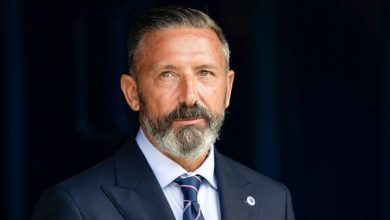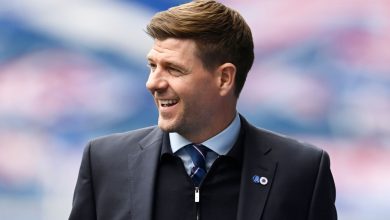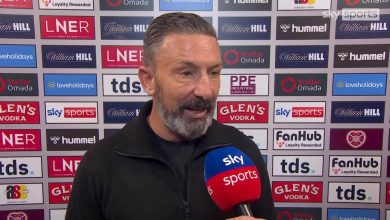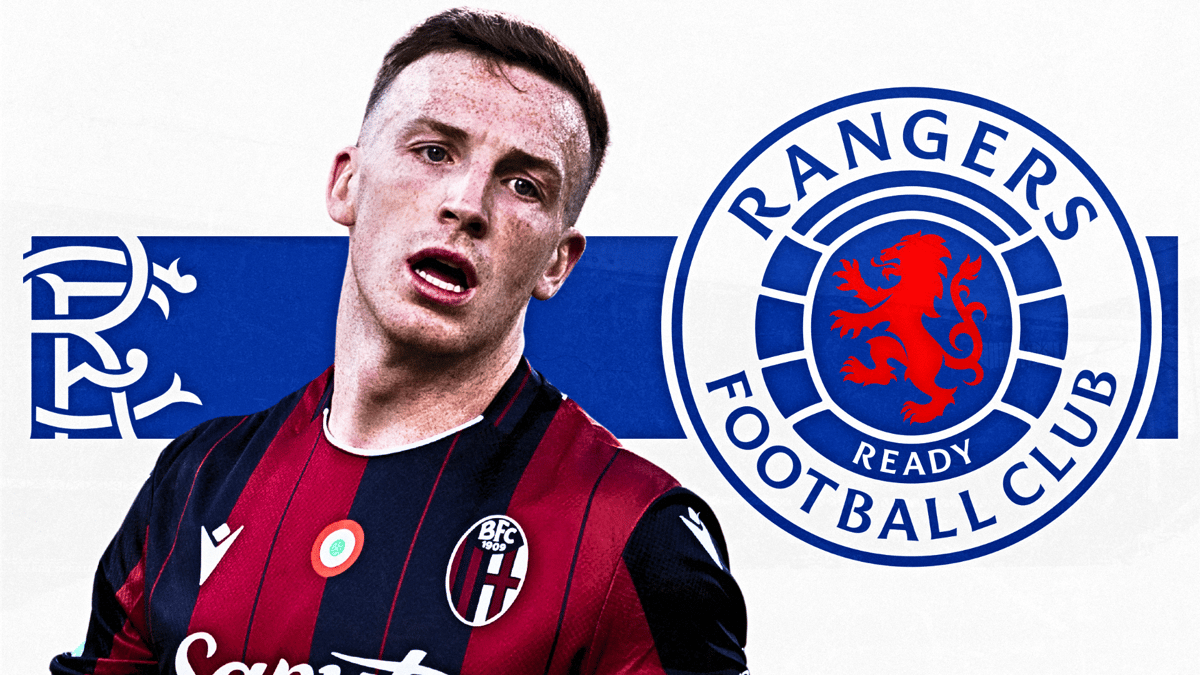
Derek Ferguson has questioned the wisdom of Rangers’ pursuit of Bologna captain Lewis Ferguson this summer, suggesting the Ibrox club ought to have known the scale of investment required before ever entering into talks with the Italian side. His comments, delivered on the Open Goal podcast, have added a fresh layer of scrutiny to what has already been a closely watched and, in places, criticised transfer window for Derek McInnes and his recruitment team
The former Rangers midfielder confirmed that contact was indeed made with Bologna over a potential deal for his son during the transfer window, with McInnes understood to be keen on adding greater quality, composure and leadership to his midfield options. On the surface, the logic behind the move was sound. Lewis Ferguson has built a strong reputation in Italian football, captaining Bologna and playing extensively in Serie A, one of Europe’s most demanding leagues, while also becoming an established international with Scotland. Few names on the market this summer would tick as many boxes for a club looking to add both quality and leadership to its spine.
That fit wasn’t accidental context — it lines up almost precisely with the profile Rangers chairman Andrew Cavenagh outlined as a priority for the club’s recruitment going forward, a point that becomes clearer when placed alongside Cavenagh’s own comments from earlier in the year.
Whatever the merits of the profile match, the deal ultimately ran into a financial wall. Bologna are understood to value their captain somewhere in the region of €15 million to €20 million, with more specific reporting suggesting the Italian club’s current asking price sits closer to €17 million. For a player of Ferguson’s standing — a captain in a major European league, still inside what would typically be considered the prime years of his career — that kind of valuation isn’t unusual by modern transfer market standards. But it’s a very different proposition for Rangers to fund compared to, say, a domestic Scottish Premiership target or a lower-profile addition brought in to provide squad depth
It’s precisely that gap between ambition and financial reality that Derek Ferguson zeroed in on in his comments. His argument wasn’t that Rangers were wrong to admire the player, or wrong to want him — it was that entering formal discussions with Bologna, only to find themselves unable to bridge a gap that, in his view, should have been obvious from the outset, represented a poor use of time and resources. Speaking candidly on the podcast, he asked directly whether the whole exercise hadn’t simply been a waste of time, given that Rangers must surely have been aware the valuation sat somewhere between €15 million and €20 million before they ever picked up the phone to Bologna. His conclusion was blunt: Rangers, in his assessment, simply aren’t currently in a position to complete a deal of that financial magnitude for a single player, which raises the obvious question of why the pursuit was launched in the first place.
What makes Ferguson’s intervention notable isn’t just the specific critique of the Bologna approach, but the fact that it taps into a broader current of frustration that has been building around Rangers’ recruitment more generally this summer. It would be easy to dismiss his comments as an isolated grievance about one failed pursuit, but Ferguson went considerably further, offering a wider assessment of how the current Rangers squad compares to what he expected when McInnes was first appointed.
According to Ferguson, the team currently on the pitch doesn’t yet resemble the kind of side he anticipated under McInnes’ management. His expectation, based on the manager’s track record and reputation, wasn’t necessarily for a team built on flair or eye-catching football — he was clear that he didn’t expect Rangers to suddenly become the most aesthetically pleasing side in the league. Instead, he expected organisation, physical presence, relentless work-rate, and a fundamental identity built around winning games through discipline and structure — hallmarks that have typically defined McInnes-managed teams throughout his career. The suggestion embedded in his comments is that the current squad doesn’t yet reflect that identity as clearly as it should, raising a question about why that gap exists.
That question led Ferguson to a more pointed diagnosis: is the issue with the players McInnes has identified as targets, or is it with Rangers’ ability, as a club, to actually convert those targets into completed transfers? His own reading leaned firmly toward the latter explanation. In his assessment, McInnes has been reasonably clear about which players he wants brought into the club, but the process of actually getting those deals over the line has, in his view, been too slow — creating a gap between managerial ambition and squad reality, and generating what he described as a degree of visible frustration as a result.
That assessment takes on added significance when placed against the backdrop of just how much squad turnover Rangers have already undergone this summer. The club has been active in the market across multiple positions, bringing in a wide range of new faces as it looks to reshape the squad under its new manager. Yet, according to Ferguson’s reading of the situation, sheer volume of activity hasn’t necessarily translated into landing the specific, higher-profile targets that might have given the squad the leadership and composure McInnes has reportedly been chasing.
That’s an important distinction. A club can be extremely busy in a transfer window — completing plenty of incoming deals — while still falling short of its most important targets, particularly when those targets come with price tags in the range Bologna were said to be holding out for over Ferguson. If Ferguson’s assessment is accurate, Rangers may find themselves with a numerically well-stocked squad that nonetheless lacks some of the specific attributes — leadership, big-game experience, footballing IQ — that the club’s recruitment strategy was ostensibly designed to prioritise
To understand why the pursuit of Lewis Ferguson attracted so much attention in the first place, it’s worth revisiting exactly what Rangers chairman Andrew Cavenagh said about the club’s recruitment priorities toward the end of last season. Cavenagh was explicit that the club’s approach going forward would place less emphasis on raw, unproven talent, and considerably more emphasis on characteristics like squad chemistry, leadership, resilience — described as “steel” — and footballing intelligence.
Viewed through that lens, Lewis Ferguson is close to an ideal fit. He isn’t an unproven prospect being taken on faith; he’s a captain with a substantial body of senior football behind him, operating at a high level in one of Europe’s most tactically demanding leagues, and with the additional credibility of full international honours for Scotland. Few available midfielders this summer would have matched that profile as closely, which goes some way to explaining why Rangers were willing to make an approach at all, even with the financial risk that came with it
Beyond the pure football logic, there’s also a distinctly personal thread running through this story that adds extra weight to the speculation. Ferguson isn’t simply a talented midfielder Rangers identified through data and scouting reports — he has genuine, formative roots at the club. He came through the Rangers academy as a young player before being released, a decision that forced him to rebuild his career away from Ibrox, first with Hamilton and later with Aberdeen, before eventually establishing himself on the continent with Bologna.
That early rejection clearly left a lasting impression. His agent, Bill McMurdo, has previously spoken about how much the decision affected Ferguson at the time, recalling that the club’s assessment — that he was too heavy and unlikely to make the grade as a professional — stung considerably, particularly given how his career has subsequently unfolded far from Ibrox. It’s the kind of story that resonates deeply within football, where players released young by boyhood or academy clubs often carry that experience with them, whether as motivation or as a lingering point of disappointment.
Despite that history, McMurdo has been unambiguous in stating that a return to Rangers remains something his client genuinely wants before his career draws to a close. He’s expressed total confidence that Ferguson will, at some stage, play for Rangers, describing it as something close to an inevitability rather than merely a possibility worth speculating about. That level of certainty from a player’s representative doesn’t guarantee anything in transfer terms, but it does suggest the ambition runs in both directions — this isn’t solely a case of Rangers admiring a player from a distance, but potentially a genuine mutual interest that simply hasn’t yet found a financial framework that works for both parties.
As things stand, Rangers have been unable to close the gap between their own valuation of what they’re prepared to spend and Bologna’s asking price of around €17 million. Derek Ferguson’s comments make clear that, in his view, the approach itself was questionable from the outset if the club already understood the scale of investment that would be required to get a deal done. Whether that criticism is entirely fair — clubs frequently test the water on ambitious targets without necessarily expecting to complete every deal they explore — is something reasonable observers might disagree on. Testing interest, gauging a club’s genuine willingness to sell, and establishing a relationship for potential future negotiations are all things clubs do routinely, even when a fee looks prohibitive at first glance.
Even so, the broader point Ferguson raises — about the pace of Rangers’ recruitment and the gap between McInnes’ apparent targets and what’s actually been delivered — is one that will likely continue to be scrutinised as the transfer window moves toward its conclusion. The door on a Lewis Ferguson move may not be permanently closed; his personal connection to the club, his agent’s stated confidence in an eventual return, and Rangers’ clear interest in his profile all suggest this story could resurface in a future window if circumstances change. For now, though, Rangers face a decision about whether Ferguson represents the kind of premium addition worth restructuring their summer budget to pursue further, or whether the financial gap with Bologna proves too significant to bridge before the current window closes.