MAN CITY BOSS BLAMES WINGER FOR EPL TITLE COLLAPSE AS ETIHAD TENSIONS ERUPT Enzo Maresca has reportedly launched a stunning attack on Jérémy Doku, claiming the winger was a key factor in Manchester City’s failure to retain the Premier League

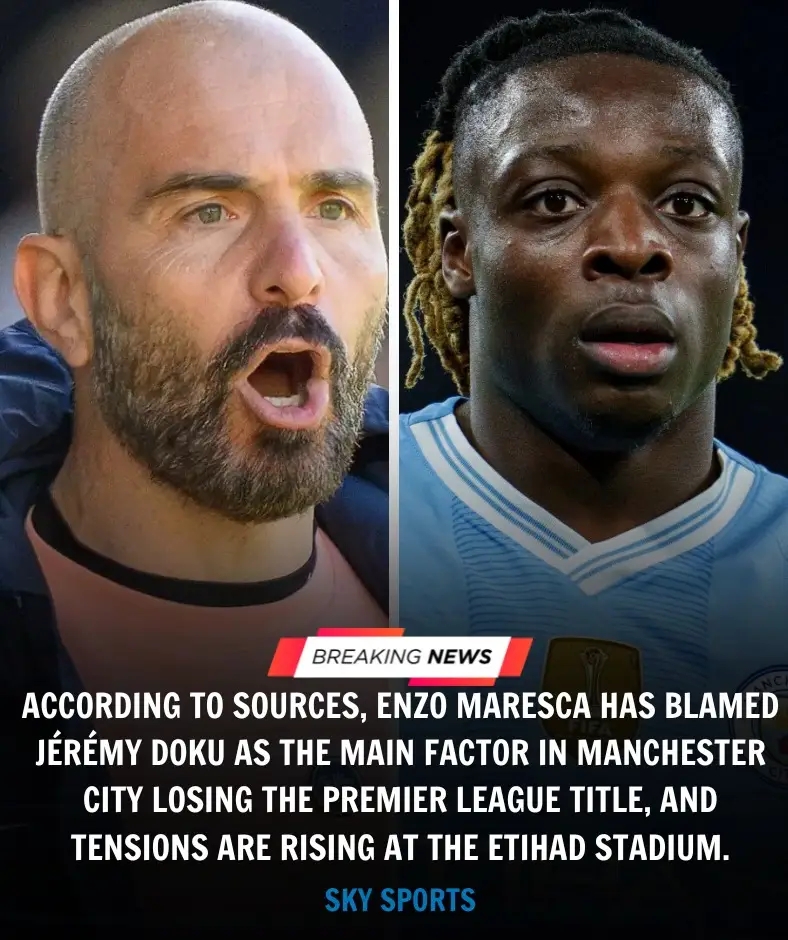
🚨 A storm has reportedly erupted at the heart of Manchester City, with shocking claims emerging that assistant manager Enzo Maresca has launched a furious internal criticism of winger Jérémy Doku following what is being described as the club’s failure to secure the Premier League title this season.
The situation, if accurate, paints a dramatic picture of tension, frustration, and blame inside one of the most dominant football machines in world football. Manchester City, a club built on control, structure, and consistency, are now being linked with rare signs of internal division, with reports suggesting that emotions behind the scenes have boiled over after a disappointing end to their title challenge.
According to the claims circulating in media reports, Maresca is believed to have pointed the finger at Doku as a major factor in City’s inability to maintain their title-winning form throughout the season. The accusation is said to have stunned members of the dressing room and coaching staff, especially given the club’s usual culture of collective responsibility rather than individual blame.
The report has quickly spread across football circles, creating debate among fans, analysts, and former players about whether such criticism is justified or whether it reflects deeper tactical frustrations within the squad structure.
For a club like Manchester City, where standards are extremely high and every season is measured by trophies, even small dips in performance can lead to intense scrutiny. The Premier League title race is often decided by the smallest margins, and any perceived inconsistency can become a focal point for criticism.
Doku, who arrived with high expectations due to his explosive pace, dribbling ability, and direct attacking style, has been both praised and criticised during his time in England. His ability to change games in moments is widely recognised, but questions have occasionally been raised about his consistency, decision-making in final-third situations, and tactical discipline in structured systems.
It is within this context that the reported comments from Maresca have emerged, suggesting that internal frustration may have been building over time. However, it is important to note that these claims remain unverified publicly by the club, and no official statement has been released from Manchester City regarding any internal disagreement.
Still, the idea that a senior coaching figure would directly blame a single player for a title collapse has added fuel to an already intense conversation surrounding City’s season.
The Premier League campaign itself was highly competitive, with multiple teams pushing for the title deep into the final stages. Manchester City, who have dominated English football in recent years, were once again expected to be the benchmark. However, inconsistent results in key fixtures reportedly cost them crucial points, allowing rivals to gain momentum at decisive moments.
In such a high-pressure environment, tactical decisions, squad rotation, injuries, and individual performances all come under microscopic analysis. Wingers like Doku are often judged not just on flair and creativity, but also on end product, defensive contribution, and decision-making under pressure.
Reports suggest that Maresca’s frustration may stem from specific matches where attacking transitions broke down or final decisions in key moments failed to deliver expected outcomes. In modern football systems, especially under managers influenced by positional play, wide forwards are expected to maintain structure while also providing consistent attacking threat.
Doku’s natural style, which relies heavily on direct dribbling and individual creativity, can sometimes contrast with structured tactical demands. This tension between freedom and system is often where disagreements in football philosophy emerge.
Inside Manchester City’s setup, harmony has long been one of the club’s biggest strengths. Under the leadership structure built around senior coaching and tactical consistency, players are usually protected from public criticism. That is why these reported comments, if accurate, stand out as unusual and potentially significant.
Even within highly competitive squads, internal disagreements are not uncommon, but they are usually managed behind closed doors. The idea that such criticism may have become public suggests either a breakdown in communication or an intentional attempt to send a message following a disappointing campaign.
Some analysts believe that if Maresca did express frustration, it may have been part of a broader tactical review rather than a personal attack. Coaches often highlight areas for improvement, and wide players are frequently central to discussions about chance creation, defensive tracking, and attacking efficiency.
However, the framing of the reports has led to a more dramatic interpretation, suggesting that Doku has been singled out as a “main reason” for the title loss. This level of individual blame is rare at elite clubs, especially those operating at Manchester City’s level, where success and failure are usually attributed to collective performance.
The reaction among supporters has been mixed. Some fans argue that Doku’s inconsistency in certain matches may have contributed to dropped points, while others strongly defend the winger, pointing out that adaptation to Premier League intensity takes time and that attacking players should not be scapegoated for broader team issues.
There is also recognition that Manchester City’s system relies heavily on balance across all positions. Midfield control, defensive stability, and finishing efficiency all play a role in determining results over a long season. Isolating one player as the decisive factor in a title race is therefore seen by many as overly simplistic.
Within the dressing room, such reports can also have psychological effects. Players are highly sensitive to narratives about responsibility and blame, and any suggestion of internal division can influence morale, even if the claims are not fully accurate.
Doku himself has not responded publicly to the situation, and there is no indication that the club intends to escalate the matter. Manchester City’s internal structure is typically designed to prevent media narratives from disrupting focus, especially during off-season transitions or major tournaments.
Nevertheless, the timing of these reports is significant. With the season concluded and attention turning to squad planning, transfer decisions, and tactical evaluation, any hint of dissatisfaction could influence future decisions about player roles and squad structure.
Maresca, who has built a reputation as a tactically detailed coach, is known for his emphasis on positional discipline, structured attacking patterns, and controlled build-up play. His coaching philosophy prioritises precision and consistency, especially in wide attacking roles where decision-making is critical.
Doku, on the other hand, represents a more instinctive attacking profile. His game is built on acceleration, one-on-one ability, and unpredictable movement. While this makes him a dangerous attacking weapon, it can also create tactical imbalance if not fully integrated into a structured system.
This contrast in footballing philosophy may be at the core of the reported tension, rather than any personal conflict.
Historically, elite clubs often experience similar debates when integrating highly creative wingers into rigid tactical frameworks. The challenge is always finding the balance between freedom and structure, individuality and discipline, flair and control.
Manchester City have generally managed this balance better than most teams in world football, which is why they have dominated English football for much of the past decade. However, even dominant teams face internal pressure when results fall short of expectations.
As the situation develops, attention will likely shift to whether any official clarification is provided by the club or coaching staff. Until then, the reports remain part of the wider transfer and analysis narrative surrounding Manchester City’s season.
What is clear is that the club will enter the next campaign with renewed focus on addressing weaknesses and restoring their dominance. Whether that involves tactical adjustments, squad changes, or renewed roles for certain players remains to be seen.
For Doku, the coming period may be crucial in defining his long-term role at the club. Young attacking players often face periods of adaptation in elite systems, and how he responds to criticism—whether internal or external—could shape his future trajectory.
For Maresca, the reported comments, if accurate, highlight the intense scrutiny that comes with operating inside a high-performance environment where expectations are always set at the highest level.
And for Manchester City as a whole, the story reflects a simple truth of elite football: even the most successful teams in the world are not immune to tension when trophies are not delivered.
As fans continue to debate the situation, one thing remains certain—every detail inside the Etihad will now be analysed more closely than ever, especially as the club prepares for another demanding season where margins will again be razor thin.
For more on the original report, see: [Original report on Maresca and Doku controversy](https://medianews48.com/enzo-maresca-blasts-jeremy-doku-he-is-the-main-reason-man-city-lost-the-epl-title-as-internal-tensions-emerge-at-the-etihad-113-minhthu/?utm_source=chatgpt.com)