Manchester City owner have successfully ask pep to leave hos club following the signing of his replacement

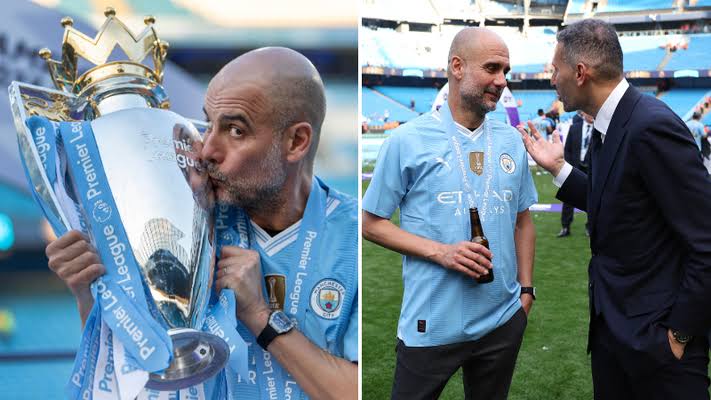
The night at Wembley did not just end with Manchester City lifting another trophy, it also left behind a deep tactical conversation that many fans are still trying to understand. What really happened on that pitch was more than just a win. It was a chess match, one where Pep Guardiola once again showed why he is considered one of the most intelligent minds in football history, and why Mikel Arteta, despite his growth, still has lessons to learn at the highest level.
For years, Guardiola has built his identity around aggressive pressing. His teams are known for suffocating opponents, winning the ball high up the pitch, and turning defense into attack within seconds. It is a system that has brought him success across different leagues and teams. From Barcelona to Bayern Munich and now Manchester City, the philosophy has remained consistent. Press high, control possession, dominate space, and punish mistakes quickly.
So when Manchester City walked onto the pitch against Arsenal in the Carabao Cup final and did something completely different, it caught everyone by surprise. Fans, analysts, and even Arsenal players themselves struggled to understand what they were seeing in real time.
Instead of pressing aggressively from the front, City dropped deeper. They allowed Arsenal to have the ball in areas where Guardiola’s teams would normally hunt aggressively. It looked strange at first. It even looked risky. But as the game progressed, it became clear that this was not a mistake. It was a carefully planned trap.
Arsenal, under Arteta, are a team that thrives on structure and rhythm. They like to build from the back, move the ball through midfield, and create overloads in wide areas. Their system depends on control, patience, and precise positioning. But what happens when the opponent refuses to press? What happens when the usual triggers are not there?
That is exactly the problem Arsenal faced.
Without the expected pressure, Arsenal’s players hesitated. They had time on the ball, but they did not have clarity. Passing lanes that usually open under pressure remained closed. Movement became slower. Decision-making became uncertain. Instead of speeding up their game, the extra space actually slowed them down.
This is where Guardiola’s genius came into play. By stepping back, City invited Arsenal forward, but only into specific areas. These were not dangerous areas for City. Instead, they were zones where Arsenal could be isolated, where mistakes could be forced, and where City could regain control at the perfect moment.
One of the key figures in this tactical battle was Martin Zubimendi. The midfielder, known for his intelligence and calmness on the ball, found himself under unexpected pressure—not from aggressive pressing, but from positional traps. He was often left with the ball, but with limited options ahead of him.
City’s players blocked passing lanes rather than chasing the ball. They positioned themselves in a way that forced Arsenal into predictable patterns. And once Arsenal committed to those patterns, City would strike.
Zubimendi, in particular, struggled to adapt. He was caught between trying to progress the ball and avoiding mistakes. At times, he held onto possession too long. At other times, he rushed his decisions. It was a difficult situation, and one that highlighted how even the most composed players can be unsettled by a clever tactical approach.
But it would be unfair to place all the blame on one player. This was a team-wide issue. Arsenal as a whole failed to adjust quickly enough. They continued to play as if City would eventually return to their usual pressing style. They waited for a pattern that never came.
Meanwhile, City grew in confidence.
Players like Jeremy Doku and Rayan Cherki became key outlets in transition. With Arsenal pushing forward, spaces began to open on the wings. And when City won the ball, they attacked those spaces with speed and precision.
Doku’s directness caused constant problems on one side, while Cherki’s creativity and unpredictability added another layer of danger. Arsenal’s defense, which is usually well-organized, found itself stretched and exposed.
Every time Arsenal lost the ball, City looked dangerous. It was not about controlling possession anymore. It was about controlling moments.
This is what made Guardiola’s approach so effective. He did not try to dominate the game in the traditional sense. Instead, he chose when to dominate. He picked his moments carefully, and when those moments came, his team executed perfectly.
Arteta, on the other hand, found himself in a difficult position. As a former assistant to Guardiola, he knows exactly how City operate. But this time, Guardiola changed the script.
The question then becomes: should Arsenal have done better?
The answer is yes.
At this level, teams must be able to adapt. Football is not just about executing a plan. It is about reacting to the opponent’s plan as well. Arsenal had the quality to adjust, but they lacked the flexibility in that moment.
One possible solution could have been quicker ball movement. Instead of holding onto possession and trying to find perfect openings, Arsenal could have increased the tempo. Faster passing might have disrupted City’s shape and created more space.
Another option could have been more direct play. With City sitting deeper, there was space behind their midfield. Arsenal could have taken advantage of this by making more runs in behind and playing longer passes.
But these adjustments did not come soon enough.
As the game progressed, frustration began to grow among Arsenal players. Passes became less accurate. Movements became less coordinated. And City continued to take advantage.
By the time the final whistle blew, the result felt almost inevitable.
For City fans, it was a moment of celebration. Another trophy, another demonstration of Guardiola’s brilliance. The Etihad faithful could take pride not just in the victory, but in the way it was achieved.
For Arsenal, it was a lesson.
A painful one, but an important one.
Arteta has done an incredible job in transforming Arsenal into a competitive team. They are organized, disciplined, and capable of playing beautiful football. But games like this show that there is still a gap between them and the very best.
That gap is not just about quality. It is about experience, adaptability, and tactical awareness.
Guardiola has spent years at the top, constantly evolving his ideas. He understands that football is always changing, and that staying ahead requires innovation. This willingness to adapt is what makes him so dangerous.
And this is what Arteta must learn.
The good news for Arsenal is that they have the foundation to improve. They have talented players, a clear philosophy, and a manager who is eager to learn. Matches like this, while disappointing, can serve as valuable experiences.
They highlight weaknesses, expose limitations, and provide opportunities for growth.
For Zubimendi, it is a chance to reflect and improve. For the team, it is a reminder that control does not always mean dominance. And for Arteta, it is another step in his journey as a manager.
As for Manchester City, this victory reinforces their status as one of the best teams in the world.
They are not just a team with great players. They are a team with a great mind behind them.
Guardiola’s ability to surprise opponents, to change tactics when needed, and to execute those tactics perfectly is what sets them apart.
And on that night at Wembley, it was enough to outsmart Arsenal and secure another piece of silverware.
In the end, football is a game of details.
Small decisions, small movements, small adjustments.
And in this game, those details made all the difference.
City got them right.
Arsenal did not.
But the story does not end here.
There will be more battles between these two teams. More opportunities for Arteta to test himself against his former mentor. More chances for Arsenal to prove that they have learned from this experience.
And when that moment comes, it will be fascinating to see how they respond.
Because in football, as in life, it is not just about how you win.
It is also about how you learn when you lose.