English club, including severe penalties that directly affect the titles they won in the past. Immediately afterwards, Manchester City chairman Sheikh Mansour strongly appealed to FIFA — but received only a cold and firm rejection.

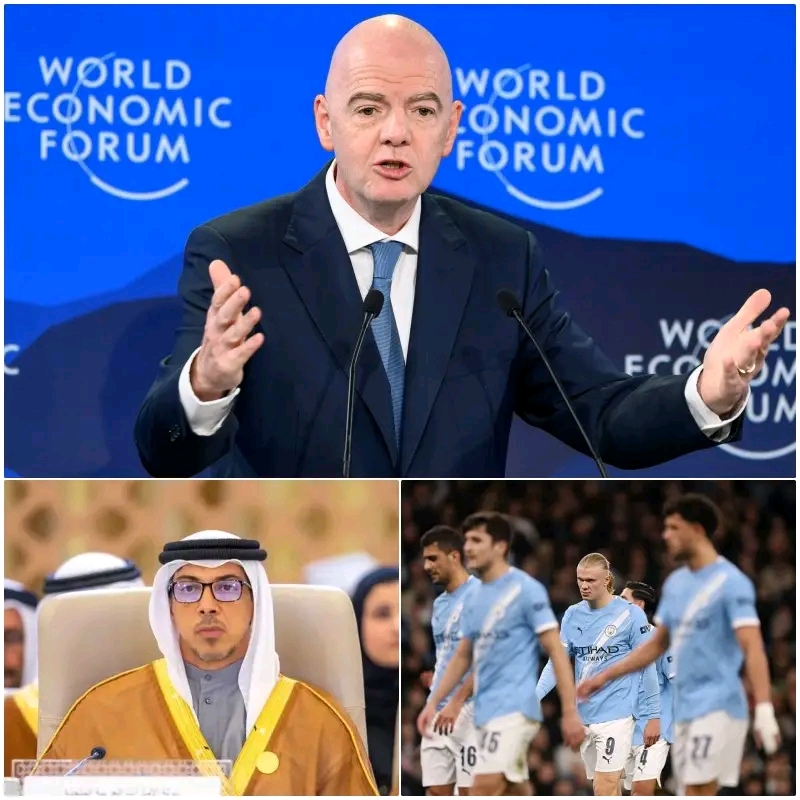
The football world stood still the moment the announcement came out. It was the kind of news that does not come often, the kind that shakes not just one club, but the entire sport. Fans, pundits, players, and even rival clubs all turned their attention to one place as Gianni Infantino finally delivered what many were calling the most anticipated decision in modern football history. After months, even years, of tension, speculation, and fierce debate, the verdict on Manchester City’s 115 financial charges was no longer a mystery. It was final.
And it was brutal.
For a long time, Manchester City had stood as a symbol of dominance in English football. Their rise under immense financial backing had turned them into a powerhouse, winning trophies, breaking records, and redefining what success looked like in the modern era. But behind all the glory, there had always been whispers. Questions about finances. Allegations of rule-breaking. Doubts that refused to disappear no matter how many trophies were lifted.
Now, those whispers had turned into a storm.
When Gianni Infantino stepped forward to speak, the atmosphere was heavy. This was not just another press conference. This was a moment that could change history. The world listened as he confirmed that after a thorough investigation, FIFA had reached a final decision. There would be no more delays, no more speculation, no more waiting. The verdict was here.
And it was described as “historic” and “unprecedented.”
The punishment handed down to Manchester City was unlike anything seen before. It was not just a fine. It was not just a points deduction. It was something much deeper, something that struck at the heart of everything the club had built over the years. The penalties directly affected titles they had already won, casting a shadow over their achievements and raising serious questions about their legacy.
For fans, it felt like the ground had suddenly disappeared beneath their feet.
The idea that past titles could be affected was something many had feared but hoped would never happen. Football history is built on moments, memories, and victories. To see those victories now under threat was something almost impossible to accept. Yet, this was exactly what the ruling suggested. The success that Manchester City had celebrated for years was now being re-examined under a harsh and unforgiving light.
As the news spread, reactions came from everywhere. Some fans were in shock. Others were angry. Rival supporters, on the other hand, saw it as justice finally being served. Social media exploded with opinions, debates, and emotional responses. This was not just about one club anymore. This was about fairness, integrity, and the future of football itself.
But while the world reacted, inside Manchester City, the situation was even more intense.
At the center of it all was Sheikh Mansour, the man who had transformed the club from a struggling side into one of the most powerful teams in the world. For him, this decision was not just a sporting issue. It was personal. It was about reputation, about legacy, and about everything he had invested into the club over the years.
And he did not accept it quietly.
Almost immediately after the verdict was announced, Sheikh Mansour launched a strong appeal. It was a desperate attempt to challenge the ruling, to fight back against what he and the club believed was an unfair and excessive punishment. The appeal was urgent, passionate, and determined. It showed that Manchester City were not ready to accept defeat, not on the pitch and certainly not off it.
But the response they received was cold.
FIFA did not hesitate. The answer was firm, clear, and unchanging. The appeal was rejected. There would be no reconsideration, no softening of the decision, no second chances. The verdict would stand.
That moment hit Manchester City like a second blow.
For a club used to controlling games, dominating opponents, and dictating outcomes, this was something completely different. This was a situation where they had no control. The decision had been made, and it was final. The power that had once seemed unstoppable now felt limited, challenged, and under pressure.
Inside the club, questions began to rise. What would this mean for the players? For the manager? For the future of the team? The uncertainty was everywhere. Players who had once been part of title-winning squads now found themselves wondering how those titles would be remembered. Would they still count? Would they be taken away? Would their achievements be questioned forever?
It was a situation no player ever wants to face.
For the fans, the emotional impact was even deeper. Supporting a football club is about pride, about identity, about belonging. To see that identity suddenly challenged was painful. Some fans stood by the club, defending it, believing in its innocence. Others felt confused, unsure of what to believe anymore. The connection between the club and its supporters was being tested in a way it never had been before.
Meanwhile, the wider football community watched closely.
This decision was not just about Manchester City. It was a message to every club, every owner, and every league. It showed that financial rules were not just guidelines. They were serious, and breaking them could lead to serious consequences. The era of ignoring financial regulations, if it ever truly existed, was now clearly over.
For some, this was a necessary step. They argued that football needed fairness, that no club should gain an unfair advantage through financial manipulation. For others, it raised concerns about consistency, about whether all clubs would be treated the same way in similar situations.
The debate was endless.
Back at Manchester City, the focus slowly began to shift from reaction to response. The club knew they could not change the verdict, but they still had decisions to make. How would they move forward? How would they rebuild trust? How would they protect their future in the face of such a massive setback?
These were not easy questions.
The management team, the coaching staff, and the players all faced a new reality. The focus could no longer be only on winning matches and lifting trophies. It also had to be on rebuilding credibility, on showing that the club could operate within the rules and still succeed.
It was a challenge that would define the next chapter of Manchester City’s story.
At the same time, the role of Gianni Infantino came under intense scrutiny. Some praised his leadership, saying he had taken a strong stand to protect the integrity of the sport. Others criticized the decision, questioning whether it was too harsh or too targeted. In football, every decision creates winners and losers, and this one was no different.
But one thing was clear. This was a turning point.
Football had entered a new phase, one where financial accountability would be taken more seriously than ever before. Clubs around the world began to look at their own situations, their own practices, and their own compliance with regulations. The ripple effect of this decision was immediate and widespread.
For Manchester City, however, the focus remained on survival and recovery.
The club had built something special over the years. A winning culture, a strong squad, and a global fanbase. But now, all of that was under pressure. The challenge was not just to continue competing, but to do so under a cloud of controversy and doubt.
The road ahead would not be easy.
Every match, every victory, every defeat would now be viewed through a different lens. Critics would question, rivals would mock, and the media would analyze every detail. The pressure would be constant, relentless, and unforgiving.
Yet, if there is one thing football has shown time and time again, it is that clubs can rise even after the darkest moments.
Manchester City now stood at a crossroads. One path led to decline, to being remembered for controversy rather than success. The other path led to redemption, to proving that they could overcome adversity and rebuild their reputation.
Which path they would take remained to be seen.
But one thing was certain. The decision delivered by Gianni Infantino had changed everything. The appeal from Sheikh Mansour had failed. The punishment was set. And the world of football would never look at Manchester City the same way again.
This was not just a verdict. It was the beginning of a new era.