Mohamed Salah wish granted after FSG Liverpool U-turn that surprised football world

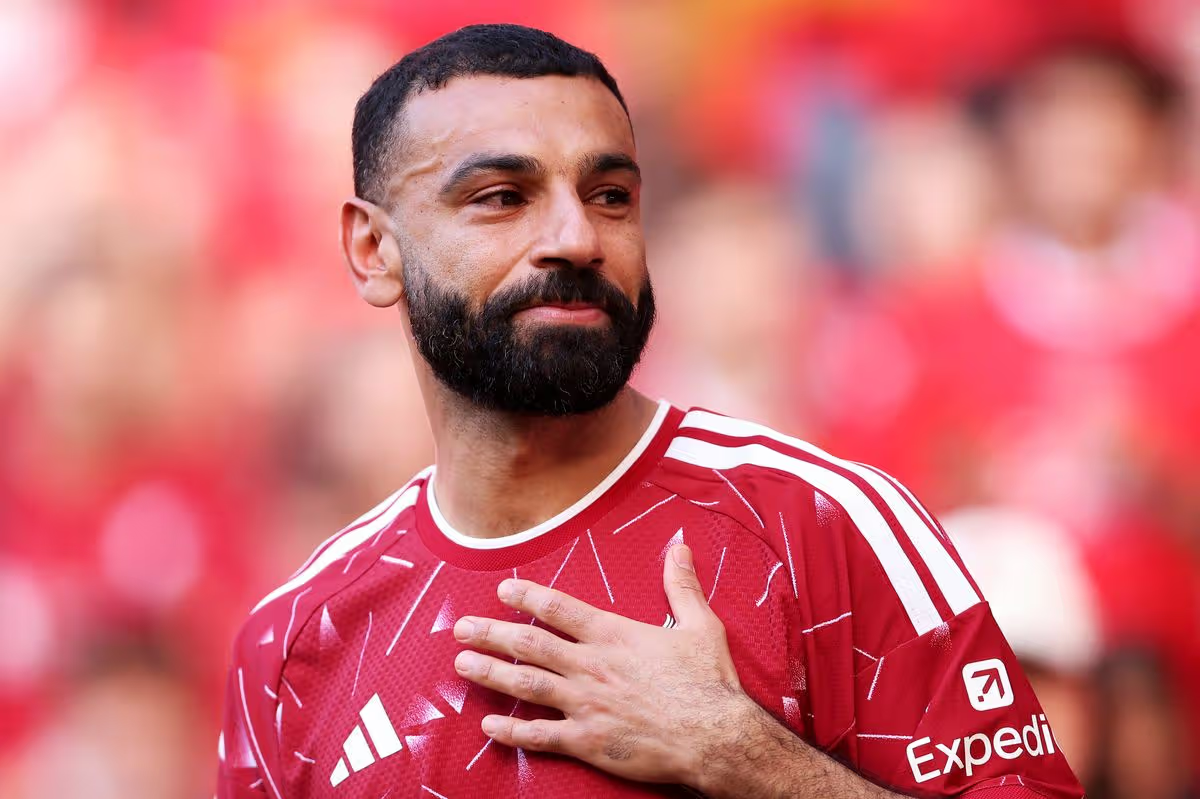
Mohamed Salah’s final chapter at Liverpool has taken a dramatic and emotional turn, and the football world is still trying to process everything that has unfolded around Anfield in recent months. What was expected to be a quiet ending to one of the greatest Premier League careers has instead turned into a story filled with tension, opinion, conflict, and finally, what many are calling a “wish granted” moment for the Egyptian superstar.
Salah, who played his last match for Liverpool last month, left the club as one of its greatest ever players. His goals, consistency, and influence over nearly a decade transformed Liverpool into a dominant force in English and European football. But as his time at Anfield came to an end, it was not just memories and trophies that defined his exit. It was also his voice, which became louder and more direct than ever before.
During his final season, Salah was not afraid to speak openly about what he believed was happening inside the club. After a frustrating draw against Leeds United earlier in the season, he publicly claimed that he was being used as a scapegoat for Liverpool’s inconsistent performances. He felt that criticism was being unfairly directed at him, while deeper issues within the team were being ignored.
His comments shocked many fans at the time.
Salah had always been seen as a professional, focused on scoring goals and avoiding controversy. But this time, he stepped into a different role. He was no longer just a player performing on the pitch. He was now a senior voice questioning the direction of the club.
As the season went on, those concerns did not disappear. In fact, they grew stronger. Reports suggested that Salah had privately warned Liverpool’s hierarchy that standards inside the club were slipping. He believed that the identity that once made Liverpool feared across Europe was slowly fading.
For many supporters, those words were difficult to hear.
Liverpool fans had grown used to success under Jürgen Klopp, a period defined by intensity, pressing, and fearless attacking football. The phrase “heavy metal football” became symbolic of that era. It represented chaos for opponents, energy for fans, and dominance for Liverpool.
But in Salah’s view, something had changed.
The situation reached a breaking point after Liverpool’s 4-2 defeat to Aston Villa in May. What followed that match would become one of the most talked-about moments of the entire season. While the club was still analyzing the loss internally, Salah took to social media with a statement that immediately spread across the football world.
It was not a short comment.
It was not a casual observation.
It was a strong, emotional, and direct message about what he believed Liverpool had lost.
In his post, Salah called for Liverpool to return to the attacking identity that once terrified opponents. He described it as “heavy metal football,” a style that defined their most successful years. He made it clear that, in his view, this identity should never be negotiable.
He wrote that Liverpool should not settle for occasional wins or inconsistent performances. Instead, he insisted that the club should always aim to dominate matches, control intensity, and play with the aggression that once made them champions.
The message was powerful, and it quickly spread beyond Liverpool supporters.
Football fans across England and Europe began discussing it. Pundits debated whether Salah was right to speak out publicly. Some praised his honesty, saying he was defending the club’s identity. Others felt it was inappropriate for a player to openly criticize tactical direction while still part of the squad.
But what made the situation even more intense was the reaction inside the dressing room.
Reports suggested that several Liverpool players liked or reacted to Salah’s post on social media. Names linked to the reaction included key figures from the squad, players both experienced and young, who appeared to agree with the sentiment that Liverpool’s identity needed to be restored.
Whether this was a silent protest or simply support for a club legend’s opinion, it added another layer of drama to an already sensitive situation.
Behind the scenes, Liverpool’s hierarchy were reportedly aware of the growing tension. The club was entering a transitional phase, and questions were being asked about direction, philosophy, and long-term planning. Salah’s comments only intensified those discussions.
For a player of his status to publicly challenge the club’s style of play was not something that could be ignored.
As the season came to an end, Salah played his final match at Anfield against Brentford. The atmosphere was emotional, as fans knew they were witnessing the end of an era. Salah waved goodbye to supporters who had watched him score hundreds of goals and deliver unforgettable moments.
But even in that emotional farewell, the questions about Liverpool’s future remained.
What kind of team would they become without him?
Would they continue in the same direction or change course entirely?
At that time, Liverpool’s manager Arne Slot still had the backing of Fenway Sports Group. The Dutch coach had brought a more structured and controlled style of play compared to the high-intensity approach of previous years. While some appreciated his tactical discipline, others felt it lacked the excitement and aggression that defined Liverpool’s golden period.
Salah’s comments, however, appeared to reflect a wider feeling among certain sections of fans and possibly players: a desire to return to a more direct, high-energy style of football.
Then came the twist that nobody fully expected.
In early June, news broke that Arne Slot had been dismissed following an end-of-season review. The decision shocked much of the football world. While there had been pressure and debate around Liverpool’s performances, few predicted such a dramatic managerial change.
The club released a statement explaining that the decision was not a reflection of Slot’s talent or effort, but rather a belief that the team needed a different direction. The wording suggested a philosophical shift rather than a simple reaction to results.
For many observers, the timing of the decision raised questions.
Was this already planned?
Was it influenced by internal feedback?
Was it connected to the growing debate about Liverpool’s playing style?
While the club did not directly link Salah’s comments to the managerial change, the timing naturally led to speculation.
Supporters began to wonder whether Liverpool were preparing for a return to the “heavy metal” identity that Salah had called for.
Shortly after Slot’s departure, Liverpool appointed Andoni Iraola as their new head coach. Iraola, known for his intense and aggressive style of football at Bournemouth, immediately signaled a more energetic approach. His teams were known for quick transitions, direct attacking play, and high pressing — elements that closely resembled the style Liverpool fans had once adored.
In his first public comments, Iraola spoke about maintaining identity, intensity, and aggression, while also adapting to the players available. He acknowledged that Liverpool had a strong footballing tradition and suggested that certain fundamentals would remain unchanged.
For many fans, this was exactly what they wanted to hear.
The reaction from supporters was immediate. Social media was filled with optimism, with many suggesting that Salah’s “wish” for Liverpool to return to a more aggressive style of football had been granted.
Whether that was truly the case or simply narrative-driven interpretation, the connection between Salah’s comments and Liverpool’s new direction became one of the biggest talking points in football.
From a broader perspective, the situation highlighted how modern football is influenced by more than just results on the pitch. Player voices, social media reactions, tactical identity, and club philosophy now all play a role in shaping decisions at the highest level.
Salah’s influence at Liverpool had always been enormous, but this final chapter added a new dimension to his legacy. He was no longer just a goalscorer or match-winner. He had become a voice that reflected the emotions of a section of the club’s identity.
Some fans agreed with him completely. They felt Liverpool had lost some of the energy and fear factor that once made them unstoppable. Others believed evolution was necessary and that football had moved on from the heavy metal style.
Both sides had valid arguments.
But what could not be denied was the impact of the discussion.
It influenced debates.
It shaped narratives.
It may even have contributed, directly or indirectly, to major changes at the club.
As Salah moves on to the next stage of his career, his final moments at Liverpool will not just be remembered for goals and trophies. They will also be remembered for his outspoken final message about what Liverpool should represent.
A message about identity.
A message about intensity.
A message about returning to a style of football that once made Anfield one of the most feared stadiums in the world.
And now, with a new manager in place and a new direction being shaped, Liverpool fans are left to wonder whether this new era will truly reflect that vision.
One thing is certain.
Mohamed Salah may have left Anfield, but his influence on the club’s final turning point will be debated for years to come.