Pep Guardiola: Honestly, I can’t understand that…” 😱 Both men signed for Man City in January, but thanks to a little-known rule, only one can feature at Wembley today

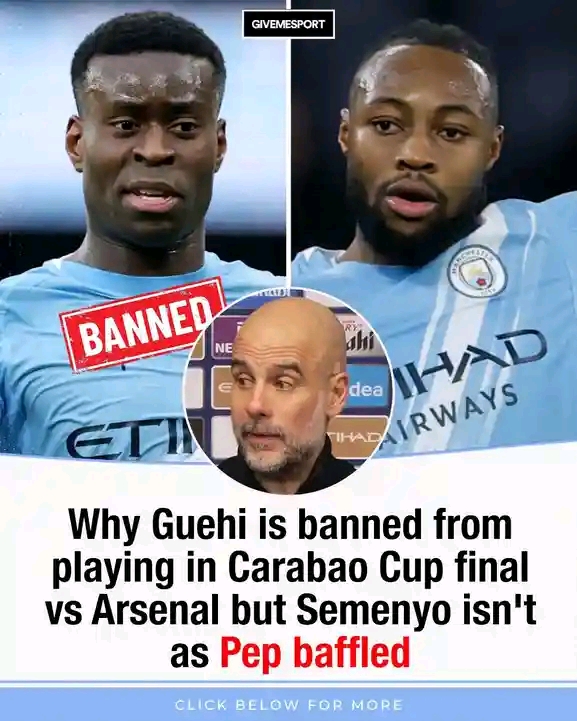
confusion, frustration, and drama have taken over Manchester City just hours before one of the biggest matches of their season, and it all centers around one painful question that fans cannot stop asking… why can Antoine Semenyo play in the Carabao Cup final, but Marc Guehi cannot?
This is not just a simple rule explanation. This is a story about timing, missed chances, big money decisions, and a manager who feels the system has worked against his team at the worst possible moment.
Manchester City came into the January transfer window with a clear plan. Pep Guardiola wanted to strengthen his squad, add experience, and make sure his team had enough depth to compete on all fronts. The Premier League title race was heating up, the Champions League was demanding full focus, and the Carabao Cup was suddenly within reach again. City needed reinforcements, and they moved quickly.
The first big move was Antoine Semenyo. The winger arrived from Bournemouth in a deal that shocked many fans because of the price tag and the timing. But Guardiola saw something special in him. He believed Semenyo could bring energy, pace, and direct attacking threat to a team that sometimes struggles to break down deep defenses.
Just days after signing, Semenyo was already thrown into action. And this is where everything started to change.
In the first leg of the Carabao Cup semi-final against Newcastle United, Semenyo started the match and delivered instantly. He scored, he impressed, and he showed exactly why City had spent so much money to bring him in. That night at St James’ Park, Manchester City took control of the tie and moved one step closer to Wembley.
That moment was not just important for the result. It was crucial for something much bigger… eligibility.
Because Semenyo played in that semi-final before a key deadline, he became officially registered to play in the competition for Manchester City. That one appearance changed everything for him.
Now let’s look at the other side of the story.
Marc Guehi was also a major target for Manchester City. The Crystal Palace captain had built a reputation as one of the most reliable defenders in the Premier League. Strong, calm, intelligent, and a leader at the back, he was exactly the kind of player Guardiola wanted to add to his defense.
But the deal took longer.
Negotiations dragged on. There were discussions about price, structure, and timing. While City were pushing to complete the signing, the calendar was moving forward, and the Carabao Cup semi-final first leg came and went.
By the time Guehi finally joined Manchester City, it was already too late.
And this is where the rule comes in.
The Carabao Cup has a strict regulation. A player can only represent a club in the competition if they are registered before a certain point. That point is either before the transfer window closes or before the first leg of the semi-final, whichever comes first.
Guehi missed that moment.
It was not about his quality. It was not about his form. It was not about fitness or tactics. It was simply about timing.
Because he joined after that first semi-final match, he became ineligible to play in the final. No exceptions. No flexibility. No second chances.
For Guardiola, this was hard to accept.
After the semi-final victory, the City manager spoke openly about the situation. He could not understand why a player who now belongs to the club, who trains with the team, who is part of the squad, cannot play in one of the most important matches of the season.
He questioned the rule. He challenged the logic behind it. And he made it clear that the club would try to change the situation.
Manchester City sent a request to the English Football League. They asked for special permission. They tried to argue that modern football has changed, that transfer windows are complex, and that rules like this should be more flexible.
But deep down, Guardiola already knew the answer.
He even joked about it in his press conference. When asked what response he expected, he simply said… “No.”
And that is exactly what happened.
The EFL rejected the request. The rule remained unchanged. Guehi remained unavailable.
For Manchester City fans, this news hit hard.
This was supposed to be a moment of strength. A moment where the team could show its full power on the big stage at Wembley. Instead, they are now going into the final without one of their newest and most important defensive signings.
And the timing could not be worse.
City are already dealing with injury concerns. Key defenders have had fitness issues, and Guardiola has had to rotate his backline more than he would like. Having Guehi available would have given him more options, more stability, and more confidence.
Instead, he must now rely on the players he already had.
Ruben Dias, John Stones, Nathan Ake, and others will need to step up. They have the experience, they have the quality, but the absence of Guehi removes an important layer of depth.
Meanwhile, on the other side, Arsenal are preparing with full focus.
They secured their place in the final with a strong performance against Chelsea, and they are coming into this match with momentum and belief. For Mikel Arteta, this is a huge opportunity to win another trophy and prove that his team can deliver in big moments.
The contrast between the two teams is clear.
Arsenal have stability. City have disruption.
Arsenal have clarity. City have frustration.
And yet, this is football.
Sometimes, the smallest details create the biggest stories.
A ten-day difference in transfer timing has now turned into one of the most talked-about issues ahead of the final. Fans are debating it, pundits are analyzing it, and players are trying to stay focused despite the noise.
For Guehi himself, this situation is especially painful.
He joined Manchester City with dreams of winning trophies. He imagined himself playing at Wembley, competing in finals, and making history with his new club.
Instead, he will be watching from the sidelines.
He can train. He can support his teammates. But he cannot step onto the pitch.
And that is the hardest part.
Because in football, moments like this do not come often. Finals are special. They define careers. They create memories that last forever.
Missing one because of a rule feels unfair, even if the rule is clear.
For Semenyo, the story is completely different.
He arrived, he played, and he secured his place in the squad at the perfect time. Now he has the chance to play in the final, to make an impact, and to become a hero.
Two players. Two transfers. Two completely different outcomes.
All decided by timing.
As the final approaches, Guardiola must now make tough decisions. He must find the right balance, the right lineup, and the right strategy to overcome Arsenal.
He cannot change the rules. He cannot bring Guehi into the squad. All he can do is adapt.
And if there is one thing Guardiola has shown throughout his career, it is his ability to adapt.
Manchester City have been in difficult situations before. They have faced injuries, suspensions, and unexpected challenges. And more often than not, they have found a way to win.
This will be another test.
A test of depth. A test of mentality. A test of focus.
For the fans, the emotions are mixed.
Excitement for the final. Frustration about the rule. Curiosity about how the team will perform without one of its new signings.
And above all, hope.
Hope that despite everything, Manchester City can still lift the trophy.
Hope that the absence of Guehi will not define the result.
Hope that the players on the pitch will rise to the occasion.
Because in the end, football is not just about rules and regulations.
It is about moments.
Moments of brilliance. Moments of courage. Moments that change everything.
And as Wembley prepares to host another unforgettable final, all eyes will be on Manchester City and Arsenal.
One team chasing history.
The other chasing redemption.
And somewhere in the background, a story that will not be forgotten… the story of why one player can play, and another cannot.