PEP GUARDIOLA’S SHOCKING CHAMPIONS LEAGUE FINAL VERDICT HAS SENT THE FOOTBALL WORLD INTO TOTAL CHAOS AS ARSENAL AND PSG PREPARE FOR EUROPE’S BIGGEST NIGHT

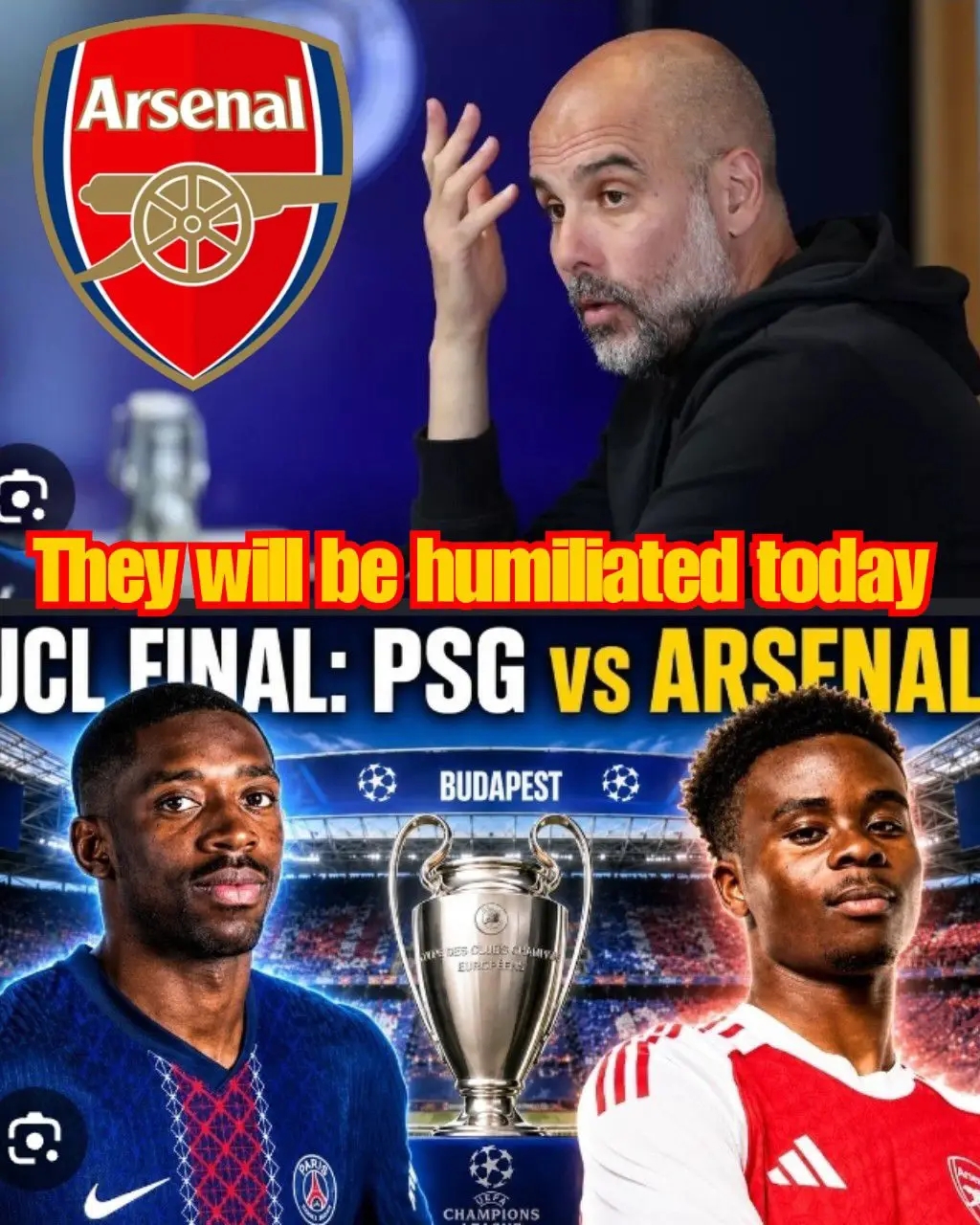
But because of one explosive line allegedly spoken by one of the greatest managers of all time, Pep Guardiola, just hours before the biggest match of the season between Arsenal FC and Paris Saint-Germain.
The quote spreading across football media, fan pages, and social platforms is as dramatic as it gets:
“If they dare score one goal today, they will concede four immediately because they have the attack and lack the midfield.”
That single sentence has now taken over the entire Champions League final build-up, turning an already massive occasion into something even more intense, more emotional, and more unpredictable.
Supporters are arguing.
Pundits are debating.
Former players are reacting.
And the two clubs involved are preparing for a match that already feels like it has gone beyond football and into something much bigger.
Because when a figure like Guardiola speaks—whether officially or in a reported comment—people listen.
Even when the message is unclear.
Even when the target is not explicitly named.
Even when it sounds like a tactical warning mixed with psychological warfare.
The football world tries to decode every word.
And right now, the interpretation is dividing opinion everywhere.
Some believe Guardiola is pointing directly at PSG, suggesting that their attacking firepower is dangerous but structurally unbalanced in midfield.
Others believe it is Arsenal who are being described, with the implication that their attacking ambition may leave them exposed if the game becomes open.
But what everyone agrees on is simple:
This is not just a prediction anymore.
It has become part of the final itself.
And that is exactly what makes this Champions League showdown feel different from anything we’ve seen in recent years.
Because both teams arrive with completely different identities, different journeys, and different emotional pressures.
Arsenal arrive as a team transformed.
Not long ago, they were rebuilding.
They were questioned.
They were doubted.
They were seen as talented but incomplete.
Now they stand on the edge of European glory after a long, painful, and disciplined rise under their manager.
Their style is built on structure.
Their confidence comes from control.
Their belief comes from consistency.
They press aggressively, they pass with purpose, and they attack with coordination that has developed over seasons of hard work.
This is not the Arsenal of chaos.
This is the Arsenal of control.
A team that has learned how to suffer, how to adapt, and how to win ugly when needed.
For their supporters, this final feels like destiny arriving late but arriving strongly.
Years of frustration are now condensed into ninety minutes.
Years of near misses now lead to one final chance at redemption.
And yet, standing in their way is a PSG side built for exactly this moment.
Paris Saint-Germain have lived through everything European football can offer—hope, heartbreak, expectation, and pressure that never seems to disappear.
Every season brings the same goal: win the Champions League.
Every season brings the same pressure: deliver or face criticism.
But this time feels slightly different.
There is a sense that PSG are not just relying on names anymore.
They are playing with structure.
They are playing with balance.
They are playing with more discipline than in previous years when chaos sometimes defined their biggest nights.
Still, their identity remains attacking.
Their strength remains forward momentum.
Their danger remains in transition moments where they explode forward with speed and precision that can destroy any defence in seconds.
And that is exactly why Guardiola’s reported comment has struck such a nerve across football.
Because at its core, the statement is not just about prediction.
It is about balance.
It is about control of midfield space.
It is about what happens when attacking talent meets structural weakness.
“If they score one, they concede four immediately…”
It is a brutal way of describing a team that either dominates or collapses depending on control of the middle of the pitch.
And in Champions League finals, midfield control is often the difference between history and heartbreak.
Every tactical analyst knows this.
Every former player repeats it.
Every manager builds entire game plans around it.
Because when midfield control is lost, everything else begins to fall apart.
Defenders become exposed.
Attackers become isolated.
Transitions become dangerous.
And momentum shifts instantly.
That is why Guardiola’s name being attached to this kind of statement has made it explode even further.
Because he is not just any voice in football.
He is a coach who built dynasties on midfield control.
He is a manager who believes possession is protection.
He is someone who sees football as structure before chaos.
So even a single sentence, real or reported, carries weight far beyond normal pundit opinions.
But while the world debates interpretation, both teams are focused on something much more important: the match itself.
Arsenal’s preparation has been built around controlling rhythm.
They want to slow PSG’s explosive transitions.
They want to force PSG into structured defending.
They want to dominate possession in key phases and prevent counter-attacks from forming.
For Arsenal, the game is about patience.
It is about discipline.
It is about avoiding emotional collapse when PSG inevitably produce dangerous moments.
Because PSG will create chances.
That is guaranteed.
The question is whether Arsenal can control when and how those chances come.
On the other side, PSG’s plan is almost the opposite.
They want space.
They want chaos.
They want transitions.
They want Arsenal’s defensive structure stretched until gaps appear.
They know that if the game becomes open, they have the speed, movement, and attacking talent to punish any mistake.
For PSG, the key is not slow control—it is explosive moments.
One pass.
One run.
One mistake.
One goal.
And suddenly the entire final can change.
That is why this match feels so balanced, yet so dangerous for both sides.
Because both teams believe their style is the correct one.
Both teams believe they can impose themselves.
Both teams believe they are one good performance away from glory.
And yet both teams also know that one bad phase could destroy everything.
That is the tension Guardiola’s alleged comment has amplified.
It has turned tactical discussion into psychological warfare.
Fans are now not just asking who will win.
They are asking who will survive their own weaknesses longer.
Social media reactions have been immediate and extreme.
Arsenal fans believe the quote highlights PSG’s defensive vulnerabilities.
They argue that if Arsenal score first and control midfield, PSG could struggle to recover.
PSG fans see it differently.
They believe it is a warning to Arsenal that attacking too aggressively could leave them exposed to PSG’s deadly transitions.
Neutral fans are enjoying the chaos.
Because this is exactly what big finals are supposed to feel like—uncertain, emotional, and unpredictable.
Even former players and pundits are split.
Some insist midfield control will decide everything.
Others believe individual brilliance will override tactics entirely.
But in football, both can be true.
A match can be controlled for 80 minutes and still be lost in 10 seconds.
A team can dominate statistics and still lose the trophy.
That is why this final carries so much weight.
It is not just about strategy.
It is about moments.
A single interception.
A single mistake.
A single finish.
A single decision under pressure.
And suddenly history is rewritten.
For Arsenal, winning would represent the completion of a long rebuild.
It would confirm their rise back into Europe’s elite.
It would validate their tactical system, their recruitment, and their long-term vision.
For PSG, victory would represent relief as much as glory.
It would finally remove years of pressure and expectation.
It would silence criticism that has followed them across seasons.
It would establish a new identity for the club on the European stage.
So when Guardiola’s name enters the conversation with such a dramatic quote, even indirectly, it adds another layer of pressure to an already massive occasion.
Because players see these headlines.
Fans discuss them.
Media repeats them.
And suddenly, they become part of the atmosphere inside the stadium.
As kickoff approaches, everything feels heightened.
The noise.
The expectation.
The tension.
The belief.
And the fear.
All of it mixed into one final night where two elite teams will try to impose their identity on the biggest stage in club football.
Maybe Arsenal will control the midfield and dictate the game.
Maybe PSG will explode in transition and break through instantly.
Maybe the match will be decided by tactics.
Maybe it will be decided by emotion.
Maybe it will go exactly as predicted.
Or maybe, as football so often proves, it will do something completely unexpected.
Because no matter how many predictions are made—even from voices as powerful as Pep Guardiola—the game still has to be played.
And until the final whistle, nothing is guaranteed.
That is the beauty of it.
That is the fear of it.
That is why the world will be watching.