RANGERS PLAYER RATINGS VS JAGIELLONIA BIALYSTOK AS FALL GUY LANDS 3/10 AND DEBUTANT ASSESSED

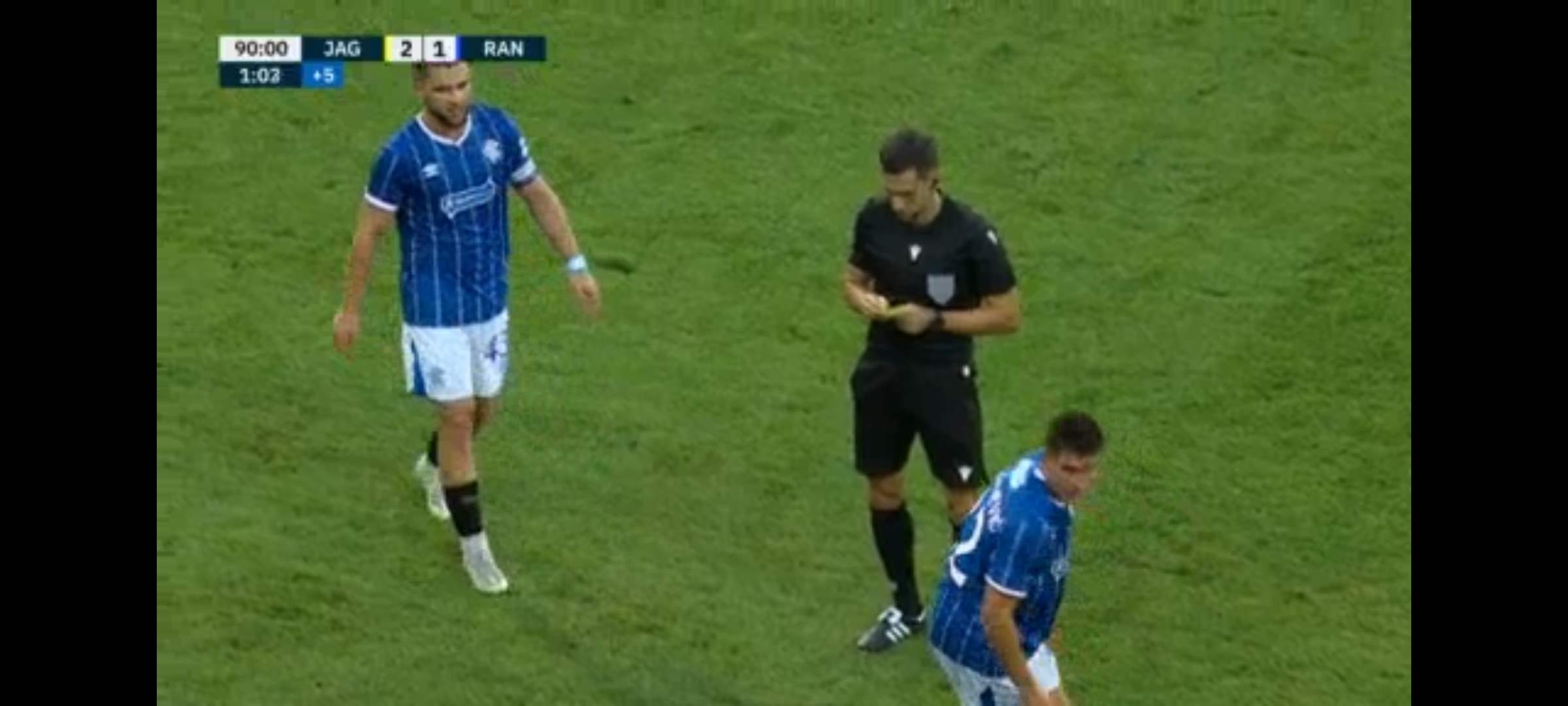
Derek McInnes endured his first taste of continental management heartbreak on Thursday night as Rangers threw away an early lead to lose 2-1 to Jagiellonia Bialystok in the first leg of their Europa League third qualifying round tie in Poland, a result that leaves the Ibrox return leg next week looking considerably more nerve-shredding than it should have been given how the evening began. For four minutes it looked like the perfect start to McInnes’ European reign at Rangers, the sort of gift a manager dreams of on his continental bow, but what followed was a collapse built on individual errors, defensive hesitancy and a collective inability to seize control of a match that was there for the taking. The final whistle brought with it a familiar sinking feeling for the travelling support, and after the game the inquest into where exactly it went wrong began in earnest, with several individual performances standing out for very different reasons.
The opening goal could scarcely have been scripted better for the visitors. Tuur Rommens, deployed at left-back and growing into the sort of attacking outlet Rangers have craved from that position, whipped a low ball across the face of the box that home defender Guilherme Montoia could only turn into his own net inside the opening four minutes. It was the kind of start that settles nerves, quietens a hostile away crowd and hands the initiative firmly to the team in blue. Rangers looked composed, comfortable in possession and largely in control of the game’s rhythm, with Mohamed Diomande in particular pulling the strings in midfield and looking every inch the technician Rangers fans have come to appreciate since his emergence as a first-team fixture. For a spell it seemed as though McInnes’ side would use the away goal as a platform to press home their advantage and perhaps even wrap the tie up before a ball had been kicked at Ibrox.
Instead, sloppy defending at both ends of the pitch let the hosts back into the contest with alarming speed. Kajetan Szmyt levelled matters in the 13th minute with a goal that had Rangers supporters wincing as much for how it was conceded as for the fact it went in at all, the ball sliding under a Rangers defender’s foot in a moment of carelessness that summed up a worryingly familiar pattern for this back line. Eight minutes later, more defensive slackness allowed Szmyt to add his second and complete the turnaround, Rangers undone twice in the space of nine first-half minutes by errors that will have McInnes demanding urgent improvement before the return fixture. What had promised to be a routine away leg with a cushion to protect instead became a damage-limitation exercise, and Rangers went in at half-time trailing a tie they should, by rights, have been controlling.
McInnes made his intentions clear at the break, introducing Cammy Devlin, Nicolas Raskin and Findlay Curtis all at once in an effort to inject fresh legs, composure and directness into a side that had lost its way. The changes did bring about a shift in territory, with Rangers dominating possession for large stretches of the second half and pushing men forward in search of an equaliser that would have made the return leg a formality rather than a genuine test of nerve. Findlay Curtis in particular caused problems after linking up with Raskin, and there was a moment deep into stoppage time when Rangers came agonisingly close to salvaging something from the evening, only for Curtis to see his effort crash back off the woodwork rather than nestle into the net. It would have been a fitting reward for a spirited second-half response, but instead Rangers were left to reflect on a missed opportunity and a tie that now hangs in the balance heading into the second leg at Ibrox.
For McInnes, this was about as tough an introduction to continental management as could have been designed. Domestic knockabouts and the rigours of Scottish Premiership away days are one thing, but European ties carry their own particular pressures, and Rangers’ summer rebuild is still very much a work in progress. New signings are bedding in, defensive partnerships are still forming, and the squad is still finding its identity under a manager who inherited a difficult job in the wake of considerable upheaval at Ibrox. A result like this, while disappointing, is not necessarily catastrophic in isolation, particularly with the return leg still to come in front of a passionate home support who will roar the team on in search of a turnaround. But it does underline just how much work remains to be done if Rangers are to establish themselves as a side capable of matching the continental ambition the club’s ownership and support demand.
Turning to the individual performances, our ratings out of ten for each Rangers player who featured in Poland make for a mixed bag, reflecting a game in which some players stood tall while others contributed directly to the collapse.
In goal, Ivor Pandur was given a rating of 6 out of 10 for a night in which his distribution was consistently tidy and composed, helping Rangers build attacks from the back even in the moments when the outfield players in front of him were struggling to retain shape. He could do little about either goal conceded, with the leveller in particular coming from a position where no goalkeeper alive would have had any realistic chance of intervening given how the ball squirmed under a defender’s foot. He did produce a smart save to deny Prelec’s initial effort in the buildup to the second goal, showing sharp reflexes, but there was simply no answer available when Szmyt reacted quickest to convert the rebound. On the whole it was a solid if unspectacular evening between the sticks for the goalkeeper, and one that will not have done any lasting damage to his standing as Rangers’ first-choice number one.
At right-back, Ross McCrorie was handed the task of deputising for the injured Ben Godfrey and earned a 6 out of 10 for a performance that, while imperfect, showed the versatility and reliability that has made him such a useful squad option under successive Rangers managers. He struggled to react with sufficient urgency for the hosts’ second goal, caught slightly flat-footed as the move developed, and there were moments when he found himself dragged out of position by Jagiellonia’s movement down that flank. Nevertheless, McCrorie stuck diligently to his defensive responsibilities throughout and offered a level of experience and game intelligence that Rangers will value as they navigate an injury list that already looks concerning this early in the season. His willingness to fill in wherever required continues to endear him to supporters, even on a night when the collective defensive display left plenty to be desired.
It was in the heart of the defence where Rangers’ evening truly unravelled, and the individual ratings reflect that grim reality starkly. Dujon Sterling was marked down to a 4 out of 10 after a difficult night that included an overhit cross-field pass toward Daisuke Yokota which encapsulated a scratchy first-half showing, along with a hair-raising moment when he nearly played Rangers into serious trouble by misjudging a routine pass back to his centre-back partner Emmanuel Fernandez. Sterling has shown better in a Rangers shirt before, and this will likely be filed away as one to forget rather than a worrying trend, but on a night when composure at the back was at an absolute premium, his uncertainty on the ball proved costly at various junctures.
If Sterling had a night to forget, his central defensive partner Emmanuel Fernandez endured something considerably worse, earning the lowest mark of the evening at just 3 out of 10 as the player squarely identified as the fall guy for Rangers’ defensive capitulation. Fernandez continues to endure a difficult start to life in Scottish football this season, and his lackadaisical attempt to cut out the ball that eventually slid under his foot for Jagiellonia’s opening goal will be replayed in slow motion by Rangers supporters wincing at just how avoidable the error appeared. Worse was to follow for the defender, who then slipped inside the penalty area at a critical moment as Jagiellonia worked their way toward what would prove to be the winning goal, compounding an already torrid evening with a second high-profile mistake. There will be sympathy in some quarters given how early it still is in his Rangers career, and every young or newly arrived defender goes through a period of adjustment to a new league and a new environment, but McInnes will need to see a rapid response from Fernandez if confidence is not to become a genuine issue heading into a hugely important second leg at Ibrox.
At left-back, Tuur Rommens picked up a 6 out of 10 rating for an evening that included the assist, of sorts, for Rangers’ opening goal, his low, driven delivery across the box proving too much for Montoia to deal with. It was a reminder of the attacking threat Rommens can offer down that flank, and on another night his contribution might have been the difference between victory and defeat rather than a mere consolation talking point. He did pick up what was, by most assessments, a fairly harsh booking for what looked to be an innocuous challenge moments after the restart, a decision that will have frustrated the player and his manager alike given the tightrope it forced him to walk defensively for the remainder of the match. Even so, Rommens continues to look like one of the more encouraging pieces of Rangers’ summer rebuild, and his overlapping runs remain a genuine weapon in this side’s attacking arsenal.
In central midfield, the picture was similarly mixed. Dan Neil, wearing the captain’s armband in what was a significant show of trust from McInnes so early in his tenure at the club, was given a 5 out of 10 after failing to fully grasp the opportunity presented to him. His decision-making in the buildup to Jagiellonia’s second goal came in for particular scrutiny, with questions asked about whether a more incisive or urgent choice on the ball might have snuffed out the danger before it fully materialised. Neil was withdrawn at half-time as part of McInnes’ triple substitution, a clear signal that the manager felt a change was needed to shift momentum, and it will now be up to the summer signing to bounce back in the second leg and show the leadership qualities that persuaded Rangers to hand him such early responsibility.
Alongside him, Tochi Chukwuani also received a 5 out of 10 having been drafted back into the starting eleven having sat out the previous match at Tannadice. It proved to be a mixed return to the side, with Chukwuani picking up a booking for a rash first-half challenge on Wojtuszek that added an unwelcome layer of caution to his evening, and like Neil he was hooked at the interval as McInnes sought to change the complexion of the match. There were flashes of the energy and industry that have made Chukwuani a useful option in the middle of the park, but on the whole this was a night where the central midfield battle was lost more often than it was won, and the manager’s decision to overhaul that area of the pitch at half-time spoke volumes about his assessment of the first-half performance.
The standout performer in Rangers’ midfield, by contrast, was Mohamed Diomande, who earned a 6 out of 10 and was widely regarded as one of the more encouraging presences on the pitch across the full ninety minutes. His clever reverse pass in the buildup to Rangers’ opening goal set Rommens free down the left and demonstrated the kind of vision and technical quality that has made Diomande such an important part of the midfield setup this season. Beyond that single moment of quality, he contributed positively in a number of other passages of play, particularly in the opening half when Rangers were dictating the tempo and pattern of the match. Diomande’s continued progress will be a source of genuine encouragement for McInnes as he looks to build a midfield capable of controlling matches at this level.
Further forward, the front three offered a mixture of promise, frustration and understandable rustiness given the unusual circumstances one of them found himself in. Thelo Aasgaard, who had been among the standout performers in Rangers’ league opener at Dundee United just days earlier, was given a 4 out of 10 for what was described as a night to forget. Looking miles off the electric pace that had made him such a menace on Friday night, Aasgaard lost possession on the edge of the Jagiellonia box in a moment that directly led to the counter-attack culminating in the hosts’ second goal, a costly turnover that will sting given how influential he had been just days prior. Nothing seemed to come off for the winger on this occasion, and it serves as a reminder of just how quickly form and fortune can fluctuate in a compressed fixture schedule, particularly for a squad still finding its rhythm under a new manager.
Leading the line, Youssef Chermiti was preferred to Lawrence Shankland and rewarded that trust with a 6 out of 10 rating, pressing high up the pitch in the early stages and doing well to win back possession on more than one occasion before trying his luck from distance with an effort that ultimately lacked the power to seriously trouble the Jagiellonia goalkeeper. Chermiti also fashioned a few half-chances as the match wore on, showing the kind of movement and intelligence that has made him an increasingly important option for McInnes as he weighs up his options in attack. It was far from a vintage individual display, but Chermiti’s work rate and willingness to press from the front will not have gone unnoticed by his manager.
Perhaps the most eye-catching name in the entire team sheet, however, was Daisuke Yokota, who was thrown straight into the deep end just a little over twenty-four hours after officially putting pen to paper on his Rangers contract. Given a 5 out of 10 for a debut that came with almost no time for the new arrival to acclimatise to his surroundings, teammates or the club’s tactical setup, Yokota found himself effectively running on adrenaline throughout, unable to meaningfully influence proceedings but showing no shortage of courage in accepting the challenge thrown at him by his new manager. It is an almost impossible ask for any player to be parachuted into a competitive European fixture on unfamiliar soil having barely had time to unpack, and supporters will rightly extend patience to Yokota as he settles into life at Ibrox over the coming weeks. First impressions in football are rarely fair reflections of a player’s true ability, and this was very much a case of a footballer being asked to sprint before he had learned to walk in his new environment.
Among the substitutes, Nicolas Raskin was given a 5 out of 10 for the composure he added to the midfield after coming on, a timely reminder of the calming influence he can provide even amid uncertainty over his long-term Ibrox future given ongoing transfer interest from Villarreal. Findlay Curtis picked up a 6 out of 10 having carved out arguably the best chance of the entire second half, linking superbly with Raskin before being denied by the frame of the goal in a moment that will haunt Rangers if the tie ultimately slips away from them. Cammy Devlin was credited with a 5 out of 10 for a typically hard-working cameo that helped Rangers wrestle back a measure of control in midfield, while Vanja Dragojevic, introduced with around fifteen minutes remaining in place of the struggling Aasgaard, was given a 4 out of 10 as he tried to make an immediate impact in unfamiliar circumstances. Lawrence Shankland, meanwhile, was not rated having not featured, McInnes opting to keep his summer signing in reserve on this particular occasion.
Rangers now turn their attention to the second leg at Ibrox, where a raucous home support will be relied upon to help drag the team over the line in a tie that looked to be heading firmly in the Light Blues’ favour before a nine-minute defensive collapse turned the contest on its head. McInnes will have plenty to work on this week, from shoring up the uncertainty at centre-back to ensuring his midfield offers greater control against a Jagiellonia side who will now travel to Glasgow full of belief having secured what was, by any measure, a thoroughly deserved victory in the first leg. Whether Rangers can find the response required to overturn the deficit will go a long way toward defining the early weeks of the McInnes era in Europe, and after a night like this, few among the Ibrox support will be taking anything for granted heading into what promises to be a tense and pivotal second leg.
The scale of the task facing Rangers should not be understated. Overturning a one-goal deficit against a side who have shown they can hurt this defence is entirely achievable, particularly with home advantage and a support capable of lifting the team through moments of doubt, but it will require a marked improvement in concentration levels from the back four in particular. Errors of the sort that gifted Jagiellonia both of their goals in Poland simply cannot be repeated at Ibrox if Rangers are to progress into the next round of qualifying, and McInnes will surely have used the days since the first leg to drill home that message in training. There is also the question of personnel, with Ben Godfrey’s fitness likely to be a significant factor in team selection, while the manager may also be tempted to reconsider his central defensive pairing given the difficulties both Sterling and Fernandez experienced in Bialystok.
There were, in fairness, enough positive signs in the second-half performance to suggest Rangers have the attacking quality required to make life uncomfortable for Jagiellonia on home soil. The introduction of Raskin, Devlin and Curtis at the interval transformed the visitors from a side struggling to assert control into one dominating possession and territory, and had Curtis’s late effort gone in rather than cannoned back off the woodwork, the tie would look a great deal more comfortable heading into the second leg. That cutting edge, allied to the creative influence of Diomande and the raw threat offered by whichever forward line McInnes opts to select, gives genuine grounds for optimism that Rangers can find the goals required at Ibrox. The concern, as it so often is with this Rangers side in its current state of transition, will be whether the defence can hold firm for long enough to allow that attacking quality to tell.
For a manager still finding his feet in the job, still shaping a squad reshaped extensively over the summer, and still working out his best available team on a game-by-game basis, defeats of this nature are part of the process, however unwelcome they may feel in the immediate aftermath. What matters now is the response, both in terms of results and performances, and Rangers supporters will be watching closely to see whether the character shown in that second-half fightback in Poland can be replicated and improved upon in front of their own fans. A place in the next round of Europa League qualifying, and the financial and prestige benefits that come with continued continental involvement, hangs in the balance, and McInnes knows there is little margin for further error