RANGERS SHOULD’VE HAD A PENALTY, SAYS STEWART, AS COMPARISON MADE TO CONTROVERSIAL HIBS SPOT-KICK

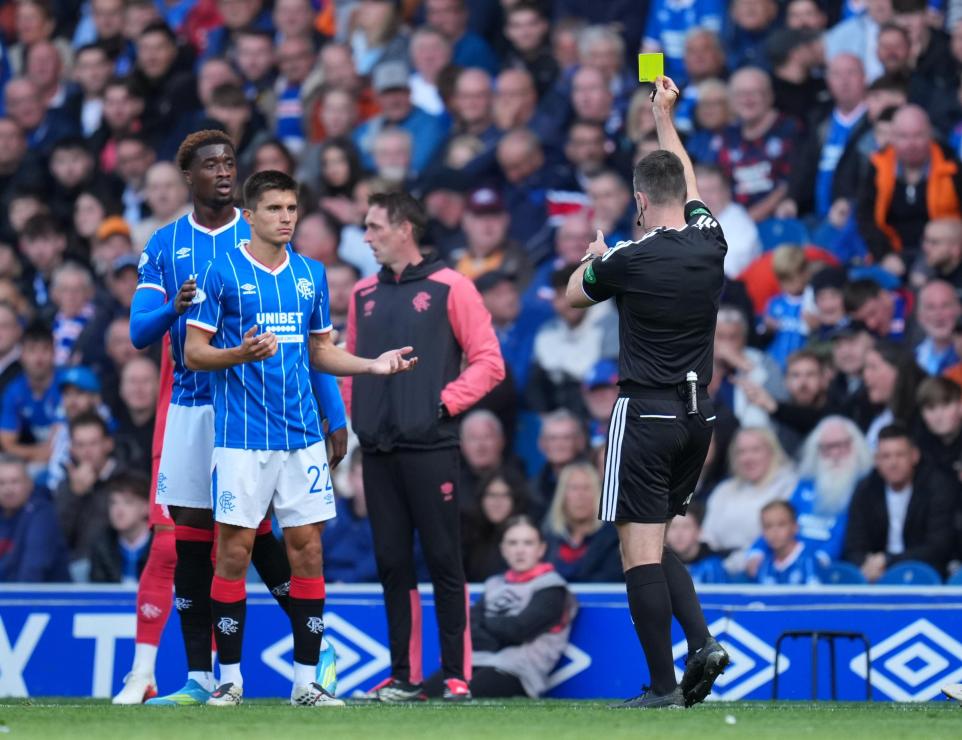
Michael Stewart has waded into the ongoing debate over refereeing standards in Scottish football, insisting Rangers should have been awarded a penalty for a shove on Nicolas Raskin during their 5-1 League Cup win over St Mirren at the weekend, and drawing a pointed comparison with the far more controversial penalty awarded against Rangers in their earlier defeat to Hibernian. Speaking on Premier Sports, the former Scotland midfielder didn’t hold back in his assessment, arguing that officials have effectively lowered the bar for what constitutes a foul so early into the season, and that the inconsistency being shown between similar incidents is starting to wear thin, even for a pundit who says he’s trying hard not to become a permanent critic of Scottish refereeing.
The specific incident that sparked Stewart’s frustration came during Rangers’s convincing win over St Mirren, when Raskin, deployed as captain for the afternoon in Lawrence Shankland’s absence from the starting eleven, appeared to be on the receiving end of a clear two-handed shove inside the penalty area. No spot-kick was given, and while the result of the match was never in doubt given Rangers’s eventual 5-1 margin of victory, Stewart made clear that the officiating call itself deserved scrutiny regardless of how comfortably the game ultimately finished. “Looking at that incident regardless, you do wonder how it wasn’t picked up because it does look like a penalty kick,” he said, adding bluntly of the wider situation, “we said it last week: never a penalty.”
What gives the comment real weight, though, is the direct comparison Stewart drew with the penalty Rangers conceded against Hibernian earlier in the season, a decision that has already generated considerable debate among supporters and prompted Rangers themselves to formally request an explanation from the Scottish FA. That incident saw Vanja Dragojevic and Hibs defender Jason Kerr tangle inside the box, with referee officials ultimately pointing to the spot in what proved a pivotal moment in David Gray’s side’s win at Ibrox. Stewart was unequivocal in his view of that call at the time, arguing both players were guilty of giving as good as they got in the coming together and that, in his opinion, no penalty should have been awarded at all. Setting that decision alongside the non-award for the Raskin incident against St Mirren, Stewart’s argument is essentially one of consistency, that if contact of the Kerr and Dragojevic variety is enough to warrant a penalty, then a clear two-handed shove on Raskin inside the box surely clears that same threshold with room to spare.
It’s the kind of comparison that resonates strongly with supporters precisely because it captures the sense of whiplash that comes from watching decisions in similar situations go different ways within the space of just a few weeks. Stewart himself acknowledged as much, noting that fans have continued picking apart both incidents since they happened and are likely to keep doing so as the pattern of decisions this season continues to be scrutinised. “Fans get frustrated and they will go look at it,” he said, before returning to the Raskin incident specifically to reiterate his central point. “So that Raskin one specifically, I think the picture speaks for itself.”
Stewart’s broader argument goes beyond simply relitigating two individual incidents, though, and cuts to a wider concern about the standard being set for contact fouls in the penalty area so early into the new Scottish football season. His contention is that once officials start pointing to the spot for contact of the Dragojevic-Kerr variety, essentially a coming together where both players are jostling for position rather than one clearly and unilaterally fouling the other, it creates an inconsistent benchmark that then makes non-awards like the Raskin incident look even more glaring by comparison. “I am tired of it already,” Stewart admitted of the frequency with which these debates have already cropped up barely a month into the campaign, while being careful to frame his criticism as measured rather than reflexive. “I am trying to tread a tightrope here in regards to trying to resolve a situation I have with the SFA, but equally, I’m not going to ignore situations,” he explained, a comment that suggests some genuine tension in his own position as a pundit trying to hold officials accountable without simply becoming another voice adding to the pile-on that so often follows contentious decisions in Scottish football, particularly those involving Rangers and Celtic’s closest rivals in Edinburgh and Leith.
He was careful, too, to stress he didn’t want his criticism to tip over into excess, conscious of how quickly measured analysis can curdle into the kind of blanket conspiracy-tinged complaining that tends to dominate phone-ins and social media after any contentious decision involving either half of the Old Firm. “I don’t want to go overboard, but that is why I’m so frustrated with some of these decisions early this season because it’s lowering the bar,” he said, a fairly careful and specific framing that positions his criticism around consistency and standard-setting rather than any suggestion of bias against Rangers specifically.
The broader context here matters too, because this isn’t the first time officiating standards involving Rangers have become a talking point this season, and it comes against a backdrop of a club that has, fairly or not, developed something of a habit of feeling hard done by on decisions in recent seasons. The Hibernian penalty award to Kerr and Dragojevic was significant enough in isolation to prompt Rangers to formally seek clarification from the governing body, a step the club doesn’t take lightly and one that reflects genuine institutional frustration rather than simply supporters venting on social media. Layer the Raskin non-award on top of that, and you start to see why voices like Stewart’s, offering a relatively neutral, pundit-level assessment of both incidents rather than a Rangers-aligned complaint, carry a bit more weight in the broader conversation about consistency from Scottish officials this season.
It’s also worth placing all of this within the wider narrative of Rangers’s start to the campaign under new head coach Derek McInnes, a period that has already been defined by plenty of scrutiny and second-guessing, whether that’s been aimed at team selection, results, or now, increasingly, the standard of officiating the team has been on the receiving end of. Rangers took just two points from their opening four competitive fixtures before finally getting off the mark with the 5-1 win over St Mirren in which the Raskin incident occurred, a result that offered some much-needed relief after a genuinely difficult opening month, but which also, ironically, is now generating its own separate officiating controversy despite the comfortable scoreline. It’s a reminder that even in matches Rangers win comfortably, questions about consistency and fairness in decision-making can still linger and generate discussion well after the final whistle.
For Raskin specifically, the incident adds another layer to what’s already been an eventful few weeks. Having worn the captain’s armband against St Mirren in place of Shankland, delivering what was widely regarded as one of his best individual performances in a Rangers shirt this season, being on the receiving end of a missed penalty call, however inconsequential to the final result, is a minor footnote in what was otherwise a hugely positive afternoon for the Belgian, whose long-term Ibrox future has been the subject of persistent transfer speculation throughout the summer window. If anything, the manner in which he was targeted physically inside the box, and the fact that pundits like Stewart are willing to publicly back up the claim that it should have been given, only adds further evidence to the growing case that Raskin remains one of Rangers’s most influential and closely-marked players regardless of the uncertainty hanging over his contract situation.
There’s a useful thread here too connecting back to the earlier, much higher-profile penalty controversy that continues to loom over Scottish football’s broader conversation about VAR and officiating consistency, the infamous Vaclav Cerny incident from the 2024 League Cup final against Celtic, when Liam Scales was adjudged to have fouled the Rangers winger only for the officials to award a free-kick on the edge of the box rather than a penalty, despite replays showing the infringement occurred on the goal line. That incident, which the Scottish FA’s own head of refereeing Willie Collum later publicly admitted was a clear error, has become something of a reference point whenever questions about penalty-area decision-making and Rangers arise, and while it long predates this current run of incidents involving Dragojevic, Kerr, and now Raskin, it forms part of the broader backdrop against which any new controversy involving marginal calls in the box tends to be viewed by supporters and commentators alike. Whether fair or not, there remains a section of the Rangers fanbase primed to view any subsequent non-award as part of a longer pattern rather than an isolated inconsistency, and Stewart’s comments, however measured in tone, are likely to feed into that ongoing narrative regardless of his stated intention to avoid going overboard.
What happens next in terms of any formal response from the Scottish FA remains to be seen. Unlike the Hibernian penalty award, which prompted Rangers to seek an official explanation, there’s been no indication yet that the club intends to formally raise the Raskin incident through the same channels, and given the result of the St Mirren match was never seriously in doubt, it may simply be filed away by the club as another data point in the broader conversation about consistency rather than something requiring immediate escalation. For neutral analysts like Stewart, though, incidents like this one matter regardless of the final scoreline, because the underlying question, whether officials are applying a consistent standard for what constitutes a penalty-worthy foul, extends well beyond any single match or any single club’s grievances.
For McInnes and his players, the more pressing concern in the days following the St Mirren win was always going to be the small matter of the Conference League play-off tie against Jablonec rather than the finer points of penalty-area officiating from a match Rangers won by four clear goals. But incidents like the Raskin shove, minor as they may have been in the context of the final result, have a way of accumulating into a broader narrative over the course of a season, and if Rangers continue to find themselves on what many neutral observers regard as the wrong end of marginal calls, whether that means missing out on penalties they should have received or conceding ones they arguably shouldn’t have, it’s the kind of storyline that will keep resurfacing in punditry and phone-in shows regardless of how well the team itself is performing on the pitch.
For now, Stewart’s intervention serves as a useful, relatively balanced marker in that ongoing conversation, criticism aimed not specifically at protecting Rangers’s interests but at holding officials to a consistent standard across contrasting incidents, a distinction that matters given how quickly debates like this can otherwise collapse into simple tribal point-scoring. Whether the Scottish FA’s officiating hierarchy takes any public notice of the comparison Stewart has drawn between the Kerr-Dragojevic penalty and the Raskin non-award remains to be seen, but with supporters already primed to scrutinise every contentious decision closely this season, it’s unlikely to be the last time questions of consistency and fairness dominate the conversation around Rangers matches in the weeks ahead.