The Supercomputer that predicted Liverpool to win last season premier League, have again predicted the outcome of Arsenal next five premier League fixtures

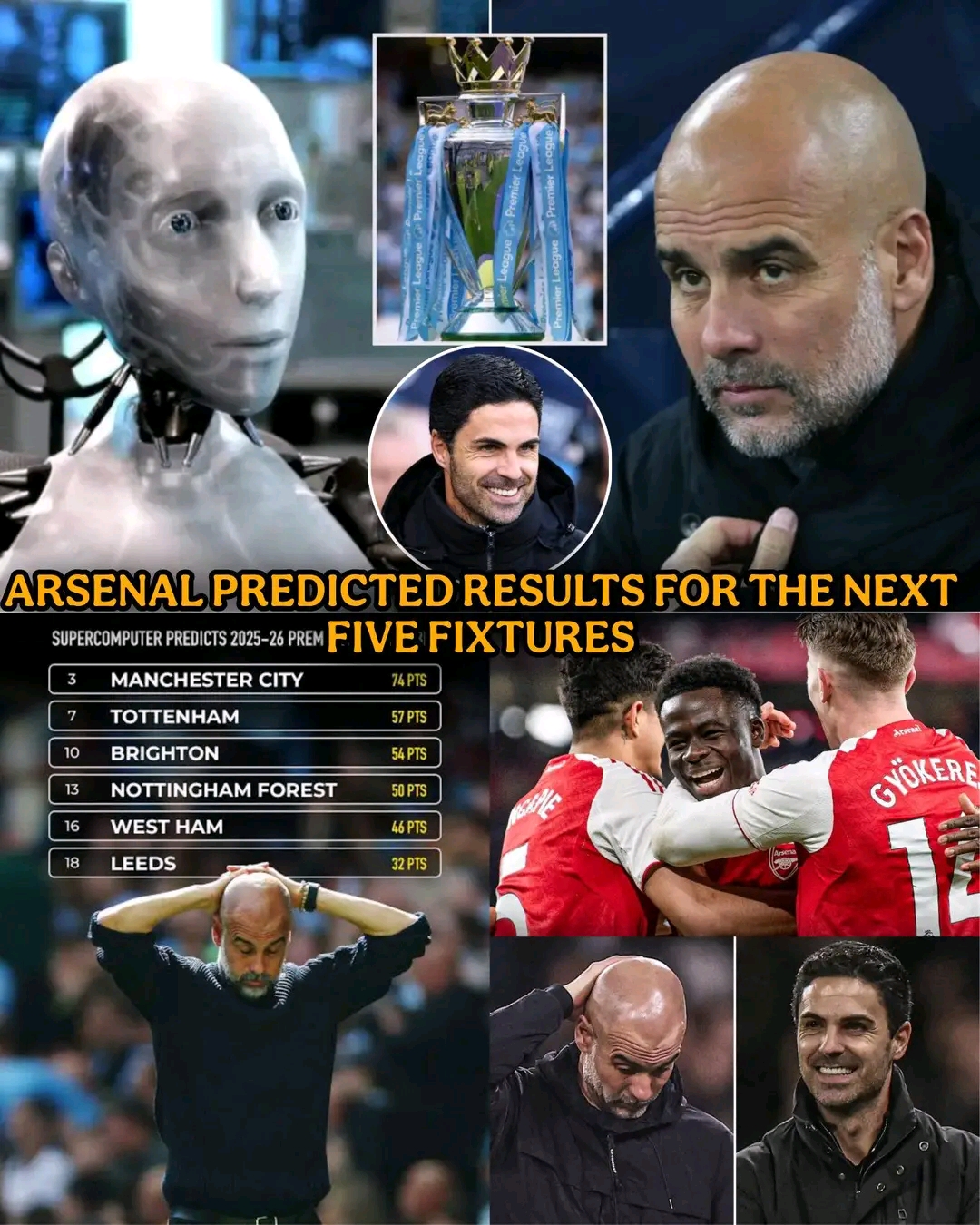
The Premier League title race is once again becoming one of the most dramatic stories in football, and after Manchester City dropped points yesterday, a new prediction has suddenly sent shockwaves across the football world. Fans everywhere are now talking about a supercomputer that became famous last season after correctly predicting that Liverpool would win the Premier League title. That prediction shocked many people at the time because several pundits believed other teams had a stronger chance, yet the machine analysis proved to be correct in the end. Now that same powerful system has returned with another bold prediction, and this time it has focused its attention on Arsenal and their next five Premier League fixtures.
The timing of this prediction could not be more dramatic. Manchester City dropping points has immediately changed the mood around the title race. Every point matters at this stage of the season, and when a team like City fails to win, it opens the door for their rivals. Arsenal fans know this better than anyone because they have been chasing the Premier League dream for years. Every season they start with hope, but the pressure of the long campaign always tests the team’s strength, mentality, and consistency.
Now, with the title race becoming tighter and emotions rising among supporters, the supercomputer has calculated the possible outcomes of Arsenal’s upcoming games. These matches could define the season. They are not just ordinary fixtures anymore. Each match now feels like a final because the smallest mistake could decide who lifts the Premier League trophy at the end of the season.
Last season when the same supercomputer predicted Liverpool to win the league, many fans laughed at the idea. They believed football cannot be predicted by machines because the game is full of surprises, emotions, injuries, refereeing decisions, and moments of magic that numbers cannot always measure. But as the season progressed and Liverpool continued to perform exactly as the prediction suggested, people slowly began to take the technology more seriously.
The system works by analyzing thousands of statistics. It studies team form, player fitness, goal scoring patterns, defensive records, possession numbers, expected goals, and even historical performance against certain opponents. It processes millions of possible outcomes for every match, creating simulations that try to estimate what could happen in future games. The result is not a guarantee, but it often provides a surprisingly accurate picture of how the season could unfold.
This time the supercomputer has turned its focus to Arsenal because the next five matches are seen as critical for their hopes. After Manchester City dropped points, the pressure has shifted slightly. Arsenal now know that a strong run could put them in a powerful position in the title race. But football never gives anything easily. Every opponent in the Premier League is dangerous, and even teams near the bottom of the table can cause huge upsets.
According to the prediction model, Arsenal’s upcoming fixtures contain a mixture of opportunities and serious challenges. Some of the games are against teams that historically struggle against Arsenal’s style of play, while others are against opponents that have caused problems in recent seasons. The supercomputer studied recent form and tactical patterns, trying to understand how Arsenal’s attacking system might perform against different defensive setups.
One of the most important factors in the prediction is Arsenal’s attacking power. Over the past few seasons the team has developed one of the most exciting forward lines in the Premier League. Their quick passing, aggressive pressing, and ability to create chances from wide areas have made them very dangerous. When they are playing with confidence, they can score goals against almost any opponent.
But the model also looked carefully at Arsenal’s weaknesses. Defensive concentration has sometimes been a concern during difficult away games. In tight matches, small mistakes can change everything. The supercomputer simulations included thousands of scenarios where Arsenal either controlled the match or struggled against counterattacks. These details help determine the predicted outcomes of each fixture.
Another key factor is player availability. Injuries and suspensions can completely change a team’s chances. The system studied current squad fitness and rotation patterns used by the manager. When a team plays many matches in a short period, fatigue becomes a serious issue. Even a strong team can lose momentum if key players are tired or unavailable.
The first of Arsenal’s next five matches is expected to be a very tense encounter. According to the simulation, Arsenal enter the game as favorites, but not by a huge margin. The supercomputer suggests that Arsenal have a strong chance of controlling possession and creating more scoring opportunities. However, it also warns that the opponent could threaten through fast counterattacks, especially if Arsenal push too many players forward.
In many of the simulations, Arsenal managed to secure a narrow victory. The predicted scorelines often showed a one-goal difference, suggesting that the match could be decided by a single moment of brilliance or a defensive mistake. This kind of result is common in Premier League matches where teams are closely matched in quality.
The second fixture appears slightly more complicated. The opponent has historically performed well at home, and the supercomputer analysis shows that the stadium atmosphere could play a major role. Arsenal’s away record has improved in recent seasons, but hostile environments can still create pressure.
In the simulations for this match, the results were more balanced. Some outcomes showed Arsenal winning, while others ended in draws. The model indicates that this could be one of the toughest matches in the upcoming run. A draw would not necessarily be a disaster, but it would increase pressure for the remaining games.
The third match is predicted to be more favorable for Arsenal. Statistical analysis shows that Arsenal usually perform well against this opponent’s tactical system. The supercomputer simulations often produced results where Arsenal dominated possession and created multiple scoring chances. In many scenarios the team managed to win comfortably, sometimes by two or more goals.
However, football fans know that predictions cannot account for everything. Red cards, injuries during the match, or a brilliant performance from the opposing goalkeeper can change the outcome completely. That is why even the most advanced computer models can only provide probabilities rather than certainty.
The fourth fixture is considered another dangerous test. This opponent has a reputation for being extremely difficult to break down defensively. Matches against them often become tactical battles where patience is required. The supercomputer simulations showed many low-scoring results, with draws appearing frequently among the possible outcomes.
In several scenarios Arsenal managed to win late in the match after long periods of pressure. These simulations suggest that Arsenal’s creativity in attack could eventually break the defensive wall, but it might require persistence and mental strength.
The fifth and final match in the prediction set could be the most dramatic of them all. According to the model, this game might have huge implications for the title race depending on the results of the previous matches. If Arsenal enter the game with momentum, their chances of winning increase significantly. Confidence plays a huge role in football, and teams that believe in themselves often perform better under pressure.
The supercomputer simulations show a wide range of possible outcomes for this match. Some runs of the model show Arsenal winning convincingly, while others end in frustrating draws. A few scenarios even show a surprise defeat if Arsenal fail to convert their chances.
When the results of all five fixtures were combined, the prediction suggested that Arsenal could collect a strong number of points if they maintain their current form. In the majority of simulations, Arsenal managed to win at least three of the five matches. That kind of run would place them in an excellent position in the title race, especially after Manchester City’s recent dropped points.
For Arsenal supporters, this prediction has created both excitement and anxiety. On one hand, it suggests that their team has a real opportunity to build momentum. On the other hand, it reminds everyone that the margin for error is extremely small. One unexpected result could change the entire picture.
Fans have already started debating the prediction on social media. Some supporters believe the supercomputer analysis is a good sign because of its success last season with Liverpool. Others remain skeptical, arguing that football is too unpredictable for any machine to truly understand.
Managers and players usually avoid paying attention to these predictions. Inside the dressing room, the focus is always on the next match rather than long-term forecasts. Coaches prepare carefully for each opponent, studying tactics and planning strategies that give their team the best chance of winning.
Still, predictions like this add extra drama to the Premier League story. The league is already known for its unpredictability, and when advanced technology joins the conversation, it creates even more discussion among fans and experts.
Manchester City dropping points has clearly changed the mood of the competition. For years City have been the team everyone expects to dominate the league, thanks to their incredible squad depth and tactical brilliance under Pep Guardiola. But football seasons are long and demanding, and even the strongest teams experience difficult moments.
When a dominant team drops points, rival clubs immediately sense an opportunity. Arsenal know this very well. The club has spent years rebuilding its squad, investing in young players and developing a modern style of football. The goal has always been to return to the top of English football and compete seriously for major trophies.
Now the next five matches could determine whether that dream becomes more realistic. The supercomputer prediction may not guarantee success, but it highlights the importance of this moment in the season.
If Arsenal can deliver strong performances and collect the points predicted by the simulations, they could apply enormous pressure on Manchester City and the other title challengers. Every win would increase belief among the players and supporters.
But the Premier League has taught fans many lessons over the years. Predictions can look perfect on paper, yet football often writes its own story. A late goal, a controversial referee decision, or an unexpected injury can change everything in seconds.
That is why the excitement around these predictions is mixed with caution. Arsenal supporters know they must take each match step by step. The supercomputer may see patterns in the numbers, but the real drama will happen on the pitch.
As the next round of fixtures approaches, the tension will continue to rise. Stadiums will be full of fans hoping their team can take advantage of every opportunity. Television audiences around the world will watch closely as the title race unfolds.
The coming weeks promise drama, excitement, and possibly surprises that no computer could ever fully predict. Whether the supercomputer proves right again or not, one thing is certain. The Premier League season is entering one of its most thrilling moments, and Arsenal’s next five matches could play a huge role in deciding who becomes champions.