Uefa Conference League: Rangers out of Europe after wretched penalty defeat in Jablonec

There is a particular flavor of despair reserved for Scottish clubs on European away nights, one built from decades of grim precedent — Kaunas, Progres Niederkorn, Maribor — nights that become shorthand for humiliation long after the specific details of the match itself have faded. Rangers added a new entry to that grim ledger on Thursday night, crashing out of the UEFA Conference League play-off round with a 4-3 penalty shoot-out defeat to Czech side Jablonec, a result that leaves the Ibrox club without European football beyond August for the first time since 2017.
It was, by every honest account offered afterward — including from the club’s own manager — a wretched night of football, the kind that will linger in the memory of the traveling support far longer than any single moment of quality on the pitch.l
Rangers arrived in the Czech Republic with what should have been a workable advantage. A 1-0 win in the first leg at Ibrox the previous week had given Derek McInnes’s side a cushion heading into the second leg at Jablonec’s Stadion Strelnice, a compact, unglamorous ground nestled near the Jizera Mountains in northern Bohemia — the kind of unfamiliar, unforgiving venue that has undone Scottish clubs before and would do so again here.
A single-goal lead in a two-legged European tie is never as safe as it looks on paper, and McInnes himself seemed to sense the danger in advance. He had cautioned, in the build-up, that Rangers could not afford to rely on a single strong performance carrying them across two matches — a warning that would prove eerily prophetic. That first-leg victory back at Ibrox had itself been description as turgid rather than convincing, a narrow, unconvincing win papering over performance issues that would resurface, far more damagingly, in the second leg.
Whatever hopes Rangers carried into the second leg evaporated almost as soon as the game kicked off. The performance that followed was repeatedly described by those who watched it as flat, lethargic, disjointed — a team that looked, at various points, like strangers to one another rather than a cohesive unit defending a European tie. There was little creativity on offer, little invention in possession, and a growing reliance on long, hopeful balls forward rather than any structured attempt to build and create chances.
Jablonec, by contrast, grew into the match with increasing confidence, sensing — correctly, as it turned out — that the tie was there to be won. Their equalizer arrived in the 73rd minute, and there was little argument that it was deserved. Midfielder Vakhtang Tchanturishvili drove in a strike that beat Rangers goalkeeper Ivor Pandur, leveling the aggregate scoreline at 1-1 and transforming the entire complexion of the tie in an instant. What had been a Rangers side coasting toward a routine progression suddenly found themselves needing to find something extra, against a home crowd sensing blood and growing louder by the minute.
Neither side could find a winner across the remaining minutes of normal time, and the match slid into extra time still level. Thirty additional minutes came and went without further goals — thirty minutes in which Rangers, by most independent assessments of the night, continued to struggle to impose any real authority on proceedings, unable to find the moment of quality that might have spared them the lottery to come.
Penalty shoot-outs have a cruelty all their own — reducing ninety, even one hundred and twenty minutes of collective footballing endeavor to a sequence of isolated, high-pressure individual moments, any one of which can define how an entire campaign is remembered. Rangers’ shoot-out in Jablonec followed that familiar, brutal script.
There were moments of promise. Goalkeeper Ivor Pandur produced a save at a crucial juncture, guessing correctly to deny Filip Zorvan’s effort and giving Rangers a route back into contention within the shoot-out. But Pandur’s save proved to be the high point of an otherwise disastrous sequence for Rangers from twelve yards. Findlay Curtis, stepping up with the chance to keep his side’s hopes alive, blazed his effort well over the crossbar — the kind of miss that requires no further analysis, immediately readable in the reaction of teammates and travelling supporters alike. James Penrice fared little better moments later, seeing his effort saved by Jablonec goalkeeper Jan Hanus, extinguishing Rangers’ realistic hopes of progression. From there, Jablonec’s Jan Chramosta stepped forward and calmly dispatched the decisive penalty, sending the Czech side through and Rangers spiraling out of Europe entirely
To understand why this defeat has landed so heavily, it helps to place it in its proper historical context. Rangers’ exit means the club will have no European football to look forward to beyond the month of August — a drought not experienced since 2017, when the club suffered its infamous defeat to Luxembourg minnows Progres Niederkorn under then-manager Pedro Caixinha, a result still regarded as one of the darkest nights in the club’s modern European history.
That comparison has not been lost on anyone connected to the club. Former Rangers midfielder Andy Halliday, offering his post-match analysis, placed Thursday’s exit directly alongside the club’s most notorious European humiliations — invoking not just Niederkorn but also the infamous defeat to Lithuanian side FBK Kaunas years earlier. Halliday was unsparing in his assessment, arguing that while he didn’t rate Jablonec as a particularly strong side, they were unquestionably the better team across the tie, and that Rangers were, in his words, “absolutely miles off it.”
That the exit comes so soon after another European qualifying disappointment — a loss to Polish side Jagiellonia Bialystok in Europa League qualifying, the defeat that demoted Rangers into the Conference League play-off round in the first place — only compounds the sense of a European campaign that has gone wrong at every available opportunity this summer. Two qualifying exits inside the space of a few weeks represents about as difficult a continental summer as Ibrox has endured in years, particularly set against the backdrop of the club’s run to a European final as recently as 2022.
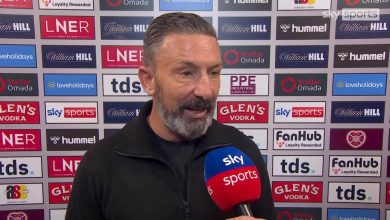
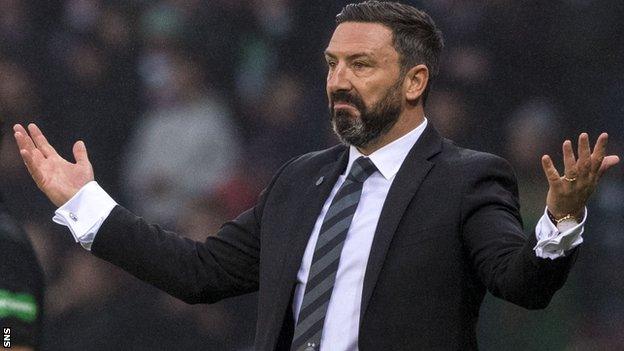
If there was one thing to admire amid the wreckage of the performance, it was the manner in which Derek McInnes addressed it afterward. There was no attempt to obscure or soften the scale of the disappointment. He said plainly that he was mortified by the performance, adding that while any team can lose a football match on a given night, Rangers should have had more than enough quality and know-how in the squad to see out a tie they had led.
He was careful, too, not to lean on the obvious mitigating context available to him. Yes, he acknowledged, there has been a significant turnover of players this summer — twelve new signings and counting, with further arrivals like Kevin Kelsy and Kim Min-su still being finalized. Yes, he admitted, the side looked inexperienced at various points during the tie. But rather than use that context as a shield, McInnes turned it immediately back into a statement of personal responsibility, insisting it falls to him to ensure the group performs to a far higher standard than it managed in Bohemia.
Perhaps the most revealing part of his post-match comments came when he was asked to reflect on how close Rangers had come to progressing — how differently things might have looked with a different bounce of the ball in the shoot-out. Rather than take the obvious comfort on offer, McInnes rejected it outright. He said that while he would gladly have taken a shoot-out win given the importance of progression, doing so would only have papered over cracks rather than reflecting any genuine sense of control over the tie. It’s an unusually self-critical thing for a manager to volunteer in the immediate aftermath of elimination, and it underlined just how seriously he views the underlying performance issues, independent of the eventual scoreline.
He didn’t shy away from the gap in quality either, stating bluntly that Rangers were miles short on the night and that the opposition were the better side across most aspects of play, meaning the result was, in his own assessment, deserved rather than unfortunate.
The fallout from the defeat has been swift and unforgiving. McInnes has now won just two of his seven matches in charge since arriving at Ibrox from Hearts over the summer — a return that, allied to Thursday’s European exit, has been enough to turn a significant portion of the fanbase, and a number of prominent former players, sharply critical of his position within just a few months of his appointment
Former Rangers striker Kris Boyd delivered a pointed assessment of the performance in its immediate aftermath, while Halliday’s comments went further still, explicitly warning that McInnes’s job would come under threat as a consequence of the result. That sentiment has since been echoed more broadly across Scottish football media, with reporting suggesting patience among sections of the Ibrox support is already wearing distinctly thin.
There’s an inescapable irony in the timing and nature of this pressure, given McInnes’s own history with both clubs at the heart of the story. He spent close to eight years in charge of Aberdeen, delivering the club’s first major trophy in nineteen years with a League Cup win in 2013-14, and twice turned Rangers down during that period — once famously in 2017, when Rangers formally sought permission to speak with him and were rebuffed, and separately when he turned down interest from Sunderland. That reputation, as a manager once considered too good for Rangers to ignore, sits awkwardly alongside the current mood of scrutiny, barely weeks into an Ibrox tenure that many of the same supporters once actively campaigned for
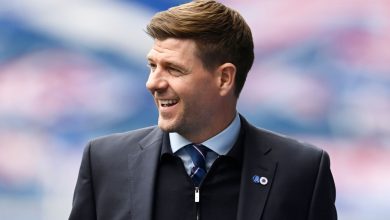
Speculation over potential successors has, remarkably, already begun to surface, despite no indication whatsoever from the club that a managerial change is being considered. Reports note that when previous manager Danny Rohl departed Ibrox, the club’s ownership group, led by chairman Andrew Cavenagh, moved swiftly to identify McInnes as their preferred candidate — but that a meaningful section of the fanbase had hoped instead to see former Rangers head coach Steven Gerrard return to the dugout. Gerrard, according to reporting around that appointment process, held discussions with the club’s American ownership after the exit of Rohl’s predecessor Russell Martin, but ultimately felt the timing wasn’t right for a second spell at Ibrox.
With pressure now mounting on McInnes so soon into his tenure, Gerrard’s name has resurfaced in fan and media speculation as a potential alternative, should results fail to improve. Adding fuel to that speculation is the well-documented willingness of Cavenagh’s ownership group to act decisively on managerial matters — Russell Martin’s own dismissal the previous season is being cited directly as evidence that the current hierarchy won’t hesitate to make a change if confidence in a manager erodes sufficiently.
Amid the broader fallout, there was also a smaller, more procedural story running in parallel, with the Scottish transfer deadline fast approaching. Asked for an update on Nico Raskin’s situation, given continued transfer speculation surrounding the midfielder, McInnes said there had been no actual offers for the player as of matchday, just a number of ongoing conversations whose specifics he wasn’t fully across. He acknowledged the situation could change but stressed he hadn’t heard anything concrete before kickoff in Jablonec.
Pressed on whether Rangers had missed Raskin’s experience and composure specifically during the tie, McInnes conceded that any side would miss a player of his caliber, and admitted Rangers had lacked a degree of midfield experience at various points. But he was careful to separate that admission from any suggestion it explained the defeat, insisting the result could not be attributed to any single player’s continued presence — or absence — within the group.
The immediate consequence of Thursday’s result is stark in its simplicity: Rangers now have no European football to sustain them through the remainder of the calendar year, leaving the Scottish Premiership and domestic cup competitions as the club’s sole focus for the season ahead. That absence carries real financial weight, given how continental broadcast revenue and prize money contribute to a club’s overall budget, and real squad-management consequences too, given how European fixtures typically allow a manager to rotate personnel, manage player workloads, and build depth and cohesion through additional competitive minutes.
Without that outlet, the entirety of the scrutiny that might otherwise have been spread across a longer, more varied season now concentrates squarely on the league campaign — a campaign that has, by the club’s own recent form, started disappointingly, with a draw and a defeat opening the account, and a serious injury to top scorer Youssef Chermiti compounding the club’s early-season problems.
Rangers’ response arrives quickly, with a trip to Aberdeen — the club where McInnes built his managerial reputation over nearly eight years — offering the first real opportunity to arrest the slide, integrate the summer’s raft of new arrivals, and offer supporters some tangible reassurance that Thursday’s performance in Bohemia represented an aberration rather than a genuine indication of where this rebuilt Rangers squad currently stands. Given the scale of investment already committed in the transfer market this summer, and the swiftly escalating external pressure now surrounding the manager himself, the margin for further disappointment appears to be narrowing fast.