Camilo Duran Should Face a Retrospective Ban as Old Firm Footage of the Raskin Clash Goes Viral


Some incidents take days to build. Others are obvious the moment they happen and simply need the rest of the football world to catch up. The clash between Camilo Duran and Nicolas Raskin inside the opening seconds of Sunday’s Old Firm derby belongs firmly in the second category. It happened almost before the match had properly started, referee John Beaton appeared to spot it in real time, and yet somehow nothing came of it. Now, with slowed-down footage doing the rounds on social media, the argument for retrospective action looks harder to ignore than it did in the moment.
This is the case for why Camilo Duran should be facing a Scottish FA charge in the coming days — and why the fact that he currently isn’t says something uncomfortable about how the authorities handle these moments when they happen fast, early, and without an obvious goal or penalty attached to them.
Rangers won 1-0 at Celtic Park on Sunday, Ryan Naderi’s first-half strike proving decisive in what was Rangers’ second Old Firm success in the space of a week, following the 3-0 League Cup win at Ibrox. It was a bruising, feisty afternoon from the very first whistle, and referee John Beaton had his hands full almost immediately — he felt compelled to caution Rangers boss Derek McInnes inside the first couple of minutes, a sign of just how combustible the atmosphere at Parkhead was from kick-off.
But the incident that deserves the most scrutiny came even before that. Within seconds of the game starting, Duran appeared to disguise an attempt to hurt Raskin. As the Belgian midfielder tried to clear the ball, Duran jumped to block it — but rather than simply contesting for the ball in the air, he kicked out at Raskin on the way down. It had the look of a challenge dressed up as an accident: the jump gave it cover, but the follow-through told a different story
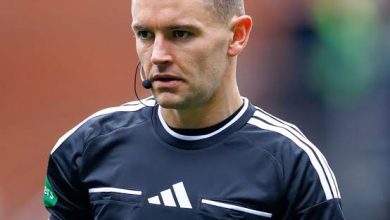
Beaton, to his credit, appeared to spot that something had happened. He stopped play immediately and went over to speak to both players. That in itself tells you the officials were not oblivious to the incident — this wasn’t a case of the referee’s eyes being elsewhere while a genuinely borderline moment slipped past unnoticed. He saw enough to intervene. And having intervened, having stopped the game specifically to address it, he chose not to take Duran’s name. No yellow card. No red card. Play simply resumed as though a conversation, rather than a genuine flashpoint, had taken place
This is the crux of the issue. There’s a version of this incident where Beaton never noticed it at all — where the ball was in the air, the challenge happened fast, and the officials can reasonably claim they didn’t have a clear enough view in real time to make a call. That would be forgivable. Referees miss things. It happens in every match, in every league, at every level of the game.
But that isn’t what happened here. Beaton stopped the game. He walked over. He spoke to Duran and Raskin directly. Whatever he saw in that moment was enough to make him intervene in the middle of an Old Firm derby’s opening seconds — which is not a decision any referee takes lightly, given how quickly stopping play in a fixture like this can shift the emotional temperature of the whole afternoon. Having made that judgement call to stop the game, the logical follow-through should have been a card. Instead, nothing. He effectively acknowledged something had occurred and then declined to act on it.
That is a harder pattern to defend than simple oversight, because it suggests the officials weighed the incident and consciously decided it didn’t merit punishment — a judgement that now looks increasingly shaky the more the footage circu
This is also where the video assistant referee bears real responsibility. Unlike some of the more technical, marginal officiating debates that dominate discussion after matches like this — offside lines, handball interpretations, whether a tackle was reckless enough for a caution — this is exactly the kind of incident VAR exists to catch. A player appearing to use an aerial challenge as cover to kick out at an opponent, in the opening seconds of the biggest match of the season, with the referee already having stopped play to look into it, is about as clear a candidate for a VAR review as you’ll find.
Instead, nothing happened. No pitch-side monitor review. No recommendation to upgrade the incident to a card. The video official watched the same passage of play that is now generating outrage online and apparently saw nothing worth flagging. With the footage now doing the rounds on social media and getting slowed down, freeze-framed and picked apart from multiple angles, it’s clear that Beaton and VAR both had every opportunity to act and let the moment slide instead.
That is precisely the kind of failure that retrospective panels exist to correct. If the system missed it in real time — for whatever reason, whether genuine misjudgement or simple reluctance to send an early flashpoint spiralling into a red card inside the opening minute of a derby — the retrospective process is supposed to be the safety net that catches what live officiating didn’t.
It would be one thing if this were an isolated slip in an otherwise flawless refereeing performance. It wasn’t. Beaton’s afternoon was littered with contentious calls, and several of them cut in Rangers’ direction rather than Celtic’s, which makes it harder to write off the Duran incident as part of some broader pattern of bias in either direction — this was simply an afternoon where the officiating, across the board, didn’t hold up to scrutiny.
Emmanuel Fernandez, booked in the fourth minute for a foul on Duran, went on to escape a second yellow card — and by extension a red card — for a challenge on Benjamin Nygren just twelve minutes later, a decision that has already drawn strong criticism from multiple former top-flight referees. Min-Su Kim was also punished, seemingly for the crime of being struck in the face by an opponent, another decision that raised eyebrows given the direction of contact.
Taken individually, any one of these moments might be written off as the kind of split-second misjudgement that happens in every fast-moving, high-stakes match. Taken together, they paint a picture of a referee who struggled to keep control of the finer details in a fixture that, by its nature, gives him almost no margin for error. The Duran incident stands out from that list specifically because it’s the one where the referee’s own actions — stopping play, walking over, engaging directly with both players — suggest he recognised something needed addressing and then chose the lightest possible response available to him: none at all.
It’s also worth setting this alongside how the afternoon unfolded for Rangers’ own management. McInnes was cautioned within the opening minutes for his reaction to decisions unfolding around his own team, and by full time he had every reason to feel his frustrations throughout the match had gone unheard, while a genuine flashpoint involving an opponent kicking out at one of his players in the game’s very first passage of play produced no sanction whatsoever. Rather than the officials engaging constructively with a manager whose complaints, on this evidence, had real substance behind them, his outburst was itself the thing that drew punishment.
That’s the uncomfortable double standard sitting at the heart of this story. A manager reacting audibly to a missed flashpoint gets carded. The player who created the flashpoint in the first place does not. It’s not hard to see why that combination leaves a sour taste, regardless of which end of the Old Firm rivalry you sit on.
None of this is to suggest Duran should be treated as some kind of repeat offender or that this incident defines his season. It’s a single moment, early in a highly charged match, and these things happen in derbies more often than anyone would like. But the entire point of a retrospective disciplinary process is that it exists precisely for situations like this one — where the emotion, speed and pressure of live officiating in the biggest fixture of the calendar can cause things to be missed or under-punished in real time, and where cooler, slower review afterwards is supposed to correct the record.
If the Scottish FA and head of refereeing Willie Collum are serious about using the retrospective process to maintain standards and deter violent conduct — rather than reserving it only for the incidents that are impossible to avoid addressing — then this is exactly the kind of case that should result in action. A three-match ban would not be an outlandish outcome given what the footage appears to show: a deliberate, if quick and disguised, act of kicking out at an opponent, spotted by the referee in real time, and then allowed to pass without consequence.
The alternative — quietly letting this one disappear from the news cycle over the coming days, as these things sometimes do once the next round of fixtures arrives — would send its own message. It would suggest that as long as an incident happens fast enough, early enough, and without an obvious clear goalscoring opportunity attached to it, the retrospective process simply won’t engage with it, no matter how clearly it shows up once the cameras slo
This isn’t just a Rangers-versus-Celtic argument, however it might read given who’s on which side of the incident. It’s a question about consistency in how Scottish football’s disciplinary bodies apply their own tools. The retrospective ban process exists, has been used before in Old Firm contexts, and has real teeth when the SFA chooses to use them. The test now is whether an incident that ticks every box — a real physical act, disguised as an accident, spotted live by the referee, ignored by VAR, and now circulating widely on video — gets the same treatment as past cases that met a similar bar.
Rangers fans, understandably, remain frustrated with how Sunday’s officiating unfolded across multiple incidents, and this one arguably sits at the top of that list precisely because of how avoidable it should have been to punish. The referee saw it. He stopped the game for it. And then he let it go.
Whether the Scottish FA agrees, and whether Duran ends up facing the charge this incident appears to warrant, will say plenty about how seriously the retrospective process is actually applied when the moment in question happens in the opening seconds of a match rather than its most-replayed highlight. For now, the noise around this one is unlikely to fade quickly. The footage is out there, it is clear, and it deserves more than a shrug and a conversation on the pitch that led nowhere.