Danny reveaked the readon he wants to leave Rangers, you need to hear this before you judge him, with his explanation he is right

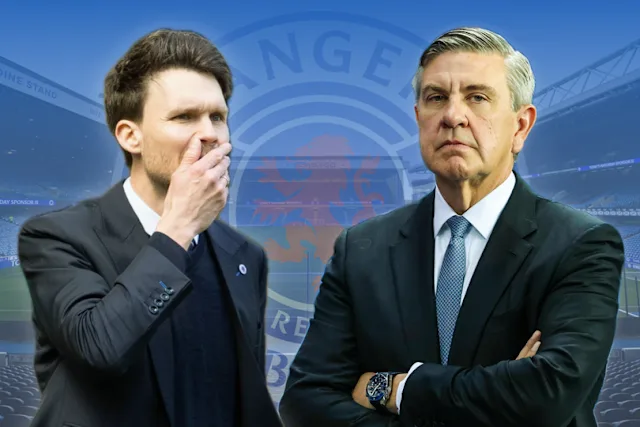
Danny Rohl’s future at Rangers has suddenly become one of the most explosive talking points in Scottish football, with reports now suggesting that the German coach is in active discussions over a potential move to RB Salzburg. What was meant to be a period of stability and long-term planning at Ibrox has been thrown into uncertainty, as one of Europe’s most structured football networks begins to circle the Rangers manager with serious intent.
Rohl arrived at Rangers in October after replacing Russell Martin, stepping into a difficult situation where expectations were high but consistency was lacking. His appointment was seen as a shift towards a more modern, high-intensity style of football, built on pressing, tactical organisation, and improved squad discipline. Early signs were encouraging, with Rangers gradually improving results and climbing back into title contention after a shaky start to the campaign.
For a brief period, belief returned to Ibrox. The team looked more structured, more energetic, and more confident in big matches. Supporters began to see a clear identity forming under Rohl, something that had been missing during previous managerial spells. However, football seasons are rarely judged on early progress alone, and the final stretch of the campaign told a more complicated story.
As the title race reached its decisive phase, Rangers’ form collapsed at the worst possible time. A series of damaging defeats saw them lose momentum completely, and the gap between themselves and Celtic widened again. By the end of the season, Rangers had finished 10 points behind their Old Firm rivals, a margin that reflected both inconsistency and missed opportunities during crucial matches.
The disappointment was not limited to the league. In the Scottish Cup, Rangers were knocked out on penalties in the quarter-finals by Celtic, a result that added further frustration to a season that had promised much but ultimately delivered too little in terms of silverware. That exit, combined with the league finish, reignited debate among supporters about whether the club was truly progressing under Rohl’s leadership or simply experiencing another temporary improvement before regression.
Despite the criticism from sections of the fanbase, Rangers’ hierarchy publicly backed the manager. Chairman Andrew Cavenagh made it clear that the club believed Rohl remained the right man to lead the project forward. The message from the board was one of patience and long-term planning, with emphasis placed on pre-season preparation, squad rebuilding, and establishing stronger leadership within the dressing room.
The intention was to give Rohl time to shape the squad according to his philosophy, rather than making reactive decisions based on short-term results. However, just as that stability appeared to be taking hold, external interest has emerged that threatens to disrupt the entire process.
Reports from Germany now claim that RB Salzburg are actively pursuing Rohl as their next head coach. The Austrian club, part of the wider Red Bull football network, are said to be in discussions with Rangers over the possibility of bringing him in to replace their outgoing manager. Salzburg’s interest is not casual or speculative; it is understood to be part of a structured search for a coach who fits their high-pressing, development-focused model.
This is where Rohl becomes a particularly attractive candidate. Long before his arrival in Scotland, he built his coaching reputation within the Red Bull system. He worked closely with Ralph Hasenhüttl at RB Leipzig, serving as an assistant and developing a deep understanding of the tactical principles that define Red Bull football. Those principles emphasise intensity, vertical attacking transitions, aggressive pressing, and strong collective organisation without the ball.
He later followed Hasenhüttl to Southampton in the Premier League, gaining further experience in English football and adapting those ideas to a different competitive environment. That exposure to multiple leagues and tactical systems has strengthened his reputation as a modern coach capable of working in different football cultures.
Before stepping into senior management, Rohl also worked alongside Hansi Flick at Bayern Munich and with the German national team setup. Those roles added another layer to his development, exposing him to elite-level coaching environments where tactical precision and player management are critical. By the time he took his first managerial role with Sheffield Wednesday in 2023, he was already viewed as one of the more promising young coaches in European football.
His journey made him a natural fit for Rangers at a time when the club was trying to modernise its football identity. The expectation was not just to win matches, but to build a more coherent style of play that could compete consistently with Celtic and perform better in European competition.
However, success in football management is rarely linear. Even though Rohl managed to pull Rangers back into contention during the season, the inability to sustain form during the final months raised questions about squad depth, mentality, and tactical flexibility. Critics pointed to the team’s fragility in key moments, particularly in high-pressure matches where results mattered most.
Those concerns have not gone unnoticed, and they form part of the wider debate now happening around his future. While the club hierarchy continues to support him publicly, the emergence of RB Salzburg has added a new layer of uncertainty that Rangers did not anticipate at this stage of their rebuild.
Salzburg’s interest is also shaped by their own recent struggles. The Austrian champions have experienced a rare dip in dominance, finishing below expectations domestically and underperforming in European competition. For a club built on developing young talent and maintaining tactical superiority in their league, such a decline has triggered urgency in their recruitment strategy.
The coaching appointment is central to that reset. Salzburg require someone who understands their system, can implement it quickly, and restore their identity as one of Europe’s most efficient development clubs. Rohl’s background within the Red Bull structure makes him a logical and appealing option.
From Rangers’ perspective, however, the timing could not be worse. Losing a manager just as he prepares for his first full pre-season would represent a significant disruption. The upcoming transfer window, squad restructuring, and tactical refinement were all planned around giving Rohl a stable platform to build on his first season.
Now, instead of focusing purely on recruitment and preparation, the club may have to consider contingency planning in case negotiations with Salzburg progress further. Even if Rohl ultimately stays, the speculation alone can create distraction at a crucial stage of the summer rebuild.
Supporters are already divided. Some believe the manager should be given more time, pointing to the early improvements in style and structure as evidence that progress is being made. Others argue that the late-season collapse exposed deeper issues that may not be solved quickly enough to satisfy the demands of the club.
What makes this situation more complex is that Rohl himself has not publicly indicated any desire to leave Rangers. There is no confirmed request for a move, and no official agreement between the clubs. At this stage, the situation remains speculative but active, driven by Salzburg’s search and Rohl’s growing reputation within European coaching circles.
The connection between the clubs also adds intrigue. Red Bull’s football network has expanded significantly over the years, linking Salzburg with Leipzig and other clubs in a shared tactical and recruitment philosophy. While Rangers are not part of that structure, the influence of modern ownership groups and football consultancy networks means managers often move within overlapping professional ecosystems.
For Rohl, the decision—if it becomes concrete—would be a defining moment in his career. Staying at Rangers would allow him to continue building a long-term project in one of the most intense football environments in Europe, where pressure is constant and expectations are extremely high. Moving to Salzburg, however, would place him back inside a familiar system where development pathways, tactical identity, and club structure are tightly aligned.
Both options carry advantages and risks. At Rangers, he has the chance to become a long-term figure in Scottish football history if he succeeds in breaking Celtic’s dominance. At Salzburg, he would enter a club designed for coaching progression, European exposure, and systematic football development.
For now, Rangers will hope that their public backing of the manager is enough to keep him focused on the job at hand. Salzburg will continue evaluating their options, and discussions may develop further as the summer window approaches.
What is already clear, however, is that Danny Rohl’s name is now firmly embedded in one of the summer’s emerging managerial stories. Whether he remains at Ibrox or not, his work has attracted attention beyond Scotland, and that alone reflects the progress he has made in a short period of time.
The coming weeks will determine whether this is simply transfer speculation or the beginning of a major managerial change that could reshape both Rangers’ rebuild and Salzburg’s future direction.