‘Everything I Have Become, I Owe To Partizan’: Inside Vanja Dragojevic’s Emotional Move To Rangers


There is a particular kind of transfer story that goes beyond fees, release clauses and negotiating leverage, and becomes instead a story about a young footballer closing one chapter of his life to begin another. Vanja Dragojevic’s move from Partizan Belgrade to Rangers is exactly that kind of story. Beneath the confirmation that he has become Derek McInnes’s seventh signing of a transformative summer at Ibrox lies a more personal narrative: a 20-year-old who rose from academy prospect to club captain in the space of a few short years, and who leaves his boyhood club with words that read less like a standard transfer statement and more like a genuine outpouring of gratitude.
In his farewell message, Dragojevic credited the club with shaping almost everything about him as a footballer, describing his path from wide-eyed academy kid to captain as a journey he would treasure for the rest of his life.
It is a rare thing in modern football for a transfer announcement to carry that kind of emotional weight, and it speaks to just how deeply embedded Dragojevic was within the fabric of Partizan Belgrade before Rangers came calling. Understanding why that farewell resonates so strongly requires looking back at the journey that brought him to this point, and forward at exactly what Rangers hope he can bring to Ibrox as they push to end their wait for a first Scottish title since 2021.
Signing Number Seven, And A Very Specific Profile
Dragojevic’s arrival takes McInnes’s incoming business to seven signings across a single, remarkably busy summer window. He joins a list that already includes Lawrence Shankland, Ross McCrorie, Ben Godfrey, Ivor Pandur, Dan Neil and Cammy Devlin, an intake that has touched almost every area of the pitch — a new centre-forward, defensive reinforcements, a new option in goal, and fresh competition in central midfield. The Serbian’s arrival, on a four-year deal with the option of an additional year, is subject to international clearance and a successful visa application, standard conditions for any overseas transfer but ones that will need to be resolved quickly given how close the new season now is.
What makes Dragojevic stand out among that group is not simply his ability but his profile as a leader. McInnes has been explicit, both in this deal and in the broader shape of his rebuild, about wanting leaders scattered throughout his squad rather than concentrated in one or two senior professionals. Awarding the Partizan captaincy at just 19 years old ticks that box in emphatic fashion, and it is clear from the language used around the signing that leadership character, every bit as much as footballing ability, was central to Rangers’ pursuit of him.
McInnes did not hide his enthusiasm upon completing the deal, saying he was excited to bring the midfielder on board. The manager went on to argue that captaining a club the size of Partizan at such a young age was itself proof of the respect and leadership qualities Dragojevic already carried, and said he was looking forward to working with him over the years ahead.
That closing sentiment — a look forward to years of working together, rather than simply excitement about the season ahead — hints at the scale of Rangers’ long-term planning around this signing. A four-year contract, with the option of a fifth, is not the profile of a stopgap addition; it is a statement that Rangers see Dragojevic as a foundational piece of the midfield for the remainder of the decade.
The Making Of A Teenage Captain
To understand how a 19-year-old comes to be trusted with the captaincy of a club as historic and demanding as Partizan Belgrade, it helps to trace the speed of his rise through the ranks. Dragojevic came through Partizan’s youth system before making his first-team debut in 2024, a debut that followed a brief loan spell at Serbian second-tier side FK Teleoptik. That loan move, while short, appears to have played an important developmental role; Dragojevic impressed enough during his time away that Partizan moved swiftly to recall him, unwilling to leave a player of his emerging quality outside the first-team picture for long.
From there, his ascent was rapid. He became a regular fixture in Partizan’s side, and by last season — still only 19 or 20 depending on the exact point in the campaign — he was wearing the captain’s armband, making 41 appearances across all competitions in the process. That is an extraordinary level of trust to place in a player so young, particularly at a club with the history, expectation and passionate fanbase that Partizan carries in Serbian football. Captaincy at a club of that stature is not handed out lightly, and Dragojevic’s case suggests a player whose maturity and standing among teammates had already outstripped his years well before Rangers’ interest became public.
His performances did not go unnoticed at international level either. Serbia national team boss Veljko Paunovic handed Dragojevic his first of two international caps in a fixture against Cape Verde in March, recognition that placed him firmly on the international stage as one of his country’s most promising young midfield talents. For a defensive-minded midfielder still in his teens to be trusted both with a first-team captaincy at club level and full international recognition inside the same period is a rare double, and it is precisely that combination — leadership, discipline, and a level of composure well beyond his years — that persuaded Rangers to pursue him so determinedly across the summer.
Serbia’s national set-up has, in recent years, developed a reputation for identifying and fast-tracking young midfield talent, and Dragojevic’s introduction to the senior squad fits that pattern. He is understood to have progressed through Serbia’s youth international age groups before earning his senior recognition, a conventional pathway that nonetheless underlines how consistently he has been rated by coaches at every level he has represented, whether at club or country. That international dimension also matters for Rangers in a practical sense: it is one of the conditions attached to finalising his move to Ibrox, with international clearance required before he can be registered to play, a process that typically involves confirmation from both the Scottish and Serbian football authorities that the transfer meets the relevant regulatory requirements for a cross-border move of this kind.
Serbian Football’s Pressure-Cooker Environment
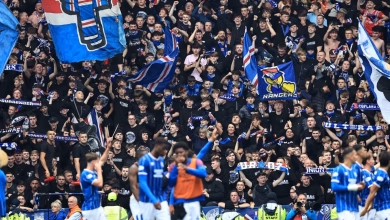
It is worth dwelling, too, on the environment Dragojevic is leaving behind, because it goes some way to explaining why Rangers rate his temperament so highly. Partizan Belgrade is one half of Serbia’s fiercest football rivalry, alongside city rivals Red Star Belgrade, and matches between the two are notorious even by the standards of European football’s most heated derbies. Playing regularly, and eventually captaining a side, in that kind of atmosphere from such a young age is not a normal footballing apprenticeship; it is a trial by fire that either overwhelms young players or accelerates their development at a pace few academies elsewhere in Europe can replicate.
Dragojevic evidently belongs to the latter category. Being handed the captaincy inside a fixture list that includes Belgrade derbies, continental qualifying ties against sides like Hibernian, and the day-to-day scrutiny of one of the Balkans’ most demanding fan cultures suggests a player who has already been tested in ways that many of his contemporaries in Western European academies simply have not. Rangers, a club whose own fixture list against Celtic carries similarly intense scrutiny and expectation, will hope that background proves to be ideal preparation rather than a culture shock.
A Mentality Match, Three Months In The Making
For all the emphasis on leadership and character, Dragojevic’s own explanation for why he chose Rangers offers perhaps the clearest insight into what drew him to Ibrox specifically, rather than any of the other clubs reportedly monitoring his situation across the summer. Speaking after his move was confirmed, he reflected on how long he had been tracking Rangers’ interest and what it meant to him once he learned of it.
He described feeling proud and excited to join a club of Rangers’ size, and explained that he had first learned of Ibrox’s interest around three months earlier — and was drawn to it instantly because he felt a “winning mentality” defined both Rangers and himself.
That phrase — a winning mentality compatible with his own — is a telling one. It suggests a player who, having captained Partizan through a season in which the club ultimately finished third in the SuperLiga and fell short domestically, was drawn to Rangers not for the size of the transfer fee or the profile of Scottish football relative to other European leagues he could plausibly have joined, but specifically because of the competitive identity and expectation that comes with representing a club of Rangers’ history. Given the frustration among the Ibrox support over recent seasons without a league title, that framing will resonate strongly with supporters hoping their new midfielder arrives with precisely the mentality needed to help end that wait.
The three-month timeline he references also confirms what had been suggested by the pace and persistence of Rangers’ pursuit throughout the negotiation: this was not a deal born of a sudden opportunity or a rival’s collapsed bid, but a long-tracked target that Rangers pursued patiently and consistently from the early stages of the summer window through to a fee finally being agreed with Partizan.
A Farewell Written From The Heart
If Dragojevic’s comments about joining Rangers speak to ambition and competitive hunger, his farewell message to Partizan speaks to something altogether different: genuine sentiment for the club that shaped him. Having spent five years at the Belgrade giants, working his way from academy prospect through a brief loan spell and into the first team before ultimately being entrusted with the captaincy, Dragojevic’s departure represents the end of the only senior footballing home he has ever known.
His words to Partizan supporters and staff were unambiguous in their warmth, tracing a personal arc from the young boy who first pulled on the club’s colours through to the captain trusted with leading it, and insisting that every step of that journey would stay with him for good.
It is worth pausing on what that farewell represents in the context of Serbian football culture specifically. Partizan is one of the two dominant forces in Serbian football, a club with an intensely passionate and demanding fanbase, and captaining such a club as a teenager is the kind of achievement that shapes a player’s identity for life, regardless of where his career takes him afterwards. Dragojevic’s message suggests a player fully aware of the significance of what he is leaving behind, even as he embraces the new opportunity in front of him. For Rangers supporters, it is also a reassuring signal about the character of the player walking through the Ibrox doors: someone capable of forming deep loyalty and connection to a club, exactly the kind of emotional investment McInnes will hope Dragojevic can eventually build with Rangers too.
Fitting Into A Squad Nearing Its Final Shape
Dragojevic’s arrival comes at a pointed moment in Rangers’ pre-season calendar. The Light Blues have their final pre-season friendly of the summer against West Ham United at Ibrox, before the serious business of the Scottish Premiership campaign begins away to Dundee United at Tannadice. That represents a tight turnaround for a new signing needing international clearance and a visa application processed before he can be registered and, in time, considered for selection, but it does at least offer the possibility of Dragojevic getting some minutes and time around his new teammates before a ball is kicked competitively.
McInnes, for his part, has made clear he is not finished shaping his squad even with seven signings already across the line. The Rangers boss is understood to be hopeful of bringing in a couple more additions before the season gets under way, an indication that the volume of turnover seen already this summer — six signings made by McInnes since taking over as manager last month, with Dragojevic becoming the seventh overall alongside earlier arrivals — is not necessarily at its conclusion. Precisely where those further additions might come remains to be seen, though wide areas and further defensive cover have both been reported as priorities as the window enters its final weeks.
What is clear is that Dragojevic slots into a Rangers midfield that has been substantially reshaped this summer. Alongside Dan Neil and Cammy Devlin, both signed on free transfers, McInnes now has genuine strength in depth and variety in central areas: experienced, Championship-tested composure in Neil and Devlin, and now a young, defensively disciplined leader with an already outsized reputation for maturity in Dragojevic. How the trio, plus any further incoming additions, are ultimately deployed together will be one of the more interesting tactical questions for McInnes to answer as pre-season progresses into the opening weeks of the Premiership campaign.
The Weight Of Expectation At Ibrox
There is no understating the scale of what is being asked of a 20-year-old arriving in a foreign country, adjusting to a new league, a new dressing room and, in all likelihood, a significant role within a heavily rebuilt squad, all while Rangers supporters watch on with heightened expectation after a summer of substantial investment. Rangers’ recent seasons have been defined by frustration — a third-place finish last time out, and a title drought stretching back to 2021 — and the sheer scale of this summer’s turnover under new ownership and a new management team means anything short of a serious challenge for silverware is likely to be viewed as a missed opportunity.
Yet everything about Dragojevic’s rise so far suggests a player who thrives precisely in moments where more is asked of him than his years would typically warrant. A rapid recall from a third-tier loan spell, a first-team debut inside months of that recall, a captaincy handed to him as a teenager at one of Serbian football’s most demanding clubs, and full international recognition soon after — at every stage of his short career, Dragojevic has been entrusted with responsibility beyond his age, and at every stage he has apparently risen to meet it.
Rangers are betting that pattern continues at Ibrox. If it does, McInnes will have not simply added a talented young defensive midfielder to his rebuilt squad, but a genuine leader capable of growing into one of the dressing room’s defining voices over the course of a four or five-year contract — precisely the kind of long-term, character-driven signing that a club attempting to reset its standards after several difficult seasons needs. Dragojevic’s farewell to Partizan showed the world what that kind of loyalty and connection looks like when it is given time to grow. Rangers will now hope to be on the receiving end of exactly the same devotion in the years ahead.