Rangers Complete Vanja Dragojević Deal As Serbian Captain Becomes Seventh Summer Signing


Rangers Football Club have confirmed the signing of midfielder Vanja Dragojević on a four-year contract, closing out a deal that has been on the radar at Ibrox for some time and adding yet another name to what is shaping up to be one of the busiest and most transformative transfer windows the club has conducted in recent memory. The move brings the 20-year-old to Scotland from FK Partizan, where his rise over the past year has been nothing short of remarkable, culminating in him being entrusted with the captaincy of a major Serbian institution at an age when most young footballers are still fighting simply to establish themselves in a first-team squad.
The scale of that achievement shouldn’t be understated. Partizan is not a small club living quietly in the shadows of Serbian football — it’s one of the two dominant forces in the country, a club with history, expectation, and a demanding fanbase that does not tolerate mediocrity from anyone wearing the shirt, let alone the armband. For Dragojević to have been handed that responsibility, and to have made 41 appearances in the role across last season, speaks to a level of maturity and leadership that clubs across Europe will have taken note of. Rangers, evidently, were paying closer attention than most.
Derek McInnes was direct in his praise of the player upon completion of the deal, making specific reference to the leadership question when explaining the club’s interest. He described Dragojević as someone who possesses huge potential and genuinely exciting attributes, but he was careful to stress that the technical qualities alone weren’t what convinced Rangers to pursue the deal. It was the character to play in this environment, as McInnes put it, that stood out — an environment that, at Ibrox, comes with pressures and expectations that few clubs outside the traditional Old Firm bubble can fully replicate. McInnes pointed to the captaincy itself as evidence of exactly the qualities Rangers were looking for, suggesting that captaining a club the size of Partizan at such a young age tells you everything you need to know about the respect he already commands among teammates and the leadership instincts he possesses well ahead of his years.
That’s a notable statement from a manager who has, over the course of this summer, been remarkably active in reshaping his midfield and squad more broadly. Dragojević doesn’t arrive as an isolated addition — he becomes the seventh new face through the door at Ibrox this summer, joining a growing list of recruits that includes goalkeeper Ivor Pandur, defender Ross McCrorie, midfielder Dan Neil, forward Lawrence Shankland, midfielder Cammy Devlin, and defender Ben Godfrey. Taken together, that’s a genuinely significant volume of incoming business, touching almost every area of the pitch — goalkeeping, defence, central midfield, and attack — and it paints a picture of a manager and a recruitment department working with real purpose and clarity of vision rather than simply patching gaps as they emerge.
It’s worth pausing on that list for a moment, because the sheer breadth of it tells its own story about the scale of the rebuild currently underway at Ibrox. Pandur’s arrival addressed long-standing uncertainty between the posts. McCrorie and Godfrey have strengthened options at the back. Neil and Devlin have added competition and depth in central areas. Shankland, arguably the most eye-catching name of the summer prior to this latest deal, was brought in to spearhead the attack with proven goalscoring pedigree. And now Dragojević arrives to further reinforce the midfield, bringing with him not just technical quality but a leadership profile that McInnes clearly values highly as he looks to build a squad capable of both winning silverware domestically and standing up to the unique pressures that come with representing a club of Rangers’ size and history.
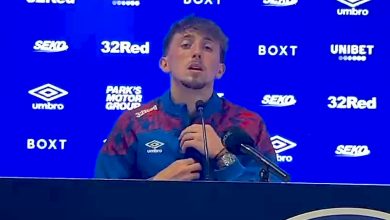
For Dragojević himself, the move represents the kind of opportunity that could define the trajectory of his career. Speaking after the deal was completed, the midfielder didn’t hide his excitement, describing the move as feeling amazing and expressing genuine pride at becoming part of a club with the size and history of Rangers. There was little hesitation or diplomatic caution in his words — this was a player who clearly views the switch not as a step taken out of necessity, but as a genuine opportunity he had been anticipating and hoping for.
Perhaps most interesting was Dragojević’s revelation about the timeline of Rangers’ interest, disclosing that he’d first become aware of the club’s interest as far back as three months ago. That detail matters, because it suggests this wasn’t a deal rushed together in the final scrambling days of the transfer window, nor a reactive move triggered by a departure elsewhere in the squad. Instead, it points to a deal that Rangers had been quietly working on for a considerable period, tracking the player, building relationships, and waiting for the right moment to formalise an approach. In an era of football where transfer business can often feel chaotic and last-minute, that kind of long-term planning reflects well on the recruitment operation McInnes has assembled around him at Ibrox.
Dragojević also touched on something that goes beyond simple career logistics or financial terms — the question of mentality. He explained that as soon as he became aware of Rangers’ interest, it immediately appealed to him because he felt the winning mentality associated with the club aligned closely with his own outlook and approach to the game. That’s a theme that recurs constantly in modern football, where players and clubs alike talk endlessly about mentality, culture fit, and shared values, sometimes to the point where the language becomes almost meaningless through overuse. But in Dragojević’s case, there’s tangible evidence behind the sentiment. This is a player who, by the age of just 20, had already been entrusted with captaining a major club through a demanding season. That’s not the profile of a player simply drawn to a bigger stage for the sake of profile or exposure — it’s the profile of someone who has already demonstrated an appetite for responsibility and pressure, and who evidently sees Rangers as a natural next step in continuing to test himself in that regard.
His international career, while still in its early stages, offers a further glimpse into his trajectory. Dragojević has now earned two caps for Serbia, having made his debut against Cape Verde earlier this year. Two caps is, of course, a modest tally in the grand scheme of a career, but it represents confirmation that his performances at club level have not gone unnoticed at the highest level of Serbian football administration. For a 20-year-old, breaking into full international recognition while simultaneously captaining a major domestic club is a rare combination, and it underlines why Rangers moved to secure his signature on a four-year deal rather than risk losing him to a rival suitor as his stock inevitably continued to rise.
From a broader strategic perspective, this signing also fits neatly into patterns that have become increasingly apparent in how McInnes and his recruitment team have approached the transfer market this summer. There’s been a clear willingness to look toward markets outside the traditional British and Irish pipelines that Scottish clubs have often relied upon, instead identifying talent in leagues like Serbia’s SuperLiga, where technical quality and physical readiness for senior football often come at a fraction of the cost associated with more heavily scouted markets across Western Europe. Dragojević’s arrival continues that trend, following a summer in which Rangers have shown a clear appetite for recruiting players with genuine sell-on potential and technical upside, rather than simply chasing short-term fixes.
The four-year length of the contract is also worth noting. Long-term deals of this nature signal genuine confidence from the club in the player’s long-term development and importance to the project being built under McInnes. It also, from a pure business perspective, protects Rangers’ investment and positions the club well financially, should Dragojević’s progress continue at the trajectory his career has followed thus far. A four-year commitment gives both player and club time to build toward something substantial, without the pressure of an imminent contract situation looming over performances in year one or two.
Of course, deals of this kind always come with an element of risk. Transitioning from Serbian football to the Scottish Premiership, while not necessarily the most dramatic leap in terms of physicality or intensity compared to, say, a move to the Premier League, still represents a significant adjustment — different climate, different football culture, different tactical demands, and, most immediately, the specific pressures that come with representing Rangers in a fixture list dominated by the ever-present shadow of Old Firm expectation. Not every player who arrives with strong references and promising underlying numbers successfully makes that transition. But the early signs, at least in terms of mentality and character, appear to tick the right boxes, and McInnes’ comments suggest a manager who has done his homework thoroughly rather than being seduced purely by reputation or statistical output.
There’s also the matter of squad integration to consider. With Dan Neil and Cammy Devlin both already recruited into central midfield areas this summer, McInnes now has a genuinely competitive central midfield unit to work with, and questions will naturally arise about exactly how these pieces fit together tactically. Whether Dragojević is deployed as a deep-lying playmaker capable of dictating tempo, a more progressive box-to-box option given his leadership profile, or even in a more advanced role depending on how McInnes wants to set up his midfield triangle, remains to be seen. What is clear, however, is that McInnes now has genuine strength in depth and quality of options in that area of the pitch — a stark contrast to previous seasons where injuries or suspensions to key midfielders often left Rangers looking notably thinner through the centre of the park.
The timing of the announcement — with pre-season fixtures already underway and the competitive season fast approaching — suggests Rangers will be eager to integrate Dragojević into the squad as quickly as possible, giving him time to adjust to his new surroundings, build relationships with new teammates, and begin to understand the tactical principles McInnes wants to instil before competitive football resumes in earnest. Whether he’s thrown straight into contention for a starting role or eased in gradually as he adapts to a new league and country will be one of the more interesting subplots to watch as pre-season progresses.
For Rangers supporters, this latest addition will likely be viewed as further evidence of ambition and intent from a club determined to reassert itself domestically after a summer of significant squad turnover. Seven signings in a single window represents substantial investment, both financially and in terms of the scouting and recruitment infrastructure required to identify, negotiate, and complete deals of this nature across multiple positions and multiple markets. It suggests a club operating with clarity of purpose under its new manager, rather than simply reacting to circumstances as they arise.
As for Dragojević himself, the challenge now shifts from securing the move to justifying it. Captaining Partizan earned him admiration and reputation in Serbian football; earning a regular starting role and winning over a notoriously demanding Ibrox support will be an entirely different test. But if his early comments are any indication — his clear excitement, his awareness of the club’s stature, and his articulation of a shared winning mentality — he appears to understand exactly what he’s walking into, and seems genuinely eager to meet that challenge head-on rather than shy away from it.
Rangers’ summer rebuild continues at pace, and with pre-season fixtures offering an early opportunity to see how these new arrivals gel together, attention will now turn to whether McInnes has further business planned before the transfer window closes, or whether the focus shifts toward departures and squad trimming as the manager finalises his group ahead of a season that will be judged, as ever at Ibrox, by trophies rather than promising performances alone.