Ibrox At War: Rangers Push Back Against SFA As Naderi Vows He Won’t Be Anyone’s Understudy

Rangers Football Club finds itself fighting on two fronts this week — one against the game’s governing body, the other being waged quietly in the treatment room and on the training pitch by a player desperate to prove he belongs in Derek McInnes’ starting eleven. As pre-season rumbles on and the new manager continues to shape his squad ahead of the Scottish Premiership return, Ibrox has become the epicentre of two very different but equally revealing storylines: a governance row over crowd disorder and matchday conduct, and a personal statement of intent from a player refusing to be cast as a bit-part performer in his own career.
Both stories, on the surface, seem unconnected. One is administrative, procedural, the kind of dry institutional wrangling that rarely excites supporters beyond a flicker of tribal indignation. The other is deeply personal, the story of a footballer staking his claim. But together they say something important about where Rangers currently stand — a club still finding its identity under a new manager, still negotiating its relationship with authority, and still trying to work out exactly who its best players are and where they fi
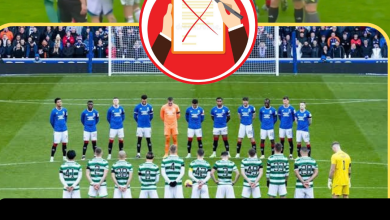
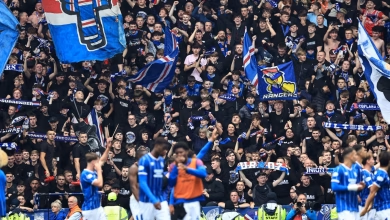
The catalyst for the first storyline is an independent review commissioned by the Scottish FA into the disorder that marred a recent Old Firm fixture between Rangers and Celtic. These reviews have become almost a ritual in Scottish football — commissioned in the aftermath of ugly scenes, greeted with outrage from whichever club feels unfairly targeted, then quietly filed away until the next flashpoint forces the conversation back into the open. This time, though, the findings appear to have struck a particularly raw nerve at Ibrox.
According to reporting from the Glasgow Times, the review concluded that Rangers’ choice of pre-match music — played over the Ibrox tannoy system while away fans from Celtic were already inside the stadium — amounted to what investigators termed a preventable provocation, a failure the club should reasonably have anticipated and avoided. The language used by the reviewers was notably blunt, describing the episode as a basic failure of matchday management rather than an unfortunate oversight. For a club that prides itself on running one of the most well-organised operations in British football, that kind of characterisation stings.
But the SFA review didn’t stop at criticising the playlist. The Daily Record’s coverage indicates that the review went considerably further, calling for a raft of tougher sanctions to be considered, including the closure of specific sections of Ibrox for future fixtures, or in more severe scenarios, closure of the stadium in its entirety. There were also recommendations around reduced ticket allocations for away supporters at future Old Firm fixtures, a measure that would have real financial and logistical consequences not just for Rangers but for Celtic and the wider matchday economy around Glasgow derbies.
Unsurprisingly, Rangers have not taken any of this lying down. The club has publicly disputed the review’s findings, pushing back both against the specific characterisation of the pre-match playlist incident and against the broader tone of the report, which they clearly feel paints the club as the primary instigator of trouble rather than one party among several with responsibility for crowd safety and conduct. Sources close to the club have been vocal in criticising what they see as an uneven application of scrutiny, arguing that Rangers are being asked to answer for atmosphere-related incidents in a way that other clubs simply are not.
This is not a new tension in Scottish football. The relationship between Rangers and the SFA has long been coloured by suspicion on both sides — accusations of bias, selective enforcement, and a sense among Rangers supporters in particular that punishments and investigations tend to fall disproportionately on their club whenever Old Firm fixtures descend into controversy. Whether that perception is fair or not is a debate that has raged in pubs, phone-ins, and social media threads for decades, and this latest review will do nothing to settle it. If anything, it adds fresh fuel to an argument that shows no sign of ever being fully resolved.
What makes this particular episode more serious than the usual post-derby bickering is the practical stakes involved. Section closures, reduced allocations, and potential stadium sanctions are not abstract punishments — they hit revenue, they hit atmosphere, and they hit the very matchday experience that clubs like Rangers spend so much effort cultivating. For a club in the early stages of a rebuild under a new manager, with recruitment plans still being finalised and a squad still being shaped for a title challenge, the last thing Ibrox needs is a governance battle eating into bandwidth, attention, and goodwill.
There’s also a broader question lurking beneath the surface here: what responsibility does a football club actually bear for the behaviour of supporters, some of whom may have no connection to official ticketing channels or club messaging at all? The playlist criticism is a curious detail in this respect — it suggests the review isn’t simply focused on crowd behaviour itself, but on the atmosphere created around it, the conditions a club sets that either inflame or defuse tension. Whether music choices genuinely constitute provocation, or whether this is regulatory overreach dressed up in the language of safety, is exactly the kind of nuance that’s likely to be lost as this story develops in the coming days and weeks.
Rangers will now have to decide how far to push their objection. Do they simply issue statements of disagreement and move on, absorbing whatever sanctions eventually materialise? Or do they pursue a more formal challenge, potentially escalating the dispute through appeal processes that could drag the story out over months? Given the club’s evident frustration with the tone of the review, a quiet acceptance seems unlikely. Expect further statements, further pushback, and quite possibly further friction between Ibrox and Hampden Park before this saga reaches any kind of resolution
While boardroom tensions simmer over SFA findings, a very different kind of statement has been emerging from within the Rangers dressing room — this one from forward Ryan Naderi, who has used pre-season interviews to make unmistakably clear that he has no intention of playing a supporting role this campaign.
Speaking to the Daily Record, Naderi delivered a pointed message about his ambitions under Derek McInnes, insisting that he is at Rangers to start matches, not simply to make up the numbers behind the club’s more established attacking options. He explicitly referenced his intention to challenge both Lawrence Shankland and Youssef Chermiti for a place in McInnes’ preferred front line, naming both players directly rather than offering the kind of diplomatic, non-committal answer that so many footballers reach for when discussing internal competition for places.
It’s a notably confident position for Naderi to stake out, particularly given the profile of the players he’s naming as rivals. Shankland arrived at Ibrox with a considerable reputation and goalscoring pedigree from his time in the Championship, immediately installed as one of the headline additions of the summer rebuild. Chermiti, similarly, represents a significant investment in the forward line, the kind of player a club doesn’t recruit intending to leave on the bench. For Naderi to publicly declare his intention to displace either of them — or both — is a bold move, the sort of statement that either signals genuine self-belief backed by what he’s shown in training, or risks looking presumptuous if his performances don’t match his words once competitive fixtures begin.
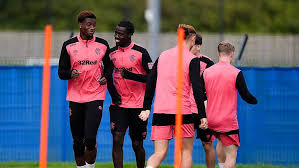
Context matters here, though. Naderi’s comments weren’t made in isolation — they came alongside praise for how Derek McInnes has approached pre-season more broadly. According to the same Daily Record report, Naderi described McInnes as someone who has successfully blended authority with humour during the early weeks of pre-season training, striking a tone that has helped build genuine chemistry within the squad while simultaneously reminding players — in no uncertain terms — exactly what the club and its supporters expect from anyone who pulls on the jersey.
That combination is worth dwelling on, because it speaks to something Rangers have arguably lacked in recent managerial regimes: a coach capable of being both approachable and demanding without those two qualities cancelling each other out. Too often in football, managers are painted in binary terms — either the stern disciplinarian who commands respect through fear, or the players’ favourite who struggles to enforce standards when it matters. Naderi’s description of McInnes suggests something more nuanced: a manager who can crack a joke in training on Tuesday and then deliver an uncompromising message about standards on Wednesday, without either undermining the other.
For a player like Naderi, operating in a genuinely competitive environment where his place is anything but guaranteed, that kind of managerial tone matters enormously. A manager who fosters humour and camaraderie creates space for players to express themselves, to take risks, to compete for places without the atmosphere curdling into toxic rivalry. But a manager who also reinforces the non-negotiable standards of representing a club like Rangers ensures that competition doesn’t come at the expense of collective discipline. If Naderi’s read on McInnes is accurate — and it’s worth remembering this is one player’s perspective, offered in the context of pre-season goodwill — it bodes well for how the forward line battle is likely to play out over the coming weeks.
Perhaps the most striking element of Naderi’s comments, and the detail most likely to resonate with supporters and headline writers alike, is his refusal to accept the framing of himself as what he described as a third wheel within the attacking unit. It’s a phrase loaded with meaning — evoking the image of someone tolerated but not essential, present but not truly wanted, hovering on the periphery of a partnership that functions perfectly well without him.
By rejecting that characterisation outright, Naderi isn’t just expressing frustration at a hypothetical scenario — he’s pre-emptively rejecting the narrative that might otherwise attach itself to him once Shankland and Chermiti’s partnership begins generating goals and headlines. It’s a smart piece of positioning in some ways. Rather than waiting to see how the pecking order shakes out and potentially having “squad player” or “rotation option” labels applied to him by pundits and supporters, Naderi has gotten ahead of that narrative, publicly declaring his refusal to accept a diminished role before a ball has even been kicked in anger.
Whether words translate into minutes on the pitch remains to be seen, of course. McInnes will ultimately make his selection decisions based on what he sees in training and in match situations, not on pre-season quotes given to newspapers. But there’s real value, both psychologically and in terms of setting a competitive tone within the squad, in a player publicly refusing to accept a subordinate role. It sends a message not just to the manager but to his attacking rivals — that whatever combination McInnes eventually settles on, Naderi intends to make that decision as difficult as possible.
Rangers’ pre-season programme has continued to offer glimpses of where McInnes’ thinking currently sits, with St Etienne visiting Ibrox for a friendly that offered fans their first look at the new manager’s side in a home fixture. Rangers came through the match with a 2-1 victory, a result that, while ultimately just a pre-season exercise, will have offered McInnes valuable information about combinations, fitness levels, and the early shape of his attacking options — including, potentially, further evidence relevant to exactly the kind of competition Naderi has been talking about.
With West Ham United up next on the pre-season schedule, McInnes has limited time remaining to finalise his thinking before competitive football resumes. Every training session and every minute of pre-season action between now and the start of the league campaign effectively doubles as an audition for players like Naderi, hoping to translate bold public statements into genuine tactical trust from their manager.
It would be easy to treat these two stories as entirely separate — one a boardroom and governance issue, the other a straightforward football matter about squad depth and player ambition. But both, in their own way, speak to the same underlying theme: Rangers as a club still working out its identity and standing, both in relation to the football authorities that govern the game in Scotland and in relation to the internal hierarchy of its own dressing room.
The SFA dispute is about respect, fairness, and the terms on which Rangers are willing to operate within the structures of Scottish football. The Naderi situation is about respect and fairness of a different kind — a player demanding to be judged on merit rather than accepted reputation, refusing to quietly accept a role assigned to him by external perception rather than earned through performance.
Derek McInnes, now several weeks into his tenure, finds himself managing both dynamics simultaneously. Externally, he’ll likely be expected to offer measured support to his club’s position on the SFA review without escalating tensions further than necessary. Internally, he’ll need to manage a genuinely competitive forward line without allowing ambition and frustration to curdle into dressing room discord — while also extracting maximum value from having multiple credible attacking options fighting for the same shirts.
If McInnes can strike that balance, Rangers may well benefit from exactly the kind of healthy internal competition that top-performing squads thrive on. Get the balance wrong, and unresolved tension — whether from a player who feels overlooked or a club that feels persecuted by its own governing body — has the potential to become a distraction Rangers can ill afford as they attempt to mount a serious challenge domestically this season.
For now, both stories remain unresolved. The SFA review dispute will likely rumble on through statements, potential appeals, and continued scrutiny of Ibrox matchday operations. Naderi’s battle for a starting spot will be settled the old-fashioned way — through performances, in training and eventually in competitive fixtures, as McInnes builds towards the season opener. Supporters will be watching both developments closely, aware that how Rangers navigate this moment — administratively and on the pitch — could set the tone for the entire campaign ahead