He scores goals he’s a killer in the box but I saw myself more all-round, I like to play with the ball. He doesn’t do more than he’s able to do.” 🗣️ “I saw an interview with him where he My dream is to touch two balls, score three goals.’ 😅 Would you take Haaland over Zlatan

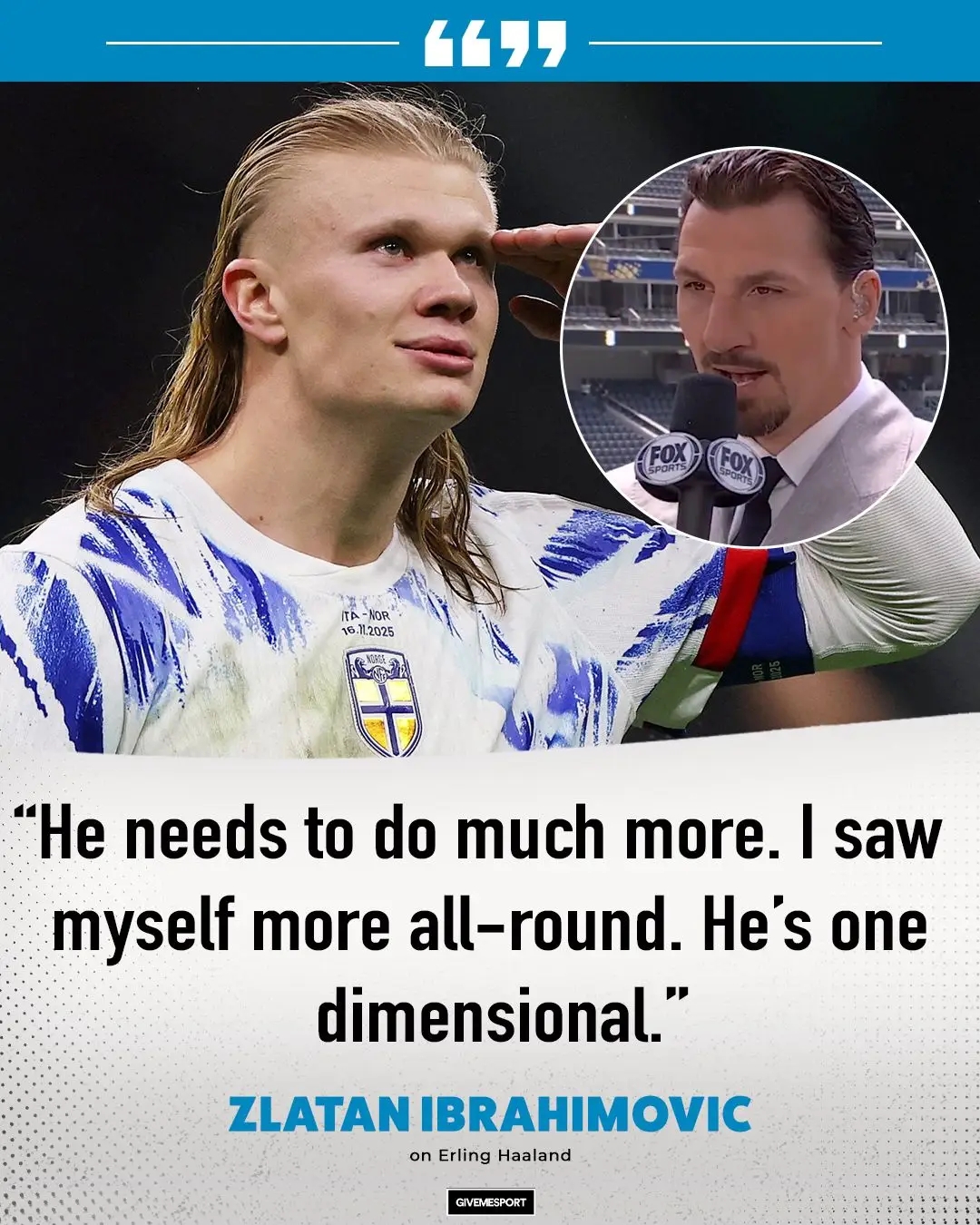
The football world has once again been pulled into a familiar kind of storm, the kind that only a few names in the game can create with just a few sentences. This time it is not a transfer saga, not a manager argument, not a club crisis, but a clash of opinions between two generations of strikers, two personalities who represent two different eras of football thinking. On one side stands Zlatan Ibrahimovic, a man who has built his entire career on confidence, dominance, ego, skill, power, and unforgettable quotes. On the other side stands Erling Haaland, the modern goal machine, a striker built like a robot in front of goal, scoring goals with ruthless consistency for Manchester City.
And now Zlatan has once again spoken in a way only Zlatan can speak.
He did not simply give an opinion. He did not carefully compare stats or politely praise a younger player. He went straight to the core of the debate, the way he always does, and made it personal, bold, and controversial. He shut down the idea that Haaland is already above him or even close to him in terms of complete ability as a striker.
In his words, Zlatan described Haaland as a “killer in the box,” acknowledging the Norwegian’s deadly finishing and his ability to punish defenders with almost no space or time. But he did not stop there. He quickly drew a line between them, making it clear that in his view, football is not just about scoring goals inside the penalty area. It is about everything else too: control, technique, creativity, personality, movement, and the ability to dominate the full pitch.
Zlatan said Haaland needs to do much more to reach what he called a “freak of nature,” referring to himself. It is classic Zlatan language, mixing arrogance with confidence, blending humor with seriousness, and always placing himself at the centre of greatness. He explained that while Haaland is a pure finisher, he sees himself as something more complete, someone who could drop deep, carry the ball, create chances, and participate in the full rhythm of the game, not just the final touch.
Then came another part of his statement that caught even more attention. Zlatan recalled an interview from Haaland where the striker jokingly described his dream as touching the ball very few times and still scoring multiple goals. Something like touching the ball twice and scoring twice, or touching it three times and scoring three goals. Zlatan laughed at the idea, but not in a light-hearted way that simply entertains. It was a laugh that carried meaning, almost like a challenge to modern football thinking.
For Zlatan, that mindset represents efficiency, but not greatness in his definition. In his world, a striker should not just wait for chances, he should be the chance, the creator, the entertainer, the player who controls the game with presence. That is the philosophy he built over two decades across Europe, playing for clubs like Ajax, Juventus, Inter Milan, Barcelona, AC Milan, Paris Saint-Germain, and Manchester United. Every step of his career was marked by moments where he did not just finish games, he shaped them.
Haaland, however, represents something very different. In modern football, especially in the Premier League, the role of a striker has changed dramatically. Managers want efficiency. They want directness. They want a player who can turn half chances into goals without needing ten touches or complex build-up involvement. Haaland fits this system perfectly. He does not waste movement. He does not overcomplicate. He does not drift into unnecessary positions. He waits, and when the chance arrives, he finishes with brutal precision.
This difference in philosophy is exactly what makes this comparison so explosive.
Zlatan sees football as art mixed with strength, personality mixed with unpredictability. Haaland represents structure, efficiency, and machine-like finishing. One is chaos controlled by creativity, the other is order perfected by repetition.
Fans across the football world immediately reacted. Some agreed with Zlatan, saying that modern football sometimes overvalues statistics and forgets the beauty of all-round play. Others strongly defended Haaland, pointing out that scoring goals is the hardest part of football and that doing it consistently at the highest level is the ultimate proof of greatness.
To understand why Zlatan speaks with such authority, it is important to look at his career journey. He was never just a striker. He was a personality that shaped dressing rooms. He was known for goals that defied logic, from acrobatic volleys to long-range strikes that seemed impossible. He scored in almost every league he played in, adapting to different styles of football across Europe. In many ways, he built his legacy on unpredictability.
Haaland, on the other hand, has built his career on something much simpler but equally terrifying for defenders: inevitability. When the ball reaches him in the box, there is a feeling that a goal is coming. His positioning is sharp, his movement is direct, and his finishing is cold. He does not need many chances to change a game. That is why managers love him. That is why defenders fear him.
But Zlatan’s argument is not about numbers. It is about identity.
When he says Haaland does not do more than he is able to do, he is suggesting that Haaland is a specialist, not a complete football artist. It is not necessarily criticism in the traditional sense, but a comparison of football philosophies. Zlatan believes greatness is measured not only by goals but by how much influence a player has on every part of the game.
In modern football analysis, this debate often appears in different forms. Some analysts focus on expected goals, finishing efficiency, and positioning. Others focus on dribbling, passing involvement, creativity, and build-up play. Haaland dominates the first category. Zlatan believes he dominated both.
That is where the tension lies.
Even though Zlatan is retired now, his voice still carries weight because he represents a generation of strikers who were expected to do everything. They were not only goal scorers; they were entertainers, target men, playmakers at times, and leaders on the pitch. Zlatan embodied that identity fully.
Haaland represents a newer evolution. He is the product of tactical refinement in football. In systems like Pep Guardiola’s at Manchester City, strikers are often positioned to finish moves rather than create them. The team builds the structure, and the striker completes it. In that sense, Haaland is a perfect final piece of a very complex machine.
Zlatan, however, sees himself as the machine and the finisher at the same time.
This is why he uses strong language like “freak of nature.” It is not just arrogance. It is his belief that he was a different type of footballer, one who could influence matches in multiple ways beyond scoring.
The debate also extends to fans asking a simple question: would you take Haaland or Zlatan?
The answer depends on what you value in football.
If you want pure goal output, especially in structured systems with high-quality service, Haaland is almost unmatched in today’s game. His consistency at Manchester City has shown that he can deliver in the biggest moments, in league races, and in Champions League pressure games.
If you want unpredictability, technical creativity, leadership personality, and moments of pure individual brilliance across different styles of play, Zlatan becomes very difficult to replace.
What makes this comparison so interesting is that both players dominate in their own definitions of greatness. Haaland does not try to be Zlatan. Zlatan was never built like Haaland. One is the evolution of modern striker efficiency, the other is the peak of traditional complete striker identity.
Football history is full of these generational comparisons. Every era produces a new type of striker, and fans often debate which is better. In the past, similar debates happened with players like Ronaldo Nazário, Thierry Henry, Didier Drogba, and others. Each brought something unique to the game.
Zlatan’s comments also reflect something deeper about football culture: ego versus efficiency. Zlatan represents ego in its purest sporting form. Not arrogance without reason, but confidence built on decades of success, spectacular goals, and dominance in multiple leagues. Haaland represents efficiency without excess, a player who focuses on results rather than expression.
Neither approach is wrong. They are simply different interpretations of greatness.
As the debate continues online, fans clip Zlatan’s words, replay Haaland’s goals, and compare their highlights side by side. One shows acrobatic finishes, long-range volleys, backheel flicks, and moments of improvisation. The other shows lightning runs, perfect positioning, one-touch finishes, and ruthless scoring consistency.
It becomes less about who is better and more about what kind of striker defines greatness in modern football.
Even within Manchester City, Haaland’s role is clear. He is not asked to drop deep like a traditional number 10 or drift wide to create play. He is positioned to finish. And he does it better than almost anyone in world football right now. That is why he is one of the most feared forwards in Europe.
But Zlatan’s voice challenges that idea by reminding fans that football is not only about scoring. It is also about how you play, how you influence the rhythm of the match, and how you express yourself as a footballer.
In the end, this debate will never have a final answer. Football does not work like mathematics where one player can be declared universally better than another. It works through eras, systems, and interpretations.
Zlatan Ibrahimovic has made his position clear. He respects Haaland’s goals, but he refuses to place him above himself in terms of complete football identity. Haaland, meanwhile, continues to let his performances speak for themselves, scoring goal after goal in one of the most demanding leagues in the world.
And so the question remains open, echoing across fans, analysts, and social media debates everywhere: would you take the finishing machine of today, or the all-round genius of the past?
In football, as always, the answer depends on what you believe greatness truly means.