PGMOL chief Howard Webb also explained with the referee could not ignore the fouls and give the goal

The tension was already high before the ball even hit the back of the net. It was one of those nights in the Premier League where every kick felt heavy, every decision felt dangerous, and every second mattered. When Manchester City travelled to Anfield to face Liverpool, nobody expected the drama that would follow. But by the end of the match, people were not just talking about goals. They were talking about VAR, about decisions, about rules, and about whether football had once again become more about officials than players.
The game itself had everything. It had intensity. It had quality. It had big moments from big players. Arne Slot’s Liverpool started brightly and took the lead through Dominik Szoboszlai, whose free-kick was simply outstanding. The Hungarian midfielder bent the ball over the wall and beyond the reach of the goalkeeper. The stadium erupted. It felt like one of those classic Anfield nights.
But this is a Manchester City side built under Pep Guardiola. They do not panic easily. They do not disappear. They respond. And that is exactly what they did.
Bernardo Silva pulled them level with a clever finish that showed his intelligence and calmness in the box. Then Erling Haaland, the powerful Norwegian striker, struck again. The away end exploded. For a moment, it looked like City had stolen the game in dramatic fashion.
Then came the moment that changed everything.
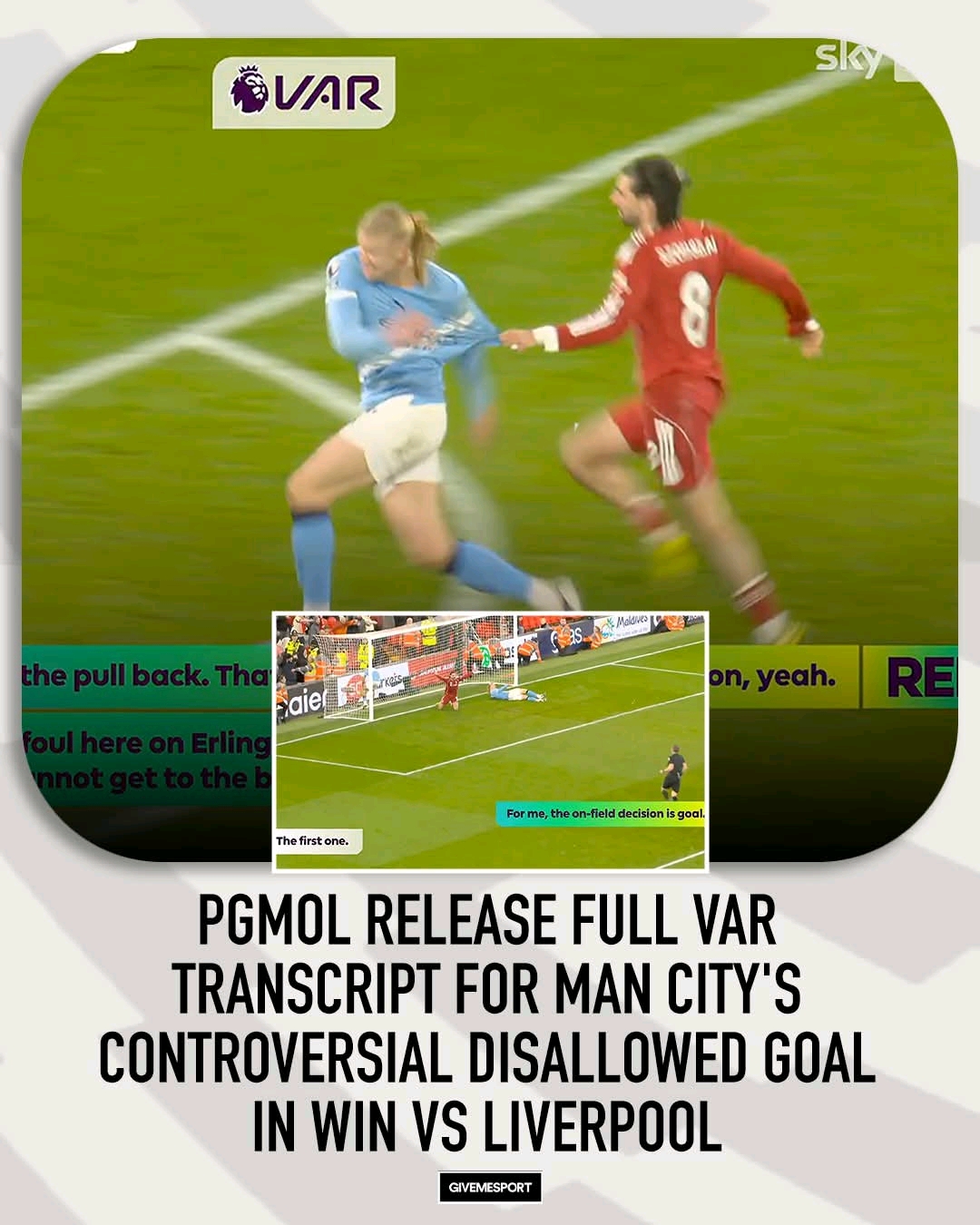
In the final stages, with Liverpool pushing forward desperately for an equaliser, even goalkeeper Alisson came up the pitch. The ball broke loose and City launched a quick attack. Rayan Cherki slid a through ball forward. Haaland sprinted after it. Dominik Szoboszlai chased him. The two players battled shoulder to shoulder. There was pulling. There was contact. Both players ended up on the ground.
The ball continued its path toward goal and eventually crossed the line. City players celebrated wildly. It looked like the winner. It looked decisive. But referee Craig Pawson had decisions to make, and VAR was already checking.
After a long delay, the goal was disallowed. Szoboszlai was shown a red card for denying an obvious goalscoring opportunity, commonly known as DOGSO. Instead of a goal, City were awarded a free-kick. Instead of a comeback chance, Liverpool were down to ten men.
The decision caused confusion and anger. Pep Guardiola was not happy. Liverpool fans were furious. Even neutral fans struggled to understand what had just happened. How could a goal be scored, yet ruled out, while also sending a player off?
That is why the Professional Game Match Officials Limited, known as PGMOL, later released the full VAR audio and transcript. They wanted transparency. They wanted fans to understand how the decision was reached.
During the conversation, the VAR officials first checked for offside. Then they focused on possible fouls. The assistant VAR mentioned DOGSO. The referee confirmed that his on-field decision was goal. But the VAR team believed there was more to examine.
They saw an initial foul by Szoboszlai on Haaland. The referee had tried to play advantage at the time. He believed City might benefit more from continuing play rather than stopping it. That is common in football. Referees often allow play to continue if it gives the attacking team a better opportunity.
But the VAR officials also saw something else. They saw Haaland pulling Szoboszlai in return. They saw holding. They saw contact that directly affected the play.
The crucial point in their explanation was this: the ball only ended up in the net because Haaland pulled Szoboszlai, preventing him from clearing it properly. In their view, you cannot allow a goal that happens because of a foul in the build-up.
Howard Webb, head of PGMOL, later explained the logic clearly. He said referees must use common sense, but there are limits. If a goal only happens because of an attacking foul, it cannot stand. Even if there was an earlier foul by the defender, the sequence matters.
According to Webb, the correct process was to go back to the first offence. Szoboszlai’s initial pull on Haaland denied him a clear goalscoring opportunity. That offence happened outside the penalty area. By the rules, that means a direct free-kick and a red card.
So instead of allowing the goal and ignoring everything, the officials had to cancel the goal, award a free-kick, and send Szoboszlai off.
Craig Pawson admitted during the audio that he had not seen Haaland’s pull in real time. That is exactly why VAR exists. The system is there to catch what referees might miss. After reviewing the footage on the pitchside monitor, Pawson agreed with the recommendation.
For Manchester City, the decision was bittersweet. They lost the goal, but they gained a free-kick and faced ten men. For Liverpool, it felt like double punishment. They lost the chance to fight for a point and lost one of their key midfielders.
Pep Guardiola criticised the situation afterwards, not necessarily saying the law was wrong, but questioning how such complex interpretations affect the flow of football. Managers often argue that too many technical details take away from the spirit of the game.
Liverpool supporters argued that advantage had already been played and that the referee should not go backwards so dramatically. City fans argued that rules are rules and that denying a clear goalscoring opportunity must be punished.
The wider football community debated the incident for days. Social media was full of clips, slowed-down angles, freeze frames and strong opinions. Some believed VAR saved the game from a wrong decision. Others believed it created unnecessary chaos.
This is the modern Premier League. Technology is part of the story. Every controversial moment becomes a national debate. Every decision is analysed in detail.
The transcript showed how calm the communication actually was. The VAR team spoke clearly. They identified each stage. They explained their reasoning. They recommended an on-field review rather than forcing a decision. That is the correct protocol.
When Pawson went to the screen, he saw the evidence. He understood that Haaland’s pull directly affected Szoboszlai’s ability to defend. He accepted that the initial foul denied a clear chance. He made the final call.
Some fans were surprised that both fouls were recognised but only one punished in the final outcome. But that is because of the sequence. The first offence stops the play legally. Everything after is judged in relation to that.
Howard Webb also pointed out that Szoboszlai appealed for Haaland’s foul. And he was right to appeal, because it was a foul. But unfortunately for him, he had already committed the earlier offence.
It was a painful lesson in football laws. Timing matters. Sequence matters. And VAR will check everything.
For Manchester City, the result strengthened their title push. For Liverpool, it was a frustrating setback. For the Premier League, it was another reminder that transparency is necessary in modern football.
By releasing the audio, PGMOL tried to build trust. Fans often feel left in the dark. Hearing the real-time discussion helps people understand that decisions are not random. They follow process.
Of course, not everyone was convinced. Some believe football was better before VAR. Some feel the human element is being lost. Others argue that without VAR, the wrong decision might have stood, and the outrage would have been even bigger.
This incident will be remembered not just for the drama on the pitch, but for the conversation off it. It showed how one moment can carry layers of interpretation. It showed how referees balance advantage, fouls, and fairness.
In simple terms, the officials believed the goal could not stand because it came from an attacking foul. They believed the defender’s earlier foul denied a clear chance and deserved a red card. So they returned to that moment and punished it correctly under the law.
Whether fans agree or not, the explanation was detailed and structured. The process was followed. The final outcome matched the rulebook.
Football is emotional. Supporters react with passion. But behind every decision, there is structure and communication. The PGMOL audio revealed that structure.
In the end, the match became another example of how modern football operates. Players fight. Managers argue. Fans debate. Officials analyse. Technology intervenes.
And somewhere in the middle of it all, the ball still rolls, the crowd still sings, and the drama continues.
This was not just about a disallowed goal. It was about understanding the laws of the game. It was about the balance between flow and fairness. It was about how even the smallest pull of a shirt can change the outcome of a Premier League match.
Manchester City moved forward. Liverpool had to regroup. The referees faced scrutiny, as always. But at least this time, the conversation was open. The words were heard. The reasoning was explained.
And in today’s football world, that transparency matters just as much as the final score.