RANGERS FANS FURIOUS AS NEW VAR ANGLE REVEALS WHY HIBS PENALTY WAS GIVEN — EX-RANGERS STAR AND REFEREES DELIVER VERDICT

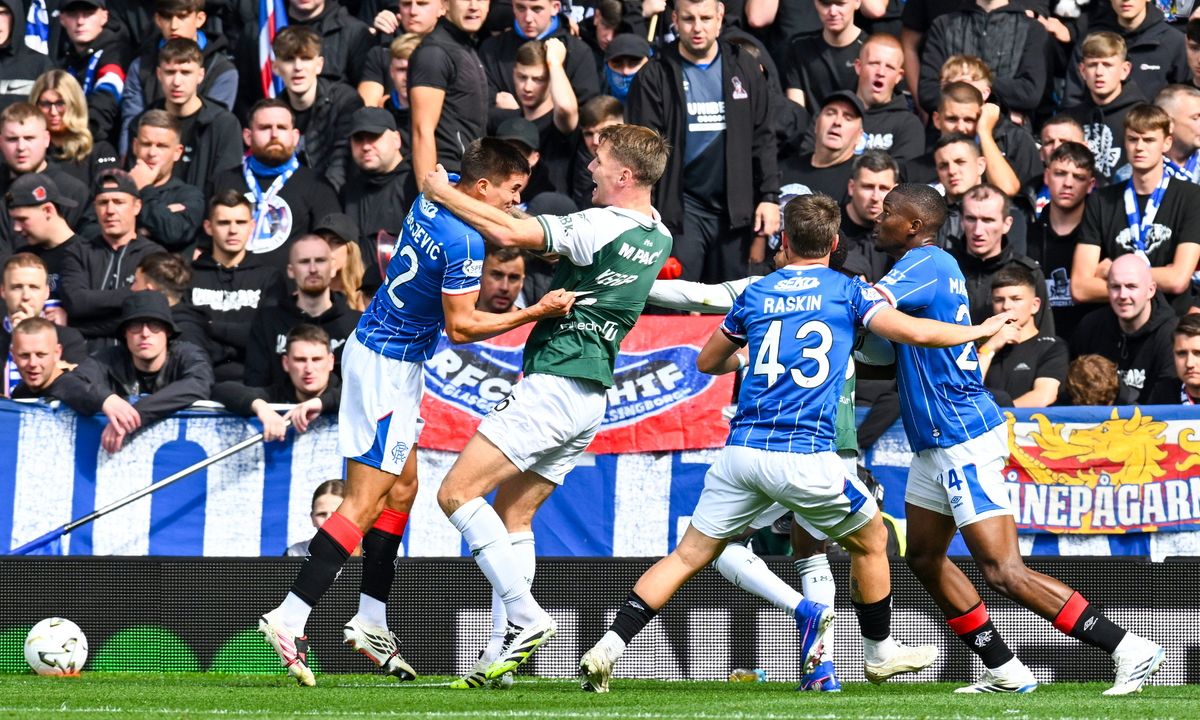
Rangers supporters have been left raging after a controversial VAR decision helped Hibernian secure a dramatic 2-1 victory at Ibrox, with a new angle appearing to show exactly why referee Don Robertson was sent to the monitor. But former players, pundits and experienced referees have questioned whether the incident should ever have resulted in a penalty.
Rangers’ painful defeat to Hibernian has continued to generate controversy after fresh analysis of the penalty incident involving Vanja Dragojevic and Jason Kerr. The match was goalless when VAR intervened following a tussle between the two players inside the Rangers penalty area, eventually leading to Robertson overturning his initial decision and awarding Hibs a spot-kick. Josh Campbell converted the penalty as David Gray’s side went on to claim a dramatic 2-1 victory in Glasgow.
For Rangers supporters, however, the biggest talking point has not simply been the defeat. It has been the decision that changed the match and the role VAR played in bringing the incident back to the referee’s attention.
The latest analysis has focused heavily on Dragojevic’s positioning during the incident. One explanation offered for the penalty is that the Rangers defender was watching his opponent rather than concentrating on the incoming ball as the cross entered the box. A BBC Sportscene angle was also highlighted, showing Dragojevic facing Kerr while contact was initiated.
That detail has become central to the debate because defenders are always taking a risk when they use their arms or make contact with an opponent inside the penalty area. The argument from those supporting the decision is that Dragojevic’s attention was on Kerr and that he initiated the contact.
But that is only one side of the argument.
The major issue remains whether the contact was sufficient to cross the threshold for a penalty. Several voices involved in the discussion have argued that it was not.
One of the most frustrating aspects of the incident for Rangers fans was the fact that the referee did not initially award a penalty. According to the source report, there did not appear to be a strong Hibs appeal immediately after the contact, yet VAR officials subsequently sent Robertson to the pitch-side monitor.
That sequence naturally created questions.
If the incident was obvious enough to warrant a penalty, why was it not spotted immediately?
And if the original decision was considered reasonable, what exactly did the replay show that required the referee to change his mind?
Those are the questions now being asked around the Rangers support.
VAR is supposed to help officials correct significant mistakes, but subjective physical battles inside the box remain among the most difficult incidents to judge. Two players can both be holding, pushing or attempting to gain an advantage at exactly the same moment.
That appears to be what made this incident so controversial.
Former Rangers defender Alan Hutton was among those who questioned the decision. Speaking on Premier Sports, Hutton described the penalty as soft while attempting to explain why the officials may have reached their conclusion.
His argument centred on Dragojevic not looking at the ball and instead focusing on Kerr as the ball travelled into the penalty area. However, Hutton also acknowledged that both players appeared to be involved in the physical confrontation.
That is perhaps the most balanced way to view the incident.
Dragojevic was certainly involved.
The Rangers defender was not simply standing away from the action while Kerr fell to the ground. There was contact, and the new angle provides additional context.
But the question is whether that contact was enough.
Hutton’s assessment suggests that while the decision can be explained, it remains difficult to regard it as an obvious penalty.
Tony Docherty also described the penalty as soft and focused heavily on the fact that the two players were tussling with each other. He noted that Kerr also appeared to have his hands on Dragojevic during the confrontation.
That observation is important because it shifts the conversation away from simply asking whether Dragojevic initiated contact.
Even if the Rangers player started the physical battle, was Kerr also committing an offence?
If both players were involved in the same kind of grappling, why should only one be punished?
That is exactly the concern raised by other commentators.
Docherty’s view was that VAR had become overly involved in an incident that had not appeared significant when it happened at normal speed.
For Rangers fans, that will be one of the most frustrating elements of the entire episode.
Former Rangers player Andy Halliday offered another detailed assessment of the incident.
Halliday acknowledged that Dragojevic did initiate contact and recognised that defenders run a risk when they put their hands on an opposing player. However, he questioned whether the incident should set the standard for penalties from set pieces throughout the season.
That is a significant point.
There is almost always some physical contact during corners and free kicks.
Players grab shirts.
Arms are raised.
Defenders lean into attackers.
Attackers attempt to create separation.
If every instance of contact is punished with a penalty, matches could quickly become dominated by spot-kick decisions.
Halliday also highlighted what he believed was an important detail: Kerr appeared to have his hands on Dragojevic’s face and an arm around his neck during the confrontation.
His argument was therefore not that Dragojevic had no involvement.
Instead, it was that the incident appeared to involve both players and did not reach the level required for a penalty.
Former Celtic captain Scott Brown took a slightly different approach.
Brown was highly critical of Dragojevic’s defending, particularly his starting position and the amount of space he allowed Kerr. According to Brown, the Rangers defender was too far away from his opponent initially, which gave Kerr room to move.
Yet despite that criticism, Brown still did not believe the incident warranted a penalty.
That makes his assessment particularly interesting.
Brown effectively separated the defensive mistake from the refereeing decision.
In his view, Dragojevic could have defended the situation much better, but that did not automatically mean Hibs deserved a spot-kick.
He also raised the concern that if this type of contact becomes the standard for penalties, supporters could see a large number of similar decisions throughout the season.
That will be a major concern for defenders across Scottish football.
The debate became even more significant when referees Steve Conroy and Des Roache reportedly placed responsibility on the VAR team for the controversial decision.
That adds another layer to the controversy.
When former players criticise a penalty, supporters can dismiss it as club bias or personal opinion.
When experienced refereeing voices question the VAR intervention, however, the conversation becomes much harder to ignore.
It suggests that the central debate is not simply about whether Dragojevic committed a foul.
It is about whether VAR should have intervened at all.
That distinction is crucial.
Whatever opinion people have about the decision, there is no denying its importance.
The game was goalless when the incident occurred.
After Robertson reviewed the footage, Hibernian were awarded the penalty.
Campbell converted.
Suddenly, Rangers were behind in a match that had previously remained level.
That changed the complexion of the contest.
Hibs could now defend their advantage while Rangers were forced to chase the game.
The pressure on the home side increased.
And with every minute that passed, the importance of the penalty became even greater.
Hibernian eventually secured a 2-1 victory, leaving Rangers supporters to reflect on what might have happened if the spot-kick had never been awarded.
Of course, nobody can say with certainty that the match would have finished differently.
Football does not work that way.
But the penalty undoubtedly became one of the defining moments.
The VAR controversy should not completely hide the fact that Rangers conceded twice and ultimately lost at Ibrox.
For Derek McInnes, that will be the bigger concern.
Managers can argue about refereeing decisions, but they cannot control officials.
They can control how their team performs.
Rangers will therefore have to examine the wider performance as well as the penalty.
Were they aggressive enough?
Did they create enough opportunities?
Did they defend effectively?
Did they react properly after falling behind?
Those questions matter because one controversial decision cannot be used to explain every aspect of a defeat.
At the same time, Rangers supporters are perfectly entitled to question the penalty.
Both things can be true.
The team may need to improve while the refereeing decision can still be debated.
The biggest individual focus will naturally fall on Dragojevic.
The Rangers defender was at the centre of the incident, and the new angle has provided additional evidence for those who believe he initiated the contact.
But even the commentators who criticised his defending did not all agree that the incident deserved a penalty.
That distinction should be remembered.
Dragojevic can learn from the situation without being made the sole reason for Rangers’ defeat.
The defender will need to improve his positioning, remain disciplined inside the penalty area and understand how closely his actions will be scrutinised.
At the same time, he can reasonably feel frustrated that a relatively brief tussle became the decisive refereeing moment of the afternoon.
The controversy has once again raised a broader question about VAR in Scottish football.
Where should the line be drawn?
If a referee sees two players wrestling in the box and decides there is not enough to award a penalty, should VAR intervene when a replay reveals additional contact?
Or should the original decision stand unless the evidence clearly proves that the referee made an obvious mistake?
There is no easy answer.
Football is filled with situations where two reasonable people can watch the same footage and reach different conclusions.
That is why VAR remains so contentious.
Technology can show what happened.
It cannot always determine how serious the contact was.
That still requires judgement.
From the Rangers perspective, the frustration is understandable because the incident did not initially appear to be a major talking point.
The match was allowed to continue.
There was no immediate sense that a penalty was coming.
Then the VAR review changed everything.
Supporters saw their team go from level to behind because of a decision made after the referee had already chosen not to award a spot-kick.
That naturally creates anger.
The situation becomes even more difficult to accept when multiple former players and pundits subsequently describe the decision as soft.
Hutton questioned it.
Docherty questioned it.
Halliday strongly questioned it.
Brown did not believe it was enough for a penalty.
And refereeing voices reportedly criticised the VAR intervention.
That does not automatically prove the decision was wrong, but it explains why the Rangers support has reacted so strongly
The Ref’s View podcast account also weighed into the controversy, describing the decision as incredible and arguing that both players were involved in the tussle. The account questioned why one player should be punished when both appeared to be committing offences and warned that it could become a long season if incidents like this are accepted as penalties.
That reaction captures the fear among defenders and supporters.
If this becomes the standard, every corner kick could become a potential VAR review.
Every shirt pull could be examined.
Every arm around an opponent could be interpreted as a foul.
And that could fundamentally change how defenders approach set pieces.
Rangers fans will therefore be watching closely when similar incidents happen in future matches.
This is where the debate ultimately comes down.
There is evidence that Dragojevic initiated contact.
There is also evidence that Kerr was involved in the physical confrontation.
The new angle provides a different perspective from the original live view.
But several former players believe the contact was simply not strong enough to justify a penalty.
That means the decision remains highly subjective.
Supporters may never agree.
Hibs fans will point towards Dragojevic’s actions and argue that the defender created the situation.
Rangers fans will point towards the mutual contact and argue that the incident should have been ignored.
The VAR team ultimately took one position.
Robertson followed that recommendation after viewing the monitor.
And Hibernian benefited.
A controversial penalty at Ibrox is always going to generate a strong reaction.
Rangers supporters expect their team to win home matches, and losing to Hibernian was already a major disappointment.
When a contentious penalty becomes part of the story, emotions naturally become even stronger.
The frustration will likely continue into the next few days as supporters analyse every available replay.
The more angles that emerge, the more debate there will be.
One group will argue that the new footage proves Dragojevic made the initial move.
Another will insist that the footage proves there was mutual contact.
And somewhere in the middle will be those who simply believe VAR should have left the original decision alone.
For Hibernian, the most important fact is simple: they won.
David Gray’s side came away from Ibrox with a 2-1 victory after Campbell successfully converted the penalty.
Whatever the wider debate, Hibs took advantage of the opportunity presented to them.
That is what football teams are expected to do.
Hibs did not control the VAR process.
They did not decide whether Robertson should review the footage.
They were simply given the penalty and had to score it.
Campbell did exactly that.
From their perspective, the controversy is unlikely to matter nearly as much as the three points
The focus will eventually move away from VAR and towards Rangers’ next match.
That is when McInnes and his players will have the opportunity to answer their critics.
A strong performance and victory would quickly reduce some of the frustration surrounding the Hibs defeat.
Another poor result, however, would increase pressure.
That makes the next fixture extremely important.
McInnes will need his players to remain focused and avoid allowing the controversy to become a distraction.
The Rangers boss cannot change the referee’s decision.
He cannot change the result.
But he can change how his team responds.
That is where leadership becomes important.
The Rangers support may be furious with VAR, but supporters will ultimately demand improvement from the players.
They want stronger defending.
They want more control.
They want better attacking football.
And above everything else, they want victories.
Complaining about the penalty will not recover the points.
Only results can do that.
McInnes therefore has to make sure the disappointment becomes motivation rather than frustration.
The players need to understand that controversial decisions are part of football.
They also need to become good enough to overcome them.
The Hibernian penalty will remain one of the biggest talking points from Rangers’ dramatic 2-1 defeat.
The new angle gives more context to the clash between Dragojevic and Kerr and shows why the VAR team may have believed there was sufficient evidence for Robertson to review the incident.
But it does not end the argument.
Far from it.
Alan Hutton called the decision soft.
Tony Docherty also questioned it.
Andy Halliday acknowledged that Dragojevic initiated contact but argued that the incident involved both players and should not have resulted in a penalty.
Scott Brown criticised Dragojevic’s defending but also concluded that the contact was not enough for a spot-kick.
Refereeing voices have also reportedly questioned the VAR team’s role, while The Ref’s View podcast account expressed serious concern about the decision and its potential implications for future matches.
So, was it a penalty?
There is certainly an argument that Dragojevic initiated the contact.
But there is also a strong argument that the incident involved both players and was too soft for VAR intervention.
That is why Rangers supporters remain furious.
The debate is unlikely to disappear anytime soon.
And if another similar incident occurs in a Rangers match, expect this moment at Ibrox to be brought up all over again.
For McInnes, though, the message is clear: the controversy cannot become an excuse.
Rangers need to respond on the pitch.
They need to turn frustration into performances.
And they need to make sure that one controversial decision does not become the defining story of their season.