Rangers Left Fuming as Nick Walsh Waves Away Clear Penalty Shout at Tannadice

Rangers supporters travelled to Tannadice on Friday night believing they were about to witness the true beginning of a new chapter under Derek McInnes, and for long spells of a dramatic Scottish Premiership opener, that optimism looked entirely justified. A summer of wholesale change at Ibrox, packed with new arrivals, difficult farewells and a renewed sense of ambition around the club, had transformed the mood among the support heading into the new campaign, with everyone eager to discover whether the extensive rebuild McInnes had overseen since taking permanent charge would translate into results once the football actually got underway. On the evidence of the opening exchanges in Dundee, there was plenty to be encouraged about, with several of the club’s summer signings featuring prominently from the outset and the visitors enjoying lengthy spells of possession that hinted at the identity McInnes is trying to instil in his new-look side.
Yet when the final whistle eventually sounded on a chaotic and increasingly bad-tempered evening in Tayside, it was not Rangers’ second-half comeback, the full debuts handed to several new faces, or even the eventual 1-1 scoreline that dominated the conversation among supporters, pundits and journalists alike. Instead, all of the post-match discussion centred on one enormously contentious refereeing decision late in the game, a moment that left Rangers players, staff and supporters convinced they had been denied the chance to leave Tannadice with all three points on the opening night of the season.
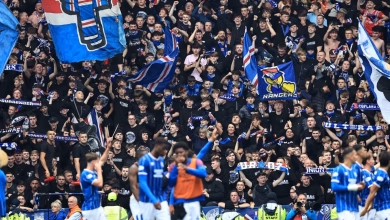
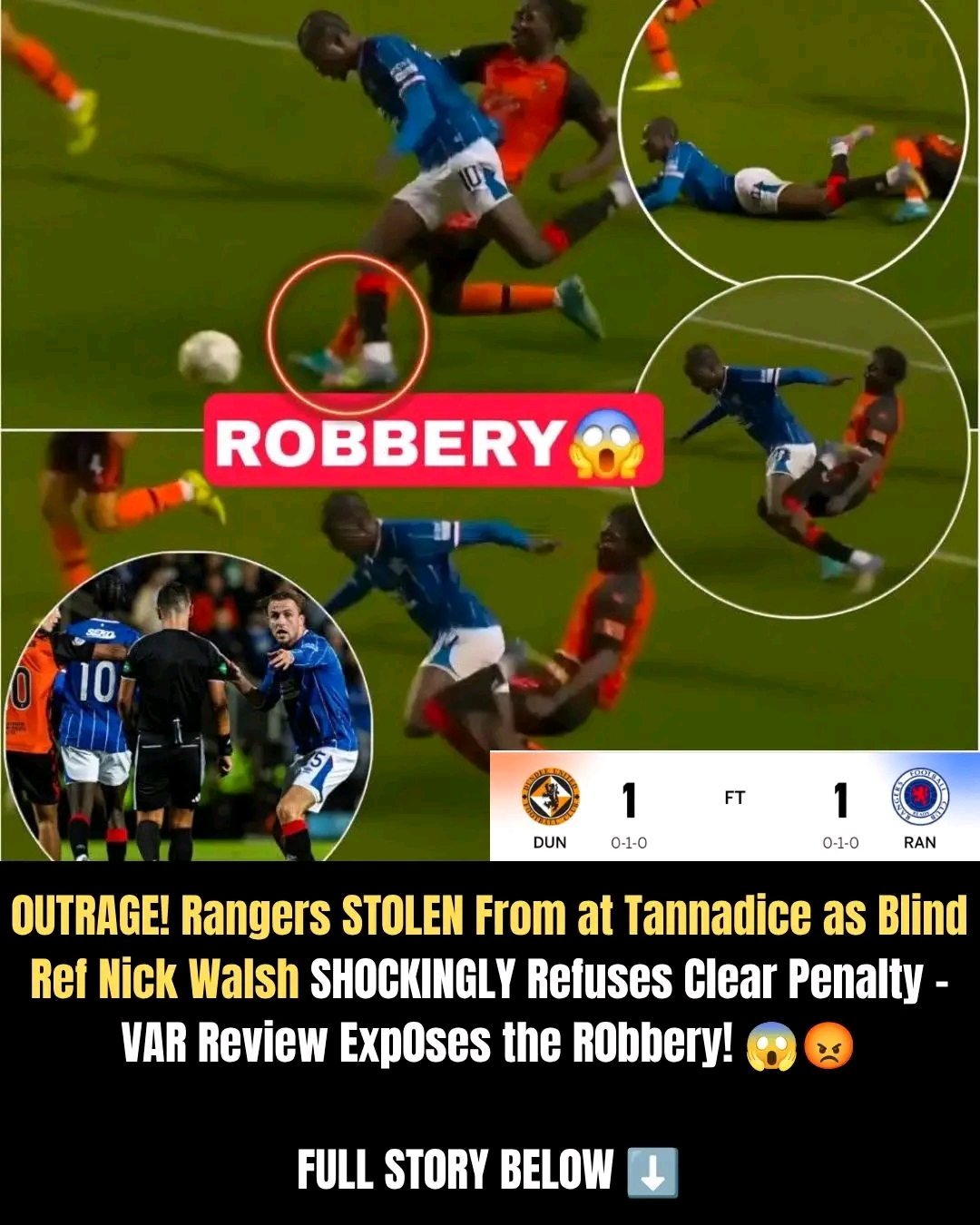
The flashpoint arrived deep into the closing stages, with Rangers pressing hard for what would have been a dramatic winner having already fought back from behind earlier in the second half. Mohamed Diomande, one of the more dynamic performers in the Rangers midfield throughout the evening, burst forward into the penalty area in search of a decisive moment, only to go down under a challenge from Dundee United defender Emmanuel Agyei. The reaction from the Rangers players was instant and unanimous, with several surrounding referee Nick Walsh to appeal for a spot-kick, while supporters packed into the away end behind the goal rose in anticipation, fully expecting the official to point immediately to the penalty spot.
Instead, Walsh waved away the appeals without hesitation, awarding Dundee United a goal kick and sparking immediate and visible fury among the travelling support and the Rangers bench alike. Television cameras were quick to cut to Derek McInnes on the touchline, capturing the Rangers manager’s stunned reaction as he protested animatedly from the technical area, clearly of the belief that his side had been denied a legitimate claim for a spot-kick at the most crucial possible moment of the match. That single incident, replayed repeatedly in the minutes and hours that followed across social media and post-match analysis shows, quickly became the defining talking point of what had otherwise been an entertaining and eventful Scottish Premiership curtain-raiser, overshadowing much of the good work Rangers had produced across the ninety minutes.
To understand why the moment carried such significance, it helps to rewind through how the match itself had unfolded up to that point. Dundee United, roared on by a vociferous home support desperate to make life as difficult as possible for the visitors on the opening night of the season, struck first just before the interval when Lachlan Rose finished off a well-constructed team move to hand Jim Goodwin’s side a deserved advantage heading into the break. It was the kind of goal that rewarded United’s willingness to press high and disrupt Rangers’ attempts to build patiently from the back, and it sent the home supporters into raptures as they contemplated the prospect of taking a significant early scalp against a Rangers side still finding its feet under new management.
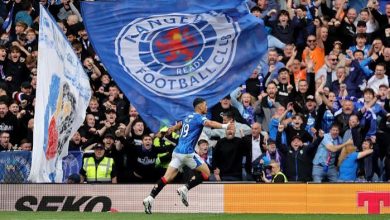
McInnes, for his part, responded in positive fashion at half-time, making changes designed to inject fresh energy and urgency into his side’s play and instructing his players to push further forward in search of an equaliser. The substitutions had the desired effect relatively quickly, with Rangers gradually beginning to assert themselves more consistently in the final third as the second half wore on. That sustained pressure eventually told when summer signing Thelo Aasgaard found the net to level proceedings, finishing smartly after excellent approach play from new club captain Lawrence Shankland, whose influence on the game had been growing steadily since the restart. The goal sparked wild celebrations among the travelling Rangers support and gave the visitors genuine belief that a first competitive victory of the McInnes era was within touching distance.
From that point onward, Rangers looked increasingly like the side more likely to find a winner, continuing to dominate large periods of possession and pushing men forward in search of the goal that would have completed a memorable turnaround on the opening night of the campaign. Dundee United, to their credit, remained a threat on the counter-attack throughout, with Goodwin’s side never entirely retreating into a purely defensive shape despite absorbing sustained late pressure from the visitors. It was in this context, with the tension rising and both sets of players fully aware of how much was riding on the outcome, that the Diomande incident unfolded, immediately becoming the moment supporters and pundits would be dissecting long after the final whistle had blown.
In the aftermath, opinion among those who witnessed the incident live appeared to split largely along familiar lines, with Rangers-supporting voices insisting Diomande had been clearly impeded inside the box and that the decision represented a significant and costly error on the part of the officiating team, while others argued the contact was less clear-cut than instant reactions suggested and that Walsh’s on-field view may have led him to a reasonable, if contentious, conclusion. What is beyond dispute is the strength of feeling the incident generated inside Tannadice and across social media in the hours that followed, with the moment quickly eclipsing almost every other talking point from an otherwise absorbing contest between two sides who both have significant ambitions for the season ahead.
Adding a further layer of intrigue to the closing stages was the news, confirmed shortly after the match, that new Rangers signing Ben Godfrey had been forced off injured during what was his competitive debut for the club. The Atalanta loanee, brought in during the summer as one of the more eye-catching additions to McInnes’s squad, was withdrawn during the closing exchanges, leaving the Rangers manager facing an anxious wait to discover the extent of the issue ahead of a hugely significant week that includes preparations for the club’s Europa League qualifying tie against Jagiellonia Bialystok. Between the controversy surrounding the disallowed penalty appeal and the uncertainty now hanging over Godfrey’s fitness, McInnes was left facing a considerable amount to process in the immediate aftermath of his first competitive match in permanent charge of the club.
Despite the frustration surrounding both the penalty decision and the fresh injury concern, there remained plenty for Rangers supporters to feel genuinely encouraged about when reflecting on the broader performance. Several of the club’s summer arrivals showed promising signs across the ninety minutes, offering glimpses of the qualities that persuaded McInnes and his recruitment team to bring them to Ibrox in the first place. The team as a whole demonstrated the kind of resilience and character required to fight back from a goal down away from home on the opening day of the season, a quality that will be essential if Rangers are to sustain a serious challenge across multiple competitions this year. McInnes’s tactical approach after the interval, in particular, drew praise from those analysing the match, with his willingness to commit players forward and take risks in search of a winning goal seen as evidence of the more adventurous, front-footed style he is looking to establish at the club.
Nonetheless, there was little doubt about which moment would dominate the headlines and post-match discussion in the days that followed. With Rangers players and staff convinced they had been unfairly denied a clear penalty at a pivotal stage of the match, and with McInnes’s visibly animated reaction captured live on television for supporters up and down the country to see, the controversy surrounding Nick Walsh’s decision looked certain to remain one of the most talked-about moments from the opening weekend of the new Scottish Premiership season, regardless of how the broader campaign eventually unfolds.
The wider context surrounding refereeing standards in Scottish football only added further fuel to the debate that erupted in the immediate aftermath of the final whistle. Contentious decisions have long been a source of frustration for supporters of clubs across the Premiership, with debates over the consistency and accuracy of officiating decisions a near-constant feature of matchday discourse throughout recent seasons. For a Rangers support already primed to scrutinise every early decision made under the club’s new management structure, an incident of this magnitude arriving on the very first weekend of the season only intensified existing sensitivities around the standard of officiating on display in the country’s top flight. Whether or not the decision itself will eventually be reviewed or discussed further by the relevant refereeing authorities remains to be seen, but the strength of feeling generated among the Rangers support in the immediate aftermath suggests this is unlikely to be the last time the incident is raised in the coming days.
For Derek McInnes personally, the evening represented a genuinely mixed bag as he embarked on his first competitive fixture since being appointed on a permanent basis. There were clear signs of progress in terms of the identity and approach he is attempting to instil, evidenced by his side’s ability to fight back from behind and dominate large stretches of the second half. Yet the frustration of falling behind early, combined with the controversy surrounding the disallowed penalty and the fresh concern over Godfrey’s fitness, meant the overriding emotion by full time was one of what might have been rather than pure satisfaction with a hard-fought point on the road. It is the kind of night that new managers often experience in their opening fixtures, filled with promising signs but also frustrating moments beyond their control, and how McInnes and his squad respond in the coming weeks is likely to say a great deal about the character and resilience of this rebuilt Rangers side.
Looking ahead, the immediate priority for Rangers will be shifting focus toward Thursday night’s Europa League qualifying assignment against Jagiellonia Bialystok, a fixture that carries enormous significance for the club’s European ambitions this season. Whatever lingering frustration remains from the events at Tannadice will need to be quickly channelled into preparation for what promises to be a demanding continental test, particularly given the uncertainty surrounding Godfrey’s fitness and the broader defensive concerns already occupying McInnes’s thinking heading into the new campaign. For now, though, the opening weekend of the Scottish Premiership season will be remembered above all for one dramatic, contentious moment at Tannadice, and the sense of injustice it left among Rangers players, staff and supporters as they departed Dundee with a share of the spoils rather than the victory many believed they deserved.
Beyond the immediate drama of the penalty shout itself, the incident also serves as a useful lens through which to examine the broader challenges facing Derek McInnes as he settles into life as Rangers manager on a permanent basis. Opening-day fixtures in Scottish football have a long history of throwing up unpredictable storylines, and few new managers arrive at their first competitive match with the luxury of a completely smooth passage through ninety minutes. McInnes will have known before kick-off that Dundee United, spurred on by their own manager’s public vow to make life as difficult as possible for the visitors, were always likely to provide a stern early test of his side’s character and organisation. What he could not have anticipated, however, was quite how much of the post-match narrative would end up being shaped by a single officiating call rather than by the tactical and personnel decisions that had occupied so much of his preparation in the build-up to the match.
That dynamic is not unique to Rangers or to Scottish football more broadly, but it does highlight the delicate balancing act facing any manager attempting to build momentum in the early weeks of a new era. On one hand, McInnes will be encouraged by the resilience his side showed in fighting back from a goal down, by the promising performances of several new arrivals making their first competitive appearances in Rangers colours, and by the more expansive, front-footed approach his team adopted once trailing after the break. On the other hand, he will also be acutely aware that supporters and media coverage alike often gravitate toward controversy over context, meaning the lasting memory of his first game in permanent charge risks being defined as much by a refereeing decision as by anything his players did on the pitch. Managing that perception, both internally within the dressing room and externally among a supporter base eager for any sign of positive momentum, will be one of the subtler challenges McInnes has to navigate in the days ahead.
There is also a tactical dimension worth considering when assessing how the Diomande incident unfolded. Late-game penalty appeals of this nature typically arise from situations where an attacking side has already committed significant numbers forward in search of a decisive goal, leaving them more exposed defensively but also more likely to create the kind of half-chances and scrambles inside the box that can lead to contentious contact. Rangers’ approach in the closing stages, pushing bodies forward and taking calculated risks in search of a winner, was itself a reflection of the more adventurous style McInnes has been keen to implement since taking over. In some respects, the fact that his side created a situation dramatic enough to produce a genuine penalty shout in the first place could be viewed as a mark of progress, even if the ultimate outcome left supporters frustrated rather than celebrating a winning goal.
The broader emotional rollercoaster of the evening, moving from the disappointment of falling behind before the break, through the euphoria of Aasgaard’s equaliser, and finally into the frustration of the disallowed penalty shout, is precisely the kind of fixture that can either galvanise a squad early in a new campaign or leave lingering doubts that need to be addressed quickly. Much will depend on how McInnes and his coaching staff frame the outcome to the players in the days that follow, ensuring the focus shifts productively toward the considerable challenges still to come rather than dwelling excessively on a decision that, rightly or wrongly, is now firmly beyond the club’s control. With a demanding continental fixture against Jagiellonia Bialystok arriving within days, there is little time for Rangers to remain fixated on what happened at Tannadice, however strongly the sense of injustice may still be felt around Ibrox.
For the travelling Rangers support, meanwhile, the emotions of the evening were likely to linger considerably longer than they will for the players and coaching staff, who must quickly turn their attention to the next fixture on the calendar. Away days at Tannadice have rarely been straightforward for Rangers in recent years, and the combination of a fiercely committed home performance, a dramatic late penalty controversy, and an injury blow to one of the summer’s most eye-catching signings ensured this particular trip to Tayside will be remembered as one of the more eventful away days in recent memory, regardless of how the rest of the season eventually unfolds. Supporters who made the journey north will have departed with a mixture of pride at their side’s fighting spirit and frustration at what many felt was a missed opportunity to begin the new era with a statement victory on the road.
As the dust settles on an eventful opening weekend, attention across Scottish football will inevitably begin shifting toward the fixtures still to come, both for Rangers and for the wider Premiership as clubs across the division look to build early momentum of their own. But for those inside Ibrox, the immediate priority remains clear: assessing the extent of Ben Godfrey’s injury, preparing for a hugely significant European test against Jagiellonia Bialystok, and ensuring that whatever frustration lingers from the Diomande penalty shout is channelled productively rather than allowed to fester as McInnes continues the delicate work of building his new-look Rangers side into a genuine force across multiple competitions this season.
It is also worth situating Friday night’s controversy within the broader pattern of how opening weekends in Scottish football tend to be remembered. History suggests that early-season storylines, whether refereeing controversies, standout individual performances or unexpected results, often carry disproportionate weight in shaping the initial narrative around a club’s campaign, even if their long-term significance fades considerably once a full body of results begins to accumulate. Rangers supporters who have followed the club through previous campaigns will recognise this pattern well, having seen countless opening-day talking points eventually give way to entirely different storylines by the time autumn arrives. Whether the Diomande penalty shout at Tannadice proves to be a genuine turning point in how the club’s season is remembered, or simply an early flashpoint that fades from memory as more fixtures unfold, will only become clear with time. For now, though, it stands as the defining image from Derek McInnes’s first competitive afternoon in permanent charge, a reminder of just how quickly fortunes and headlines can shift across the course of a single ninety-minute contest in Scottish football.