Rangers Left Fuming As Referee Nick Walsh Stays Silent On Diomande Penalty Shout

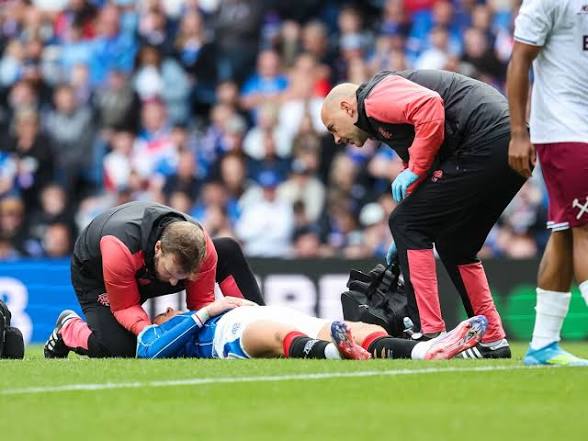
The dramatic closing moments of Rangers’ Scottish Premiership opener against Dundee United continue to dominate the conversation among supporters days after the final whistle, and the debate shows no sign of dying down anytime soon. Derek McInnes was left visibly furious on the touchline, Rangers players surrounded the referee in the immediate aftermath, and fans inside Tannadice were convinced their side had been denied a golden opportunity to snatch all three points on the opening weekend of the new season. Yet despite the sheer volume of discussion surrounding the incident across phone-ins, podcasts and social media, one important detail has largely been overlooked amid all the noise: there has been no public statement whatsoever from referee Nick Walsh explaining his decision. The only explanation available to supporters, pundits and journalists alike remains the one he gave on the pitch in real time, and for many Rangers fans, that has simply not been enough.
The flashpoint arrived deep into the second half, with Rangers pushing hard for a late winner that would have completed a dramatic opening-day turnaround at Tannadice. Mohamed Diomande, deployed in an advanced midfield role and looking to make an impact in the closing stages, drove purposefully into the Dundee United penalty area in search of a match-winning moment. As he attempted to get a shot away or work an opening, he went to ground following what appeared, to the Rangers players and travelling support at least, to be a clear challenge from Dundee United defender Emmanuel Agyei. The Rangers players reacted instantly, wheeling away in appeal, utterly convinced that Diomande had been illegally impeded inside the box and that a penalty should follow.
Nick Walsh, the man tasked with making the split-second call, saw the incident rather differently. Rather than pointing to the spot amid the wall of Rangers appeals surrounding him, the referee instantly signalled for a goal kick, making his view unambiguously clear in the moment: no foul, in his assessment, had been committed. It was a decisive, instant call rather than a hesitant one, the kind of definitive signal that referees are trained to give when they are confident in their reading of a challenge. That on-field decision has remained unchanged in the days since, with no indication from the Scottish FA or from Walsh personally that any review or reconsideration is forthcoming.
Adding further intrigue to the situation is the fact that the Video Assistant Referee did not intervene to instruct Walsh to review the incident on the pitch-side monitor. Under the current protocols governing VAR usage in Scottish football, that non-intervention means one of two things: either the officials monitoring the incident from the VAR hub agreed with Walsh’s initial call that no foul had occurred, or they concluded that, even if the decision was arguably wrong, it did not meet the required threshold of a “clear and obvious error” needed to overturn an on-field call. That distinction matters a great deal in the court of public opinion. A penalty shout that is reviewed and confirmed as correct sends a very different message to supporters than one that is simply waved away without any check taking place at all, and it is that lack of visible scrutiny that has fuelled much of the frustration bubbling up around Ibrox in the days since the final whistle.
The controversial call sparked an immediate and visible reaction from the Rangers technical area. Sky Sports cameras, broadcasting the match live, captured Derek McInnes looking genuinely stunned in the moments immediately following the decision, his body language betraying a manager who could scarcely believe what he had just witnessed. His frustration did not dissipate with the final whistle either; instead, it carried on well beyond the end of the match. The Rangers manager was seen walking onto the pitch to confront Walsh directly once the game had concluded, seeking answers in person that had not been forthcoming in the heat of the moment. McInnes later revealed that he had also held a private conversation with the match officials after the game had finished, though he stopped notably short of disclosing any detailed explanation that may have been offered to him behind closed doors. Whatever was said in that exchange has, for now, remained between the Rangers boss and the officiating team, adding yet another layer of mystery to an already contentious afternoon.
That reluctance to go into detail is, in many ways, entirely understandable from a management perspective. Managers who publicly criticise referees or reveal the specifics of private conversations with officials can find themselves facing disciplinary action from the Scottish FA, a risk that McInnes, still finding his feet in his opening weeks in the Ibrox hotseat, will have been keen to avoid. It is a well-worn tightrope that managers across Scottish football are forced to walk on a regular basis: expressing genuine frustration at contentious decisions while stopping just short of the kind of explicit criticism that invites punishment. McInnes’s visible anger in the moment, followed by his more measured and guarded comments afterwards, fits neatly into that familiar pattern.
The controversy ultimately overshadowed what had, in many respects, been an encouraging first competitive outing for the new Rangers boss. After falling behind in the first half to a goal from Lachlan Rose, Rangers responded impressively after the interval, showing the kind of resilience and character that McInnes will have been desperate to see from his players in his first real test in the dugout. Thelo Aasgaard was the man to level matters, cancelling out Rose’s opener and giving Rangers a foothold back in the contest that they would build on as the match progressed. The comeback spoke well of the changes McInnes made and the response his side produced under pressure, even if the headlines in the days that followed were dominated almost entirely by the penalty shout rather than the fightback itself.
Despite ultimately earning a point on the road against a Dundee United side who will have been reasonably satisfied with a draw against last season’s league runners-up, many Rangers supporters left Tannadice with a lingering sense that their side should have been given the chance to win the match outright from the penalty spot in the closing stages. That feeling has only intensified as the days have passed without any further clarification from officialdom. In an era where refereeing transparency is an increasingly prominent talking point across British football, with some leagues and competitions experimenting with post-match explanations, referee interviews, and public audio releases to explain contentious calls, the continued silence from both Walsh and the Scottish FA on this particular incident stands out as conspicuous by comparison.
It is worth placing this incident within the broader context of officiating controversies that have dogged Scottish football in recent seasons. Refereeing standards, VAR consistency, and the willingness of match officials to explain their decisions publicly have all been recurring flashpoints north of the border, with managers, players and pundits regularly calling for greater transparency from the governing body. Campaigns for referees to be made available for post-match interviews, similar to managers and players, have gained periodic momentum, though the Scottish FA has so far stopped short of implementing such measures on a consistent basis. Incidents like the one involving Walsh and Diomande at Tannadice only add fuel to that ongoing debate, providing another high-profile example of a contentious call that has gone unexplained and unresolved in the public domain.
For Rangers, the timing of this controversy is particularly unwelcome given what lies immediately ahead on the fixture calendar. With a crucial Europa League qualifying tie against Jagiellonia Bialystok looming in midweek, the last thing McInnes and his players will have wanted heading into a hugely significant European fixture is a lingering distraction over a refereeing decision from the opening weekend of the domestic season. Managing the emotional fallout from a moment like this, while simultaneously preparing a squad for a high-stakes continental clash, is exactly the sort of early test that can define how a new manager handles adversity in his opening weeks at a club of Rangers’ size and expectation. How McInnes channels that frustration in the build-up to the Jagiellonia tie, whether by using it as motivational fuel or by ensuring his players move on from it entirely, could offer an early insight into his man-management approach as he continues to settle into the role.
There is also a wider question here about how such moments shape the narrative around a new managerial appointment. McInnes arrived at Ibrox with plenty of expectation attached to his appointment, tasked with steadying a club that had fallen short of its own lofty standards in the previous campaign. His first competitive result, a battling 1-1 draw away at newly promoted opposition, was always going to be scrutinised closely regardless of the penalty controversy, but the Walsh incident has undeniably added an extra dimension to how that opening result will be remembered and discussed in the weeks to come. Supporters and pundits alike will now be watching closely to see whether this becomes an isolated flashpoint, quickly forgotten as the season progresses, or the first of several officiating grievances that come to define a difficult relationship between Rangers and match officials this season.
It is also worth taking a closer look at the incident itself and the specific circumstances that made it such a contentious talking point in the first place. Diomande’s run into the box came at a moment when Rangers were throwing bodies forward in search of a winner, with Dundee United understandably retreating into a more defensive shape to protect their point. Agyei, tasked with tracking Diomande’s late surge into the area, was in a recovering position rather than a set defensive stance, the kind of scenario that often produces the most contentious penalty shouts because contact can be difficult to adjudicate at full speed. Slow-motion replays shown on Sky Sports in the aftermath appeared to show some element of contact between the two players, though the degree to which that contact was sufficient to constitute a foul, rather than simply two players competing fairly for the ball, remained a matter of genuine debate among pundits watching on. Some observers felt Walsh’s instant read was entirely justified, pointing to Diomande’s own momentum and suggesting he may have gone down under his own weight rather than as a result of any meaningful impediment from the Dundee United defender. Others were equally adamant that a foul had been committed and that Rangers had been unfairly denied a clear penalty in a moment that could have decided the match.
That split in opinion is, in many ways, precisely what makes incidents like this so combustible in the modern football media landscape. In an age of endless replays, multiple camera angles, and slow-motion analysis available within seconds of an incident occurring, fans and pundits alike are now accustomed to picking apart contentious decisions in forensic detail. A split-second call made by a referee at full speed, with a single vantage point and no opportunity for a second look, is inevitably going to be scrutinised against footage that offers considerably more clarity than was available to Walsh in the moment. That gap between what the officials could see in real time and what armchair viewers can dissect frame by frame afterwards is a persistent source of tension in football, and it is a tension that shows no sign of easing as broadcast technology continues to improve.
The role of VAR in this particular incident deserves further examination too. The current guidelines for VAR intervention are built around the principle that the technology should only be used to correct clear and obvious errors, rather than to re-referee every marginal decision from scratch. That threshold is intentionally set high, designed to preserve the authority of on-field officials and prevent matches from being disrupted by lengthy stoppages for decisions that are merely debatable rather than plainly wrong. In this instance, the fact that the VAR team did not call Walsh over to the pitch-side monitor suggests that, whatever conversation took place in the video assistant referee hub, the officials involved did not consider the penalty shout to have cleared that high bar. Whether supporters agree with that assessment or not, it is a decision that was made using the same criteria applied across the rest of the league, even if the lack of any published reasoning leaves fans to guess at exactly how that conclusion was reached.
This is precisely where calls for greater refereeing transparency tend to gain the most traction. Had Walsh, or a representative of Scottish football’s refereeing body, been able to offer even a brief public explanation of the reasoning behind the non-award, much of the ongoing frustration among Rangers supporters might have been defused far more quickly. Instead, the vacuum left by official silence has been filled by speculation, debate, and no shortage of strongly worded opinions across social media and phone-in shows, with little sign of consensus emerging naturally. Football supporters, by and large, are not asking for every decision to go their way; what they consistently ask for is understanding, a clear sense of why a particular call was made, especially in a moment as pivotal as a stoppage-time penalty shout in a season-opening fixture. The absence of that explanation here has left a sense of unfinished business hanging over an otherwise credible opening result for Rangers.
Andy Halliday, among other former players turned pundits, has been vocal in the days since the match discussing incidents from the Dundee United draw, reflecting the broader appetite among ex-professionals to dissect exactly what went wrong and right for Rangers on the opening weekend. That level of scrutiny, while sometimes uncomfortable for those involved, is simply part and parcel of following a club with the history and expectation that Rangers carries. Every decision, every performance, and every talking point from a match involving Rangers tends to be picked over in extensive detail by a media landscape that thrives on debate and disagreement, and the Walsh penalty incident has proven to be fertile ground for exactly that kind of discussion.
Looking ahead, there is a reasonable chance that this controversy fades from the immediate conversation once Rangers’ attention turns fully to their Europa League qualifying assignment against Jagiellonia Bialystok. European nights have a habit of resetting the agenda quickly, particularly when qualification for lucrative group-stage football is on the line, and McInnes will be keen to ensure his players are fully focused on the challenge ahead rather than dwelling on a decision that cannot now be changed. That said, incidents like this one have a tendency to resurface later in the season, particularly if refereeing standards or VAR consistency become recurring talking points as the campaign progresses. Should Rangers find themselves embroiled in further contentious officiating moments in the weeks and months ahead, the Diomande non-award at Tannadice may well be cited as an early example in a pattern that supporters and pundits alike will be watching closely for.
For now, though, there is no official public explanation from Nick Walsh beyond his instant on-field judgment that the challenge on Diomande did not constitute a foul worthy of a penalty. Unless the Scottish FA takes the unusual step of releasing further information, whether through a formal refereeing review, published VAR audio, or some other form of official clarification, the decision looks set to remain one of the most fiercely debated moments of the opening weekend of the new Scottish Premiership season.
There is a broader lesson in here too for how supporters, clubs and governing bodies navigate these moments going forward. Football has never been short of contentious refereeing decisions, and it never will be, given the split-second nature of the calls officials are asked to make and the sheer volume of camera angles now available to scrutinise those calls after the fact. What has changed in recent years is the appetite among supporters for accountability and explanation, driven in part by other sports and other leagues around the world that have begun experimenting with greater officiating transparency. Rugby union’s use of publicly broadcast referee communication, and the NFL’s willingness to have officials explain contentious calls to broadcast audiences in real time, are often cited by football supporters as examples of a more transparent model that the sport could, in theory, move towards. Scottish football, like many domestic leagues around Europe, has been slower to embrace that shift, and incidents like the Diomande penalty shout at Tannadice serve as a reminder of why that gap in transparency continues to frustrate supporters so consistently.
For Rangers specifically, the hope will be that this becomes little more than a footnote in what is still a long and demanding season ahead. A single penalty shout, however contentious, will not define McInnes’s tenure at Ibrox, and the manager himself will be acutely aware that dwelling too long on decisions that cannot be reversed serves little practical purpose. What matters far more in the immediate term is how Rangers respond on the pitch, starting with the crucial Europa League qualifier against Jagiellonia Bialystok, and how quickly the noise around this particular incident fades into the background of a season that is only one match old. Rangers fans, still processing a mixed opening-day outcome that saw genuine promise in the second-half comeback overshadowed by refereeing frustration, will simply have to wait and see whether any further clarity emerges, or whether this becomes another unresolved chapter in Scottish football’s long-running debate over officiating transparency.