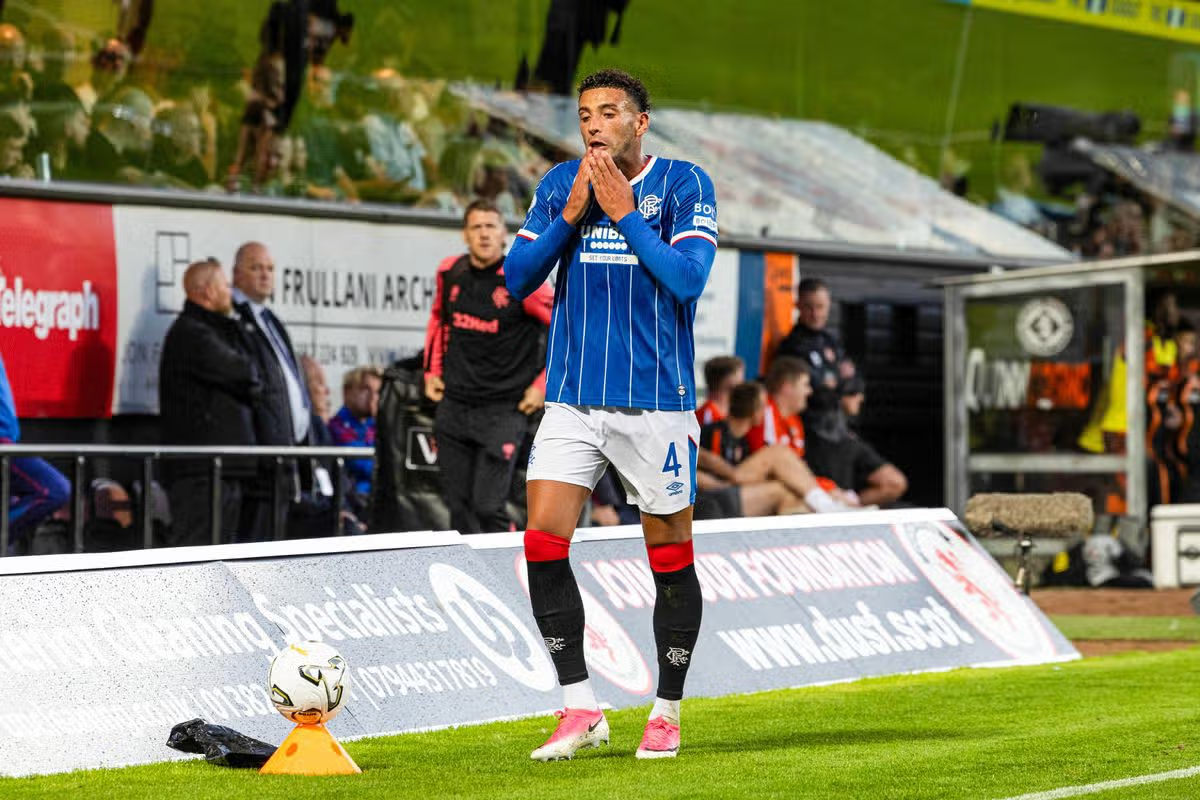
Rangers will hold their breath on Monday when Ben Godfrey undergoes a scan that could shape the rest of Derek McInnes’s early weeks in the Ibrox hot seat, with the club desperately hoping their new loan defender has avoided anything serious after limping out of Friday night’s Premiership curtain-raiser against Dundee United. The 1-1 draw at Tannadice was always going to be picked apart for signs of encouragement and cause for concern in equal measure given it represented McInnes’s first competitive outing since taking permanent charge of the club, but few could have predicted that the abiding image from the trip north would be Godfrey’s grimace as he was helped from the pitch, leaving his manager to face an anxious weekend of waiting rather than basking in the afterglow of a solid opening-night point.
The Atalanta loanee had arrived at Ibrox amid a wave of cautious optimism, one of the more eye-catching additions of a summer rebuild that has seen McInnes attempt to stamp his own identity on a Rangers squad still finding its feet after a turbulent close season. Godfrey, who built his reputation in the Premier League with Everton before a switch to Serie A, was viewed by many inside the club as exactly the kind of experienced, physically robust defender capable of anchoring a backline that has looked short of leadership and know-how in recent seasons. His arrival on loan was framed as a statement of intent, proof that McInnes and the Ibrox hierarchy were serious about competing on multiple fronts this season, from a Premiership title challenge to another assault on European qualification. That context makes Friday’s injury blow all the more painful, because it strips away, even if only temporarily, one of the very pieces McInnes was counting on to solidify his back line just as the fixtures start coming thick and fast.
According to information reaching Record Sport, the club’s medical staff will assess Godfrey on Monday, with everyone at Ibrox hoping the results come back favourably enough to limit his absence to somewhere in the region of two to three weeks. That would be a best-case scenario allowing him to potentially return for a string of pivotal fixtures in late August and into September, missing a handful of matches rather than being sidelined for months. But scans have a habit of throwing up unwelcome surprises, and until the results are in, nobody at the club can say with total confidence what they are dealing with. Should the news be worse than hoped, McInnes could be staring down the barrel of a genuine defensive crisis heading into a week that already carries enormous significance for the direction of his maiden season in the dugout.
That significance comes in the shape of Rangers’ Europa League qualifying tie away to Polish outfit Jagiellonia Bialystok, a first-leg assignment on Thursday night that arrives with the club needing to navigate continental competition while simultaneously trying to build momentum domestically. European nights have long carried special weight at Ibrox, and qualifying rounds in particular have a habit of catching sides cold if they are not properly prepared, both tactically and in terms of squad depth. Losing Godfrey for that trip to Poland, even before considering the longer-term picture, would represent a considerable blow to McInnes’s plans, robbing him of a defender whose physical profile and experience of high-pressure European nights with Atalanta made him an obvious candidate to marshal what is already a threadbare-looking backline.
The scale of the problem becomes clearer when you consider who else is unavailable to McInnes at present. John Souttar, once considered one of the more dependable options at the heart of the Rangers defence and a full Scotland international to boot, finds himself frozen out of first-team plans entirely and is understood to be closing in on an exit from Ibrox before the transfer window shuts. His departure, while perhaps understandable given the direction the club wants to take under its new manager, nonetheless removes another senior centre-back from an increasingly threadbare pool of options, leaving McInnes with precious little cover should injuries continue to bite. It is a reminder of how quickly a squad can be stretched thin when rebuilding work overlaps with the unforgiving realities of a season that refuses to wait for a manager to get his house fully in order.
With Godfrey now facing the prospect of a spell on the sidelines and Souttar effectively out of the picture, that leaves Emmanuel Fernandez as arguably the only recognised, fit senior centre-back McInnes can call upon in the short term. Fernandez has impressed in patches since arriving at the club, showing the kind of composure on the ball that modern managers crave from their central defenders, but asking one player to shoulder that responsibility alone, particularly across a punishing run of fixtures that mixes league business with continental football, is far from ideal. It is the sort of situation that exposes gaps in squad planning ruthlessly and quickly, and it is precisely the kind of scenario McInnes will have wanted to avoid in the opening weeks of his tenure, when first impressions and early results can shape the mood around a club for months to come.
Rangers’ response to this defensive shortfall may well have to come from within, with two players in particular potentially being asked to fill the void created by injury and departures. Dujon Sterling, who has typically operated in wider defensive roles since his move north, could be asked to shift infield and adapt to life as a makeshift centre-back, a role that would test his versatility but is not without precedent for full-backs pressed into service in moments of crisis. Alternatively, Ross McCrorie, whose versatility across various defensive positions has made him something of a utility man during his time at the club, represents another option McInnes could turn to in order to paper over the cracks. Neither solution is perfect, and both would represent a compromise rather than a genuine long-term fix, but with the transfer window still open and reinforcements not yet through the door, McInnes may have little choice but to improvise in the short term.
It is worth remembering that this defensive puzzle was already occupying plenty of McInnes’s thinking even before Godfrey’s injury complicated matters further. The Rangers manager has been open about his desire to add fresh faces at the back before the window shuts, going as far as to state publicly that he wants two more defenders brought into the fold to bolster a department he clearly views as needing further investment. That stance has not been merely rhetorical, either, with the club already dipping into the market to sign South African centre-back Olwethu Makhanya from Philadelphia Union in a deal worth around £3 million. Makhanya’s arrival was seen as a long-term addition designed to add depth and competition for places, a young defender with the physical attributes to eventually establish himself as a regular fixture in the Rangers back line. However, his path to featuring in the early rounds of European competition is complicated by ongoing visa issues, which mean the 22-year-old is considered a doubt for the first leg against Jagiellonia Bialystok in Poland, denying McInnes an option that, on paper at least, might otherwise have offered some relief amid the current defensive concerns.
The picture that emerges, then, is one of a Rangers side attempting to rebuild on the fly, with injuries, bureaucratic red tape, and departures all conspiring to complicate what should have been a summer of relatively straightforward squad strengthening under a new manager eager to make his mark. McInnes, for his part, has not shied away from voicing his frustrations, making clear on multiple occasions that he wants transfer business to be concluded swiftly rather than dragging on into the closing days of the window. His message to the club’s decision-makers has been blunt and to the point: reinforcements need to arrive soon if Rangers are to avoid being caught out by a thin squad as the season gathers pace across multiple competitions. Friday night’s injury to Godfrey only adds further weight to those calls, turning what might have been viewed as a slightly cautious request for extra bodies into something approaching an urgent necessity.
Beyond the specific issue of centre-back cover, the wider context of Rangers’ summer business paints a picture of a club in the midst of a significant overhaul. Lawrence Shankland arrived to considerable fanfare and has already been the subject of discussion regarding leadership within the squad, with suggestions that the striker may look to lean on senior figures at the club as he adjusts to life at Ibrox and considers what a captaincy role might look like in the future. Elsewhere, McInnes has strengthened his midfield options with the additions of Dan Neil and Cammy Devlin, two players whose energy and work-rate should help freshen up a Rangers engine room that at times last season looked short of legs and intensity. Between the sticks, Ivor Pandur has come in to provide competition and cover in goal, another piece of a rebuild that has touched almost every area of the pitch since McInnes took the reins on a permanent basis.
Yet for every arrival, there has been a departure, and the outgoing business at Ibrox this summer has been just as significant a talking point as the incomings. Belgian international Nicolas Raskin’s future remains one of the more closely watched sagas of the window, with speculation continuing to link him with a move to Villarreal after a series of eye-catching performances on the international stage during the World Cup only served to heighten interest in his services. Rangers are braced for concrete offers to materialise for the 25-year-old, and there is a growing sense around the club that his time at Ibrox may be entering its final chapter, even if nothing has yet been finalised. Losing a player of Raskin’s quality and influence in the middle of the park would represent a significant blow in its own right, adding yet another layer of complexity to a summer that already feels defined by uncertainty as much as ambition.
Further forward, Finnish international Oliver Antman has already completed his move away from the club, joining Belgian side Anderlecht last week in a transfer that brings the curtain down on his time in Scotland. It is another example of the squad churn that has characterised the early days of the McInnes era, as the manager looks to trim numbers and clear out players who do not fit into his long-term vision for the team. That process of natural attrition is set to continue in the coming days and weeks, with a cluster of players including Ross McCausland, Clinton Nsiala, Jose Cifuentes and Lyall Cameron all understood to be free to explore their options away from Ibrox should suitable offers arrive. Meanwhile, Albanian international Nedim Bajrami’s future looks set to lie in Saudi Arabia, with the winger currently waiting on the finer details of a loan move to Al-Taawoun to be finalised, a deal that would allow both player and club to move forward following a spell that never quite hit the heights many had hoped for when he first signed.
All of this business, both incoming and outgoing, forms the backdrop against which Godfrey’s injury must be viewed. It is not simply a case of one player being sidelined for a few matches; it is a fresh complication layered on top of an already complex jigsaw puzzle that McInnes and his recruitment team have been working through since the manager’s appointment was made permanent. Every departure creates a gap that needs filling, every arrival brings its own settling-in period, and every injury threatens to unravel careful planning at precisely the wrong moment. For a club with the ambitions Rangers continue to hold, both domestically and in Europe, there is precious little margin for error, and McInnes will be acutely aware that how his side responds to this early setback could go a long way towards defining the tone of his tenure in the weeks and months ahead.
The Dundee United result itself offered a mixed bag for supporters trying to take the temperature of the new-look Rangers side. A point on the road against a United team who, according to their own manager Jim Goodwin, were fully committed to making life as difficult as possible for McInnes on his competitive bow, is far from a disaster, particularly given the disruption caused by Godfrey’s withdrawal. There were signs of promise in patches, moments where the new arrivals showed glimpses of the qualities that persuaded the club to bring them in, but there were also familiar frustrations, with some describing a recurring issue in the way certain players continue to give the ball away in dangerous areas, a sin that has apparently been highlighted repeatedly in training but has yet to be fully eradicated on matchday. McInnes will have taken note of both the positives and the negatives as he begins the process of moulding his squad into a cohesive unit capable of competing on the multiple fronts the club insists it wants to challenge on this season.
Adding a further layer of intrigue to McInnes’s early weeks in charge has been the ongoing saga surrounding his SFA touchline ban, which threatened to keep him out of the dugout for a period before a successful appeal earned him a reprieve, allowing him to take his place pitchside for the visit to Tannadice. That off-field distraction, while ultimately resolved in his favour, is another reminder of just how eventful the early stages of his reign have already proven to be, with governance issues rubbing shoulders with transfer sagas and now a significant injury concern in the space of just a few short weeks. It is the kind of baptism of fire that few incoming managers would relish, but it is also, in its own way, a test that could help forge the resilience and adaptability McInnes will need if he is to succeed in one of Scottish football’s most demanding jobs.
Looking ahead, the picture will start to become clearer once Monday’s scan results are known. Should the news on Godfrey prove positive, relatively speaking, Rangers may be able to navigate the coming weeks with a degree of makeshift solutions and squad rotation before their new defender is fit to return and provide the stability the club signed him to offer. Should the results prove less favourable, McInnes may find himself pushed into the transfer market with even greater urgency than before, searching for a short-term fix to a defensive crisis that threatens to undermine the early weeks of his permanent reign before it has even had the chance to properly get going. Either way, the coming days promise to be pivotal, not just for Godfrey’s immediate playing prospects but for the broader shape and confidence of a Rangers side still very much finding its identity under its new manager, with a testing trip to Poland already looming large on the horizon and precious little time to find answers before Thursday night arrives.
There is also a wider strategic dimension to consider here, one that stretches beyond the immediate concern of who lines up at centre-back on Thursday night. Rangers have made no secret of the fact that this season is being viewed internally as a rebuilding year with genuine ambition attached, a campaign in which the club hopes to reassert itself both domestically and on the continental stage after a period in which results have not always matched the scale of the institution. Achieving that kind of reset requires stability in key areas of the pitch, and few positions matter more to a manager’s peace of mind than the heart of defence. A settled, experienced central defensive pairing tends to act as the foundation upon which everything else is built, allowing a manager the freedom to experiment further up the pitch, to blood younger players in wide areas, and to trust that mistakes elsewhere on the field will not automatically translate into conceded goals. Strip that foundation away, even temporarily, and the ripple effects can be felt throughout the entire team, forcing more conservative selections and limiting the tactical flexibility a manager might otherwise enjoy.
That is precisely the bind McInnes now finds himself in. Godfrey’s arrival was meant to provide exactly the kind of platform described above, a defender with Premier League and Serie A pedigree whose sheer physical presence and reading of the game were supposed to allow Rangers to press higher up the pitch with greater confidence, knowing they had cover in behind capable of dealing with transitions and mopping up danger. Losing him, even for what the club hopes will be a short spell, removes that safety net at precisely the moment McInnes is trying to instil new habits and a fresh style of play across the squad. It is little wonder, then, that so much attention will be focused on Monday’s scan results, with the outcome likely to shape team selection not just for the visit of Jagiellonia Bialystok but potentially for several weeks of fixtures beyond that as well.
Supporters, too, will be watching events unfold with a mixture of anxiety and cautious hope, aware that the opening weeks of any new managerial reign tend to be scrutinised more closely than most. Early setbacks have a habit of being magnified in the court of public opinion, particularly at a club with the history and expectation levels that follow Rangers wherever they go. Yet there is also an awareness among the more measured sections of the fanbase that injuries are simply part and parcel of football, an unavoidable occupational hazard that no amount of careful planning can fully insulate a squad against. What matters more than the injury itself, in many respects, is how the club and its manager respond to it, whether through smart rotation, a swift return to fitness, or, if required, further additions to the squad before the transfer window finally slams shut later this summer.
For now, all eyes turn to Monday and the verdict the scan will deliver. It is a small moment in the grand scheme of a long and demanding season, but one that carries outsized significance given everything else swirling around Ibrox at present, from the ongoing search for defensive reinforcements to the uncertainty surrounding Raskin’s future and the looming test of European qualification. Derek McInnes has already shown, in his short time in permanent charge, that he is not afraid to be direct about what his squad needs, and it would be no surprise to see that same directness on display in the coming days as he pushes the club to move quickly, whatever news Monday’s scan ultimately brings. Rangers supporters, for their part, will simply be hoping the update on their new defender is the kind that allows the club to focus fully on the football rather than yet another fitness concern layered onto an already eventful start to the campaign.