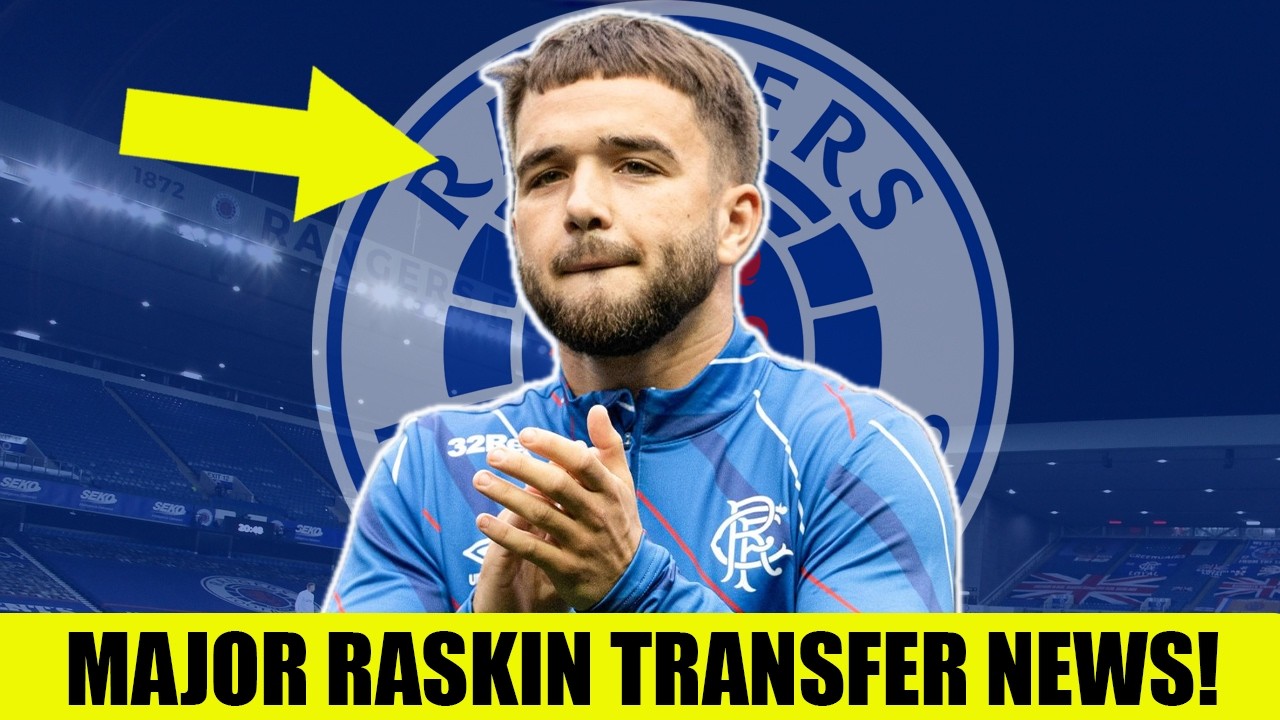
Rangers look to be on the verge of a significant piece of summer business, with Nicolas Raskin closing in on a £17million move to Villarreal that would represent one of the biggest sales the Ibrox club has sanctioned in recent memory. That fee, understood to be worth around €20million in total, would immediately be reinvested into strengthening Derek McInnes’ midfield, with two separate deals now edging closer to completion as a direct consequence of Raskin’s expected departure from Scotland.
The Belgian international’s stock has never been higher, and it is not difficult to see why. Raskin enjoyed an outstanding World Cup campaign this summer, performances that have only intensified interest in his services from clubs across the continent and put an already impressive Ibrox career firmly in the shop window. Manchester United had been credited with keeping close tabs on the 25-year-old for some time, while reports elsewhere suggested Aston Villa, Inter Milan, Bologna, Atalanta and Real Betis had all been linked with the former Standard Liège midfielder at various points during the window. It is now La Liga side Villarreal, though, who appear to have stolen a march on that considerable list of admirers, with sources in Spain indicating the Yellow Submarine are well placed to get a deal over the line in the coming days.
Should the move go through, Raskin would become new Villarreal boss Iñigo Pérez’s first signing since taking over at the Estadio de la Cerámica, a notable statement of intent from the Spanish club as they look to build around the Belgian’s considerable engine-room quality. It has not been the most straightforward negotiation, it must be said. Earlier reports out of northern Spain suggested Villarreal had seen an initial €20million bid accepted, only for that claim to lose momentum fairly quickly once it became clear Rangers were holding out for a fee closer to their valuation, with suggestions circulating that Villarreal themselves may not have been able to stretch to that full amount without complications of their own. Whatever the precise mechanics of the final structure, Rangers appear increasingly confident of getting a deal in the region of £17million agreed, even if it ultimately arrives a shade below their original asking price once the finer details are settled.
The timing of Raskin’s expected exit is significant for reasons that go well beyond the transfer fee itself. Derek McInnes has previously been open about the fact that further sales would be required before he could push on with additional incoming transfers this summer, and Raskin’s departure, along with the sizeable funds it will free up, looks set to give the Rangers boss exactly the kind of financial breathing room he has been waiting for. It is worth remembering, too, that Rangers’ recruitment plans this summer have not been limited purely to Raskin’s replacement. McInnes has also been keen on the idea of a reunion with Lewis Ferguson at Bologna, though Rangers are understood to accept that striking an agreement with the Italian club will be extremely difficult given how highly the Serie A side rate their captain, which only adds to the importance of getting maximum value from the Raskin sale to fund whatever business follows.
Much of that reinvestment already appears to be taking shape around two specific midfield targets. Chief among them is Tromso’s Jens Hjerto-Dahl, a deal that has swung through a genuine rollercoaster of twists over recent days. Well-placed sources at Ibrox had indicated the move was at real risk of collapsing entirely, only for the situation to shift again within the space of 24 hours, with freelance journalist Sam Cohen reporting that a third bid from Rangers had led to “significant progress” being made, with a fee in the region of £6.6million now understood to be back under serious discussion. Personal terms are understood not to represent a stumbling block, having been broadly agreed in principle some time ago, and Hjerto-Dahl himself has made no secret of his desire to complete the move to Glasgow, a factor that continues to work in Rangers’ favour even as the fee negotiations with Tromso have proven more stubborn than first anticipated. The 20-year-old has also had to fend off interest from elsewhere during the process, with both Besiktas and Cardiff City previously credited with interest in the Norwegian, only for Tromso to knock back the Welsh club’s advances as talks with Rangers gathered pace.
Hjerto-Dahl’s underlying numbers go some way to explaining why Rangers have persisted through the deal’s various wobbles this summer. The Norway Under-21 international has scored seven goals in 14 Eliteserien appearances during the 2026 campaign for Tromso, a return that works out at a productive rate of goal contributions from a central midfield role, including a spectacular strike from distance in his side’s most recent outing. Those attacking numbers have led to suggestions that Hjerto-Dahl could ultimately prove an even more impactful presence in the final third than Raskin himself, assuming he can make the necessary adjustment to the physicality and tempo of Scottish Premiership football, an adaptation that would represent the final hurdle in fulfilling what many now view as considerable long-term potential.
The second half of Rangers’ planned midfield double swoop appears to carry far less uncertainty attached to it. Partizan Belgrade captain Vanja Dragojevic looks to be closing in on his own move to Ibrox, with reports suggesting the 20-year-old has already touched down in Glasgow to undergo a medical and complete the remaining formalities of a switch worth around £4million. That fee would represent excellent value for Rangers given the calibre many observers already attach to the young Serbian, who arrives with a reputation of playing above his years and is viewed by many close to the deal as a genuinely exciting long-term addition to McInnes’ engine room.
Dragojevic’s departure from Partizan has not gone unmarked by his outgoing employers, either. Club boss Sasa Ilic, himself a former Galatasaray and Red Bull Salzburg player during his own playing days, offered a warm and gracious tribute to his departing captain as the move edged towards completion, wishing Dragojevic well in the next stage of his career while acknowledging the scale of the gap his exit leaves behind. Ilic went on to explain the wider financial reality driving Partizan’s willingness to sanction the sale of their own skipper, making clear that every top coach craves as much competition for places as possible within a squad, but that such ambitions are ultimately dictated by the financial realities each individual club faces. He added that Partizan had already brought in four new faces of their own this summer but conceded further additions would be required once Dragojevic’s exit was finalised, candidly acknowledging that his club’s entire operating model depends on generating revenue through player sales given its ongoing financial constraints.
Taken together, the shape of Rangers’ summer midfield rebuild is becoming considerably clearer. Should all three pieces of business fall into place as expected, McInnes would be losing his most prized midfield asset in Raskin, but replacing him with two significantly younger alternatives at a combined cost of around £12million, a deal structure that would still leave Rangers with a healthy profit once Raskin’s own sale is finalised, all while adding fresh legs, energy and long-term resale value to a Rangers midfield that has looked increasingly reliant on the departing Belgian in recent seasons. It fits a wider pattern that has characterised much of Rangers’ recruitment activity this summer, with the club already having completed the signings of Ross McCrorie, Ben Godfrey, Ivor Pandur, Dan Neil and Cammy Devlin, in addition to Lawrence Shankland, who was already at the club before McInnes’ arrival.
For Rangers supporters, there will inevitably be a degree of sadness attached to losing a player of Raskin’s undoubted quality, particularly given the way his World Cup performances this summer have elevated his reputation onto a genuinely continental stage. Few would have predicted, even twelve months ago, that the Belgian would be attracting serious interest from clubs the calibre of Manchester United, Inter Milan and Atalanta, and his departure represents the kind of outcome that speaks to just how far his game has developed during his time in Scotland since arriving from Standard Liège back in January 2023 for a fee in the region of £1.5million. That original outlay, set against the £17million now being discussed for his services, represents an extraordinary return on investment by any measure, and it underlines why Rangers, for all the emotional pull of keeping hold of one of their standout performers, are unlikely to stand in his way given the financial sense the sale makes for a club still working to balance ambitious recruitment against sustainable business practices.
There remains, of course, no shortage of uncertainty around exactly how and when these various pieces of business will be finalised, and Rangers will be conscious of the ticking clock given that both Hjerto-Dahl and Ferguson, whatever the outcome of that particular pursuit, remain in demand elsewhere. Time, rather than willingness, appears to be the most significant obstacle left standing in the way of Rangers completing what would represent a hugely significant midfield reshuffle before the transfer window shuts. Should Raskin’s move to Villarreal go through as expected, and should Hjerto-Dahl and Dragojevic both follow through on their own switches to Ibrox, McInnes would enter the new Scottish Premiership campaign with a considerably refreshed midfield unit, one built around lower average ages, greater long-term sell-on potential and a clear reinvestment strategy that Rangers’ hierarchy will hope pays dividends both on the pitch and on the balance sheet in the years to come.