Three Big Talking Points From Rangers’ Goalless Pre-Season Finale Against West Ham As Captaincy Question Looms Large


Rangers brought the curtain down on their pre-season programme with a goalless stalemate against recently relegated West Ham United at Ibrox on Sunday afternoon, a fixture that offered plenty for supporters and analysts alike to chew over as Derek McInnes now turns his full attention towards the serious business of the Scottish Premiership campaign. With competitive football just days away, this final warm-up match in front of 48,178 fans in Govan represented the last chance to run the rule over the squad before the trip to Tannadice to face Dundee United on Friday, a fixture that will officially kick off McInnes’s attempt to end Celtic’s recent dominance at the top of Scottish football.
Chances were genuinely at a premium throughout the ninety minutes, with both sides largely cancelling each other out in what was ultimately a cagey and low-event affair befitting the closing stages of a pre-season schedule. Yet even in a match short on clear-cut opportunities, there was still plenty to be gleaned about where Rangers currently stand heading into the new campaign, from lingering questions over leadership to genuine concerns about creativity in the final third, alongside growing clarity over what McInnes’s strongest starting midfield trio might look like once the season gets under way in earnest.
Perhaps the most eye-catching subplot heading into this fixture, and one that continues to generate significant discussion among supporters, revolves around who will be handed the Rangers captaincy for the new season. Regardless of where individual fans stood on former skipper James Tavernier and the question of whether he truly embodied what a “proper Rangers captain” should represent, there is no disputing that his Ibrox tenure is now firmly a thing of the past, with a new leader set to formally take the armband when Rangers travel to face Dundee United this coming Friday.
The scale of genuine competition for that role has been laid bare throughout pre-season, with a striking number of candidates having tried the armband on for size in the weeks leading up to this West Ham fixture. Lawrence Shankland, Dan Neil and Vanja Dragojevic have all previously captained their respective former clubs, giving each of them a credible claim to the role at Ibrox, while Dujon Sterling and Ben Godfrey have also both worn the armband at various points during Rangers’ pre-season schedule. That sheer breadth of options raises an interesting question in itself, namely which of these candidates McInnes will ultimately settle on, and indeed how much the specific identity of the captain genuinely matters in practical terms, given how many credible leaders McInnes appears to feel he currently has scattered throughout his dressing room.
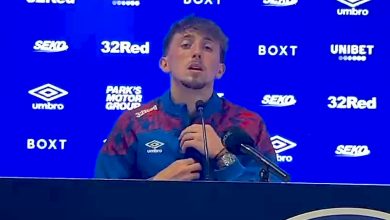
There has been a narrative in recent seasons suggesting Rangers have lacked genuine leadership figures both on and off the pitch, making McInnes’s own response when asked directly about his captaincy plans all the more encouraging for supporters hoping for a change in that regard. Speaking on the matter, McInnes explained that a leadership group exists within the training ground on a daily basis, indicating that strong character and accountability run through his squad more broadly rather than being concentrated in a single individual. He acknowledged that supporters and observers tend to become fixated on the specific question of who wears the armband, a preoccupation he said he understood given the traditions attached to the role at a club of Rangers’ stature, but he was equally clear that he considers himself fortunate to have several genuinely viable candidates to choose from.
McInnes drew a deliberate contrast with situations he has encountered previously in his managerial career, describing scenarios where a manager might survey his dressing room and feel genuine uncertainty over who could be trusted to lead the team out. That is not a feeling he currently has at Ibrox, he explained, given how many players within his group he believes could capably handle the responsibility. Still, he acknowledged that ultimately one individual has to be given the formal duty of leading the team down the tunnel, confirming that he has, in his own mind, already reached a decision on who that will be. He explained that his approach throughout pre-season had essentially been to observe each candidate from something of a distance while they wore the armband in various friendlies, and that the qualities he has continued to see from his eventual choice on a daily basis at the training ground have only reinforced the conclusion he had already reached.
Moving beyond the captaincy debate, one of the more pressing concerns to emerge from Sunday’s stalemate centred on Rangers’ lack of genuine attacking creativity, an issue that will likely occupy much of McInnes’s thinking in the closing days before the visit to Tannadice. Pre-season fixtures are, by their nature, notoriously difficult to draw firm conclusions from, given the lack of real context around fitness levels, rotation policies and the simple fact that no points are genuinely at stake. Even accounting for that caveat, though, the manner in which Rangers struggled to unlock a well-organised West Ham defence will have given McInnes and his coaching staff plenty to think about. Aside from a close-range headed effort from Mohamed Diomande, there was little to suggest Rangers ever looked close to genuinely carving their visitors open over the course of the ninety minutes.
Individually, there were mixed levels of contribution from those tasked with providing that attacking spark. On the left flank, Djeidi Gassama struggled to make any meaningful impact, with his play described as far too predictable and comfortably nullified by West Ham’s defensive efforts down that side. Elsewhere, Thelo Aasgaard showed some encouraging touches operating just behind Ryan Naderi, demonstrating clear technical quality in possession, but was let down by a tendency to make the wrong decision at the crucial moment when it came to his final touch or delivery, undermining what were otherwise promising passages of build-up play.
Encouragingly for supporters, this appears to be an issue McInnes is fully aware of and actively working to address before the competitive season begins. Speaking after the match, he was direct in outlining exactly what type of attacking reinforcement his side currently lacks, stating that Rangers need players capable of acting as genuine difference makers, individuals who can isolate defenders in one-on-one situations and operate effectively from either flank. He explained that his current striking options, Ryan Naderi, Youssef Chermiti, Lawrence Shankland and Bojan Miovski, are all more than capable of finishing off chances once presented with them, but he was candid in assessing that only Chermiti currently possesses the individual quality to consistently create genuine goalscoring opportunities for himself independently, through his own movement and technical ability.
By contrast, McInnes explained that Naderi, Shankland and Miovski remain heavily reliant on service being provided to them by their teammates, meaning the overall quality and consistency of that service becomes absolutely critical if Rangers are to maximise the goalscoring threat those forwards genuinely possess. He did note some positive signs emerging during the second half against West Ham specifically, with Rangers managing to get a greater number of crosses into the penalty area and, as a result, creating a few more presentable opportunities for their forward line. Even so, McInnes was clear that a broader shift in mentality is required throughout his squad, stressing the need for players who genuinely view creating chances for teammates as an important and valued part of their overall contribution to the team, rather than an afterthought secondary to their own individual game.
Turning to the third significant talking point from Sunday’s draw, McInnes used his post-match press conference to offer a clear assessment of where he believes his squad’s greatest strength currently lies, identifying central midfield as the area boasting the most overall quality and depth. Given the scale of investment Rangers have made in that particular department over the course of the summer, few would be inclined to argue with that assessment. The club significantly bolstered their midfield options through the triple addition of Dan Neil, Cammy Devlin and Vanja Dragojevic, three signings that have transformed the competition for places in the centre of the park.
Beyond that trio of new arrivals, McInnes also has Mohamed Diomande, Connor Barron, Thelo Aasgaard and Tochi Chukwuani all actively competing for regular game time in central areas, creating a genuinely crowded and competitive picture. Nicolas Raskin’s name can technically still be added to that list as things currently stand, though given the persistent speculation surrounding his long-term future at Ibrox, it would take a particularly confident observer to bet on the Belgian remaining part of the squad much beyond the upcoming transfer deadline.
Having such an abundance of options naturally represents a welcome problem for any manager to have, even if it does leave McInnes facing a genuine selection dilemma when it comes to settling on his preferred starting midfield configuration. Against Saint-Etienne earlier in the week, McInnes opted to deploy three central midfielders rather than the two he had used in previous fixtures, and there remains little concrete indication at this stage of exactly what formation and midfield setup supporters should expect to see when Rangers travel to face Dundee United. That degree of tactical flexibility, whether by design or simply a product of McInnes still fine-tuning his best system, adds an extra layer of intrigue heading into the season opener.
Regardless of the precise shape and personnel McInnes ultimately settles on, one player appears to have done more than enough during pre-season to force his way into serious contention for a starting berth at Tannadice. Cammy Devlin’s performance during the first half against West Ham stood out as a particularly encouraging sign, with the Australian international’s industrious, terrier-like approach clearly resonating strongly with the home support inside Ibrox. His energy levels and combative style were evident well before kick-off, with Devlin seen actively encouraging and organising his teammates in the build-up to the match, before backing that up once play got under way with a high-energy, pressing display that embodied exactly the kind of relentless work rate Rangers supporters have long craved from their midfield options.
That desire to make a genuine and lasting impression clearly did not go unnoticed among the Ibrox faithful, who responded enthusiastically to his efforts throughout his time on the pitch. On the balance of his performances across pre-season, and particularly given how well he was received during Sunday’s showing, it increasingly looks difficult to envisage a Rangers starting lineup for the visit to Dundee United that does not include Devlin, whose combination of energy, application and evident hunger to seize his opportunity appears to have gone a considerable way towards winning over both his manager and the watching supporters alike.
Taken together, these three talking points, the still-unresolved captaincy decision, the clear and acknowledged need for greater attacking creativity, and the genuinely encouraging strength and depth McInnes now possesses in central midfield, paint a picture of a Rangers side that enters the new season with both promising foundations and clearly identified areas requiring urgent attention. With pre-season now firmly behind them and Friday’s trip to Tannadice rapidly approaching, McInnes and his coaching staff have precious little time remaining to address the creativity concerns highlighted during Sunday’s stalemate, while supporters eagerly await official confirmation of exactly who will be handed the honour of captaining this newly rebuilt Rangers side into a campaign that will be measured, ultimately, by whether McInnes can end Celtic’s recent stranglehold on the Scottish Premiership title come the conclusion of the season in May