Bristol City predicted team vs Wrexham: Luke McNally return likely with home improvement needed

Some fixtures arrive with a story already attached, and Tuesday night at Ashton Gate is one of them. Bristol City, a club that spent much of last season in the top-six conversation, host Wrexham while sitting 18th in the Championship, looking for their first win in four matches and their first sign of life at home in months. Wrexham, the Hollywood-backed side whose manager was the subject of speculation only days ago, arrive having just won 1-0 at Lincoln, unbeaten in three, with a squad that is thinner in attack than its budget suggests. I should say at the start that this is a preview written before kick-off. I don’t know the result, and everything below is built from team news and the predicted lineups that have been published, some of which disagree with each other.
The fixture is on Tuesday, November 24, with kick-off at 7:45pm UK time, and it comes only three days after both clubs played. For Bristol City, the previous match was a 2-0 defeat at Middlesbrough, the league leaders, which left them 18th after 16 games. The club’s own preview describes the Robins as looking for their first win in four matches. That is a run that has turned a mid-table position into a worry, and the table tells the same story. A team that was in the promotion conversation not long ago now sits closer to the relegation places than to the top six, and the drop has been quick enough that the explanation lies in a handful of specific problems and not in a general decline.
The most specific of those problems is the home record, and it is the reason the headline speaks of improvement needed. According to the Sports Illustrated preview, Bristol City have lost six of their eight home matches and scored just four goals at Ashton Gate this season, with spirits low among the home support. Those two numbers deserve a pause. Six defeats from eight is a record that belongs to a relegation side, and four goals from eight home games is an attack that averages half a goal per match in front of its own supporters. A team that scores that rarely at home cannot expect to win often, however well it defends, and the supporters’ mood is the natural consequence. Ashton Gate has gone from a place opponents feared to a place that looks like a gift on the fixture list.
It helps to understand how that happened, though the evidence available is partial. The most visible change is in the dugout. The preview material from earlier in the season and from last year named Gerhard Struber as head coach, and the current preview is built around Michael Skubala, who confirmed after the Middlesbrough match that two players would be available for selection. I do not have a detailed account of the change of manager, and I will not guess at the circumstances. What the contrast shows is that this is a club in transition, with a new head coach working to improve results and a squad that has had to adapt to different ideas in a short period. Managerial changes often produce short-term uncertainty before they produce improvement, and Bristol City look to be in the uncertain phase.
The team news is the part of the preview that supporters will have been reading most closely. The club’s own report states that Michael Skubala confirmed post-match at Middlesbrough that Luke McNally and Joe Williams will be available for selection after missing the match due to illness. That wording is precise, and it deserves to be read carefully. Illness is a different thing from injury, and a player who has been ill may be fit to play but short of match sharpness, and a manager may prefer to ease him back. The Bristol Live preview that prompted this question describes McNally’s return as likely, which is consistent with his being available, but it is a prediction by a journalist and not a decision by the club.
McNally’s importance is easy to explain, and it has been underlined by how often his name has appeared in injury lists. The centre-back was ruled out for the rest of a previous season after an ACL injury, as one earlier team-news item in the coverage recorded, and he has been on and off the missing-player lists in several of the previews I have seen. A defender who has had that kind of injury history is not simply a name on a team sheet. His return gives a coach a left-sided option in a back three or a ball-playing partner in a back four, and it changes how a team builds from the back. For a side that has been conceding the sort of goals that lose home games, having him fit is a significant gain.
Joe Williams is the other name, and his availability matters for different reasons. He is a midfielder who has featured in the long-term absentee lists in earlier previews, and his return to the squad offers Skubala another option in a department that has been stretched. How much he is likely to play is a question the reports do not answer, and I would be wary of assuming a start. A player returning from illness who has also had a history of injuries is the kind of player a manager brings back slowly, perhaps with a place on the bench.
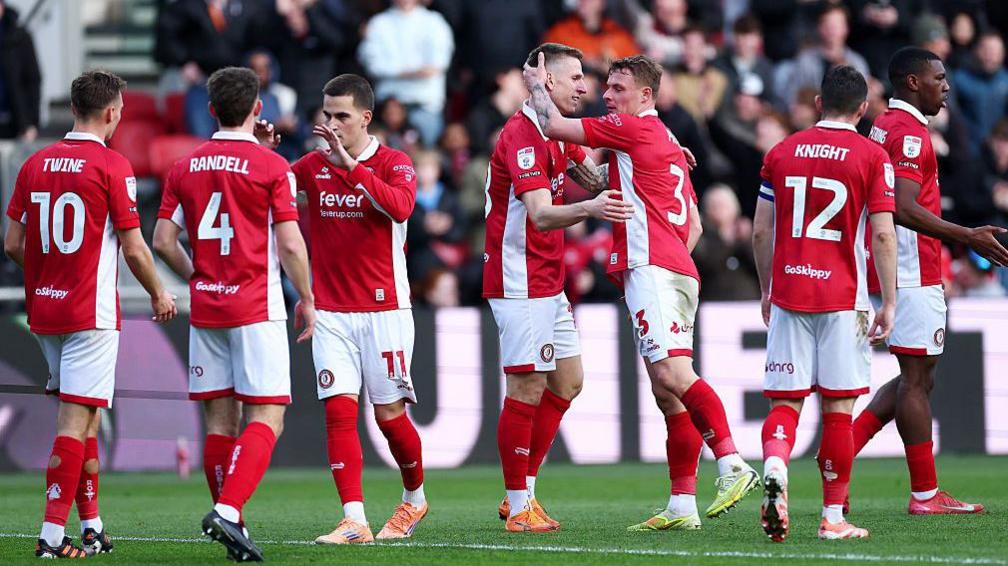
The predicted lineups disagree about how all this fits together, and the disagreement is instructive. Sports Illustrated, working with FotMob, predicts a 4-2-3-1: Collins in goal; Tanner, Dickie, Atkinson and Pring across the back; Knight and Randell in midfield; Cardines, Twine and Hirakawa behind a lone striker, Ballard. The same piece says that the defence should remain unchanged, with the expected alterations coming in attack, and it singles out the possible return of Scott Twine, whom it calls a hugely popular option among supporters. That prediction has no McNally in the defence, which sits awkwardly with the suggestion that he is likely to return. Either the writer has not taken his availability into account, or the expectation is that he will be used as a replacement later. Without the team sheet it is impossible to say.
The case for Twine is the most interesting part of that prediction. He is an attacking midfielder who has been injured for long stretches, and the earlier preview material in the coverage records him as dealing with quad tightness and being subject to late fitness decisions. A player in that position is a gamble for a coach. If he is fit and sharp, he can supply the creativity that has been missing from the home games. If he is not, he risks a recurrence that costs weeks. The fact that supporters are asking for him to be recalled suggests how badly they feel the attack needs a spark. A team that has scored four home goals in eight matches does not lack the ability to defend. It lacks someone who can open a game up, and Twine, when fit, has been that player.
Other parts of the lineup reflect the pressure on the forward line. Ballard as a lone striker is a notable choice, because it implies that the club is not leaning on the more established forwards that appeared in earlier previews. In the older material, the names were Emil Riis and Sinclair Armstrong, with the head coach managing their minutes. This time the focus is on a different pairing, and the writer attributes that to the need for changes in attack after the weekend. I should not read too much into one predicted XI. Predictions from outside the club tend to assume rotation in the position that has been underperforming, and the real selection will depend on who is fit and what the coach decides.
Now turn to Wrexham, whose position is almost the mirror image. They arrive in better form than their hosts, with a win at Lincoln behind them, and the preview coverage describes them as getting a significant confidence boost from recent results against stronger opposition. The win itself was narrow and unspectacular. As the earlier discussion of the Lincoln match showed, Wrexham had three shots on target, were outshot and out-created by the hosts, and won through a moment of quality from George Thomason in the 82nd minute. The Sports Illustrated preview says they didn’t create much against Lincoln but managed to snatch a win thanks to one moment of brilliance from Thomason, and with so many attackers still injured, will need to find another match-winner.
That last clause is the central question for Wrexham. A club with their resources should not be short of attacking options, and the fact that the preview refers to many attackers being injured is a reminder that a large squad is not the same as a deep one. The Yahoo ratings from the Lincoln match noted that the win was owed more to defensive resolve than attacking quality, and that Kieffer Moore, the veteran striker, had one attempt in the match. A team that relies on its back three and its goalkeeper to protect a lead, and on a single moment to break the deadlock, can win in this way, but it is a pattern that tends to run out. Over a forty-six-game season, the margin between a goalless draw and a narrow win is a matter of luck, and no side can count on it.
The defensive structure is more encouraging. Parkinson’s back three at Lincoln, as the ratings described it, was led by Max Cleworth, with Joe Worrall and Callum Doyle alongside, and Anthony Patterson in goal earned an 8 for saves from four different Lincoln players. If that group holds its form at Ashton Gate, Wrexham will be hard to beat, because a team that scores four times in eight home matches is not equipped to break down a settled defence. That is the logic behind the predictions I have seen. Both Sports Illustrated and Sportskeeda forecast a 0-1 Wrexham win, with the latter tipping under 2.5 goals and both teams not to score. These are the calls of previewers, not statistical models with a track record, and I would treat them as informed guesses. But the reasoning is sound: a hosts’ attack that struggles to score meeting a visitors’ defence that has just kept a clean sheet points to a low-scoring match.
There is more context in how the two teams have met in the recent past. Bristol City’s own preview records that the most recent meeting was a 2-2 draw at Ashton Gate in February, in a match the club lists under February 17, though another source in the coverage gives the date as February 16, which is probably a time-zone or reporting difference. Before that, a mightytips preview noted that Wrexham had won 2-0 in the previous meeting, which I take to be the match in Wales in November last year. The head-to-head record on the club’s page shows 15 wins for Bristol City, six draws and ten defeats in 31 meetings, with the biggest win a 4-0 victory in April 2000. That history favours the hosts, but it is a long record, and the recent results are closer than the old totals suggest. Wrexham have taken four points from the last two meetings, which is a reminder that the gap between the sides is smaller than the table implies.
The table itself is worth a moment. When these teams met in February, both were in the top half, with Wrexham eighth and Bristol City ninth, separated by a single point. Now one is 18th and the other is, by the evidence of the previews, in a more comfortable position, though I do not have the exact current table for Wrexham. The change over nine months shows how fast fortunes move in the Championship. A team that was within reach of the play-offs can drift towards the bottom half within a season, and a club that looked secure can find itself under pressure. For Bristol City, that is the worry. For Wrexham, it is a warning.
The season so far has been unsettled for Wrexham too, and the earlier conversation about Phil Parkinson’s position is relevant here. A report I cited a few days ago said they had won only two of their first ten league games, and that a failure against Preston might have been the manager’s last match. I do not know how that Preston match went, but the subsequent results, including the win at Lincoln, suggest that the pressure has eased. A manager who is unbeaten in three is in a more secure position than one who is losing, and the speculation about alternatives, including the suggestion that Steven Gerrard might be attracted to the job, tends to fade when the team is winning. A second away win in a week would strengthen that further. Conversely, a defeat at Ashton Gate against a team that has lost six of eight at home would revive the questions.
That adds an edge to the contest that goes beyond the points. For Wrexham, it is an opportunity to build a run and to answer critics who say the squad is underperforming. For Bristol City, it is a chance to show that the new head coach has a plan and that the home form can be repaired. Neither club can afford a bad result, and both have reasons to be cautious. That is the kind of match that often produces a tight, low-scoring affair, which is what the predictions suggest
The tactical matchup is more interesting than the standings imply. Wrexham have used a back three with wing-backs, and Bristol City’s most recent shapes have included both a back three and a back four, depending on the predicted lineup. If Skubala goes with a 4-2-3-1, as Sports Illustrated suggests, he will be trying to outnumber Wrexham in midfield and create overloads on the flanks. A back three with wing-backs is designed to deal with exactly that, using the wing-backs to track opposing wide players and the three centre-backs to cover the middle. The result could be a game in which Bristol City have the ball and Wrexham have the structure, and the question is whether the hosts can turn possession into chances.
The flanks are where it may be decided. Wrexham’s wing-backs, among them Issa Kaboré, who was singled out in the Lincoln ratings as a real terror for the opposing full-back, offer pace and directness. If Bristol City’s full-backs, Tanner and Pring in the predicted XI, are drawn forward to support the attack, they risk being exposed on the counter-attack. That is the trade-off for any team trying to be more attacking at home. A more adventurous setup creates more chances but leaves more space behind, and a Wrexham team that is content to defend and break quickly is well placed to punish it.
The central midfield battle matters just as much. Jason Knight and Adam Randell are the predicted pairing for Bristol City, and their job would be to control the middle, protect the back four and supply the creative players ahead of them. Against a Wrexham midfield that includes Ben Sheaf and Lewis O’Brien, the duel is likely to be physical and closely contested. Wrexham’s approach at Lincoln was to absorb pressure and wait, and if they do the same here, the midfield will be where the match is won or lost. A team that wins the second balls and keeps possession in the right areas has the best chance of creating something against a deep defence.
The goalkeeping contrast is also worth noting. Wrexham have Anthony Patterson, who earned the highest rating in the team at Lincoln. Bristol City’s predicted lineup has Collins in goal, though the earlier previews named Radek Vitek, and the discrepancy shows how much rotation and injury have affected the position. I do not have enough information to say who will play, and I would not draw conclusions from the difference between predictions. What matters is that a settled goalkeeper gives a back line confidence, and Wrexham appear to have one.
Set-pieces could be decisive in a game like this. When both teams struggle to create from open play, dead-ball situations become the main source of goals. Wrexham’s win at Lincoln came from a scramble after a corner or a loose ball, as the discussion earlier suggested, and Bristol City’s few home goals may well have come from similar situations. A team with a strong aerial presence and well-drilled routines can win a match without creating much, and both clubs will be aware of that. The return of McNally, if it happens, would help on that front, since a ball-playing centre-back who is also good in the air is useful at both ends.
It is worth being honest about the limits of this kind of preview. Predicted lineups are written by journalists working from training reports and recent selection patterns, and they are wrong often enough that the team sheet an hour before kick-off is the only reliable guide. The statistical and betting previews add a layer of apparent precision, but a pick of 0-1 is a rough guide to the likeliest outcome, not a forecast with any special authority. The two sources that gave that scoreline agreed with each other partly because they were drawing on the same facts: a poor home record, a visiting defence in decent form and a low-scoring tendency. Football does not always follow such logic, and a match between a struggling home side and an away side with a thin attack is exactly the kind of fixture that can go either way.
What would a good night look like for each side? For Bristol City, it would be a win, of course, but even a draw with a clean sheet and a more convincing attacking performance would be a step forward. The priority is to stop the slide at home and to show that the team can create chances and score. That would lift the supporters and give the new head coach some breathing room. A defeat, by contrast, would deepen the gloom, and a fourth home loss in a row would raise questions that no amount of explanation could answer.
For Wrexham, a win would extend their unbeaten run to four and show that the Lincoln result was not a one-off. It would also give them two away wins in succession, which would be a strong sign of progress. A draw would be acceptable, a point from a difficult ground, but would leave the same questions about how the team scores goals. A defeat would be a setback, particularly given the opponent’s form, and it would reopen the debate about the manager and the squad.
One thing that is unlikely to change is the importance of the next few weeks. The Championship is a league in which a handful of results can transform a season, and the congested schedule in November and December makes every match count. Both clubs have fixtures coming thick and fast, and the squad depth that has been strained by injuries will be tested. Skubala’s decisions on whom to rotate, and Parkinson’s on how to cope without his injured attackers, will shape their respective campaigns.
For supporters watching tonight, the details to look for are small ones. Whether McNally starts and how Bristol City defend set-pieces will say something about the squad’s recovery. Whether Twine is in the lineup will show how much the head coach trusts him and how fit he is. For Wrexham, the questions are who plays up front and whether the team can create more than it did at Lincoln. If Kieffer Moore is again a lone presence with little support, the visitors will rely on a single moment again, and that is a risky strategy.
At the end of the night, one of two stories will have been confirmed. Either Bristol City will have started to repair their home form and the new head coach will have a platform to build on, or Wrexham will have shown that defensive resolve can carry them through a difficult run. Neither story is dramatic, but both matter, and the winner will carry momentum into the weeks ahead. If the predictions are right, it will be a narrow Wrexham win, grinding and low on goals, the kind of result that promotion contenders collect and that their supporters accept without celebration. If they are wrong, the hosts will have found the improvement the headline asks for, and the season will look a little different.
I will not guess which. The honest position, before a ball has been kicked, is that this is a match between a team that needs a lift and a team that has found a way to win without being brilliant, and that the margins will be small. The team news, the lineups and the first twenty minutes will tell us more than any preview can, and that, in the end, is the reason people watch.