The most revealing decisions in a transfer window are the ones that never become headlines. A club that sells a player makes news, and a club that refuses to sell makes only a paragraph, but the refusal usually tells you more about how the club sees its season. Rangers’ reported decision to keep Ryan Naderi through January is one of those quiet statements. It says that the club believes it can win something this year, that it does not trust the market to hand it a replacement, and that it has finally found a striker whose value it understands. It also exposes the limits of the strategy, because the same facts that make Naderi indispensable make the squad around him look thinner than the unbeaten run suggests.
Begin with what is reported, because the story has been repeated across several outlets and it is worth keeping the layers apart. The headline comes from a piece originally published about ten days ago, and it says that Naderi has attracted significant transfer interest, but Rangers reportedly have no intention of sanctioning a sale during the upcoming winter window. A second report, credited to the journalist Fraser Fletcher, goes further. According to the Yahoo summary of it, Rangers have told every suitor that he will not leave, and the interested parties are Wolverhampton Wanderers, West Ham, an unnamed Premier League club and a Bundesliga side, none of whom, it says, will be allowed to buy him in the winter. Neither report quotes a Rangers official on the record. These are sourced accounts of private positions, which is the normal way a club’s refusal reaches the public, and the sensible reading is that the intention is real but that nothing is binding. In the language of every January window, a player is not for sale until the right bid arrives.
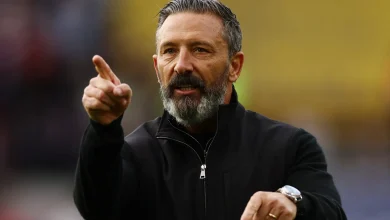
The right bid, as it happens, has already been described. In an earlier discussion of Naderi’s rise, a report said that Rangers were prepared to keep him but that a bid of £18m might get them thinking. That number should be treated as a rumour, since it comes from one outlet and is attributed to no one, but it fits a pattern. A club that says it will not sell is often a club that has a price, and the price is set high enough to deter casual interest. McInnes has been candid about the principle. Asked about January after the November international break, he said that if somebody comes in way over the top then you have to consider it. That is not a refusal. It is a statement that every player has a number, and that the number for Naderi is far above what any suitor has yet offered.
To understand why the number is so high, you have to look at what Naderi has done and at where he came from. He is 23, German-born and now a Czech international, and he arrived at Ibrox in a way that looked unremarkable at the time. He signed from the German third division club Hansa Rostock for £4.7m on deadline day in January, a day after Rangers had initially agreed a £3m move to land him in the summer. The account of the transfer says Hansa did not want to sell a player who had eight goals and five assists, and that further talks pushed the price up. A separate report put the final figure at about €5.5m with a sell-on clause. These figures are consistent once you allow for the exchange rate, and they show a club paying a fair price for a young striker with an upward trajectory, nothing more.
What makes the signing look better each month is how it came about. At the time, Rangers were in the market for a forward because of what the coverage called the goalscoring woes of their summer signings. They had been linked with Leeds striker Joel Piroe, whose move was being pushed by the club’s vice-chairman, and the player reportedly turned it down in favour of fighting for his place at Leeds. The report added that Rangers were expected to carry on talks with Hansa Rostock over a deal for Naderi after learning Piroe had no interest. In other words, Naderi was the fallback option. The striker who is now one of the most coveted players in the Scottish game was, at the moment of his signing, what a club settled for when the first choice said no. Transfer windows are full of such stories, and they are a useful corrective to the idea that recruitment is a precise science.
His output since has justified the fallback. He has scored nine goals and provided six assists in 17 games across all competitions this season, and the Yahoo piece says he has ten goal contributions in 11 league games in 2026/27, which makes him the leading figure in McInnes’s attack. The two figures measure different things and should not be read as a contradiction, the first covering all competitions and the second the league alone. What matters is the shape: a striker who is directly involved in a goal roughly every game or every other game. That is a rate that very few players in Scotland can match, and it explains why scouts have been at Ibrox. The report says that Premier League scouts have regularly been in attendance to watch Naderi and team-mate Olwethu Makhanya, which hints that Makhanya, too, has attracted attention, though the club’s stated position focuses on the striker
The national team has added to his profile. He earned his first senior cap for the Czech Republic in October, an achievement that puts him in front of scouts from across Europe. International recognition has a way of changing how clubs see a player. A forward who is performing well in the Scottish Premiership can be dismissed as a big fish in a small pond, but a player who is trusted by a national team in competitive fixtures is harder to dismiss. It was inevitable that the interest would follow.
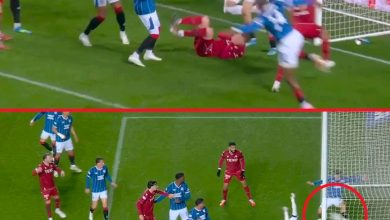
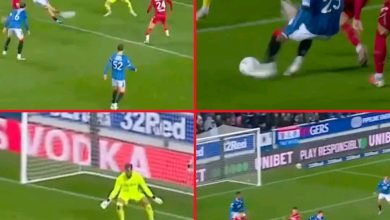
Then there is the match against Motherwell, which came after the reports were written and gives them fresh weight. Naderi scored the late winner, an 88th-minute finish that took a deflection off Martin Moormann, and the reports disagree about whether it counts as his goal or an own goal. Sky and the match data credit it to him, and Read Rangers’ coverage describes it as a deflection into the net by the defender. Whichever way the record ends up, the context is what matters. Rangers were without Kevin Kelsy, who had spent ten and a half hours in an airport on the way back from international duty, and McInnes reshaped the team so that Naderi was the lone striker for most of the night. That is a significant detail. A striker who is asked to lead the line alone, against a deep and determined defence, for more than an hour, and who is still in the right place when the decisive moment comes, is showing the kind of persistence that clubs value. It is also exactly the kind of evidence a manager points to when explaining why a player is not for sale.
McInnes has said as much in his own words. After a 2-0 win over St Mirren, the report quotes him saying that at a club like Rangers you are judged on goals, and that he wants Naderi to build a reputation for being horrible to play against. That second phrase is revealing. It describes a striker who is not just a finisher but a pest, someone who presses, harasses and wins the ball back. The Yahoo analysis supports it, noting that Naderi is no dribbler and does not hold up the ball well, but that Rangers get the best from him when wide players deliver early crosses. The same analysis puts numbers on his limitations, saying he completes fewer than a third of his dribbles and wins under four in ten duels. Those are not the statistics of a complete forward. They are the statistics of a player with a particular set of strengths, who needs the team built around him to exploit them.
That is why the replacement problem is so acute. The Yahoo piece makes the argument bluntly: Rangers have not won the league since 2021, and McInnes has no obvious alternative who scores at Naderi’s rate while Chermiti and Shankland work back to fitness. The injuries are central to this. Youssef Chermiti, whose recovery from an ACL injury was discussed earlier in this conversation, is not expected back until well into the new year at the earliest, and probably much later. Lawrence Shankland, who had a hamstring problem, is on track to return in early December, according to McInnes’s latest update. Kevin Kelsy has been Naderi’s usual partner, but he is young and was visibly tired on Saturday. In that context, selling the one forward who is scoring consistently would leave the attack with a hole that a loan or a bargain signing would struggle to fill.
The point about January replacements deserves some emphasis, because it is where the “sell now at a profit” argument breaks down. In the middle of a season, selling clubs have little incentive to part with their best players cheaply, and the supply of good strikers who are both available and affordable is thin. A club that sells in January has to buy in January, and the player it can buy is rarely as good as the one it sold. The analysis makes this argument directly, saying that finding a striker with this output in January, when selling clubs rarely loosen their grip, is close to impossible. That is a fair summary of how the market works. Rangers’ own experience supports it. A year ago, when they needed a forward, the first-choice target said no and they ended up with Naderi. Had Naderi also been unavailable, the story would have been different.
There is a financial dimension that the club is clearly aware of. Naderi’s contract runs until 2029, which means Rangers are under no pressure to sell and can wait for the best offer. The analysis notes that the club paid £4.7m and that any buyer should expect to pay several times that. That is a standard way of framing it, and it explains why the club is comfortable declining offers. A player who cost less than five million pounds and now has a market value many times higher is an appreciating asset, and the longer he performs, the more he is worth. Selling in January, in the middle of a title race, would mean accepting a price that does not reflect his potential. Selling in summer, after a full season of goals and with a second international campaign behind him, is likely to command more.
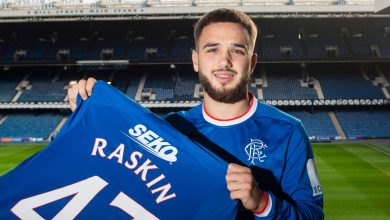
It is worth being clear about what the club is risking by holding him. A player who is told he will not be sold, while Premier League clubs are interested, can become unsettled. The risk is not that he will rebel, since Naderi has given no sign of that, but that his head might be turned if the situation drags on or if he feels the club is blocking a move he wants. A footballer in his early twenties who has been told that bigger clubs want him is in a delicate position. The best managers handle it by being honest, explaining that the club wants to win something with him this season and promising that a proper conversation will come in the summer. McInnes has shown himself capable of this kind of communication, as the episode with Nicolas Raskin demonstrated. Raskin wanted to leave in the summer, was blocked, said he was disappointed, and has since played some of the best football of his Rangers career. If Naderi follows a similar path, the club will have managed him well.
Contract security helps. A player who is signed until 2029 has a long-term stake in the club’s success and knows that a significant payday is available if he performs. He also knows that Rangers have held firm in the past and will not sell on a whim. That clarity is useful. It allows him to concentrate on football and reduces the temptation to listen to agents who might encourage him to push for a move. The bigger risk is that an injury or a loss of form would reduce his value, which is why some analysts argue that clubs should sell when the price is highest. But that argument assumes the player will decline, and there is no evidence that Naderi is likely to.
The decision also looks sensible when set against the rest of the January picture. Rangers’ stance on other players shows a club trying to rebalance its squad, not to overhaul it. The reports say that Jose Cifuentes is expected to be sold, since his representatives have held talks with the club and agreed that a sale is the best option before his contract expires next summer. His situation is the opposite of Naderi’s. He is a player who was expected to leave in the summer but suffered a knee injury in pre-season, and the club could not shift him off the wage bill. The same report says Rangers are also keen to sell Oscar Cortes when he returns from his loan at Huracan. These are the sorts of moves a club makes when it is clearing space, and they suggest that the club wants to reduce the squad’s bulk while keeping its best performers.
The same source says Rangers have decided against a move for former loanee Vaclav Cerny, despite Besiktas being open to selling, and that they have no plans to sell Djeidi Gassama midway through the campaign. This is consistent with a club that is not planning a major shake-up. Gassama’s situation is interesting in light of the criticism he received on Saturday, discussed earlier, and it shows that the club still believes in him despite an uneven night. Together, the decisions paint a picture of a team that is confident in its core and wants to move out the fringe players who are not contributing.
What would a different approach look like? A club that sold Naderi in January for a large fee would have money to spend, and the fee could, in theory, be reinvested in two or three players. That is the argument for a sale, and it is not trivial. A sale of, say, ten million pounds would be a return of more than double the purchase price in a single year. But the practical difficulty is that the replacements available at that moment would almost certainly be worse, and the title race would suffer. Rangers have not won the league since 2021, and the margin to Celtic is four points. A club that is that close does not usually sell its best forward.
The counter-argument also deserves a hearing, because there is a risk in over-reliance. Naderi’s profile, as the analysis points out, is not that of a complete striker. If opponents work out how to stop the early crosses that feed him, or if the wide players who supply them are injured or out of form, his output could drop. The match against Motherwell was a reminder of this. Rangers had 29 shots and needed a deflection in the 88th minute to win, which suggests that the team’s attack is not always as sharp as the unbeaten run suggests. A striker who relies on service is only as good as the service he receives, and if the supply dries up, the goals dry up too. That is a reason to think carefully about how dependent the team is on one player.
The sensible answer is to have cover, and that is where January might still be busy. The club has ruled out a sale of its best striker, but it has not ruled out strengthening. Earlier discussions in this conversation covered links to wide players such as Danny Armstrong, and reports of interest in midfielders. A striker who can play alongside Naderi or cover for him would be a sensible addition, particularly given Chermiti’s long absence and Shankland’s slow return. The challenge is that the same market realities apply. Selling clubs are reluctant, prices are high, and the best options are often unavailable.
It is also worth thinking about what the decision says about the club’s ambitions. A team that is serious about winning the title keeps its best players. It does not sell a forward in the middle of a campaign, however attractive the offer, unless it has a ready replacement. The refusal to sell Naderi, like the decision to turn down a reported bid for Chermiti in the summer, is consistent with a club that sees itself as a contender and not as a selling club. For a side that has gone years without a league title, that matters. It signals to the squad that the management believes in them, and it signals to supporters that the owners are willing to put sporting success ahead of short-term profit.
There is a longer-term view, too. A striker who stays and succeeds is worth more in the summer than one who is sold now. Naderi is 23, with a contract to 2029, and he has a lot of improving to do. If he scores 20 or more goals this season and plays a leading role in a title challenge, his price will rise, and Rangers will be in a stronger position to negotiate. If he is sold now, the club forgoes that potential. If the team fails to win the title and he leaves in the summer, the club will still have received a full season of his goals. Either way, the case for waiting is stronger than the case for selling.
The risk, of course, is that the summer brings no better offers, or that an injury ruins everything. Football is unpredictable, and a player who looks like a rising star can see his value fall quickly. That is the nature of the gamble, and Rangers have decided that the odds favour holding. Given what is known about his performance and the state of the squad, that decision looks reasonable.
For supporters, the news should be welcome but not a cause for complacency. A club that keeps its best striker has done the sensible thing, but it has not solved its problems. The injuries remain, the depth is limited and the schedule is about to become demanding. The January window will test whether the club can add quality without losing it. If the new signings fit and the injured players return on time, the team will be in a strong position. If not, the decision to keep Naderi will have been necessary but not sufficient.
The wider lesson is about how clubs manage success. When a player does well, the temptation is to cash in, particularly when the offer is large. The clubs that win things tend to resist that temptation, accepting that the benefit of keeping a key player outweighs the financial gain. Rangers, under McInnes, are acting like a team that believes it can win. Whether they do will depend on a hundred factors, but the decision to keep Naderi is a sign that the belief is genuine.
In the end, the story is simple. A striker who was a fallback option a year ago has become the most important player in a title challenge. Several clubs want him, and Rangers have said no. The reasons are sound: he is scoring regularly, there is no ready replacement, and the price is well above anything on offer. The risks are real, but they are outweighed by the benefits of keeping him. If the season ends with a trophy, the decision will be remembered as the moment the club chose ambition over profit. If it ends without one, it will be a reminder that holding on is not the same as winning. Either way, it was the right call to make, and the club deserves credit for making it.