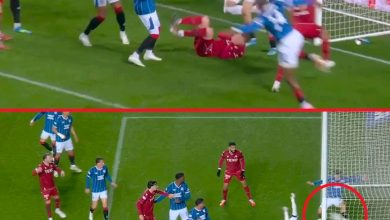
The only reason Aberdeen goal against Rangers was given as Premiership VAR goal-line checks rely on one thing

Football supporters in Scotland have grown used to a certain kind of argument. It starts in the stands, spills onto social media within seconds, and ends in a radio phone-in the following evening. The subject is almost always a split-second call that went one way or the other, and the heat of it usually comes from the suspicion that the outcome was arbitrary. When Aberdeen visited Ibrox on Tuesday night and Brad Lyons nodded the ball over the Rangers goal line, the suspicion that surfaced was a more unsettling one than usual. It was not that the officials had got it wrong. It was that they had got it right largely by luck.
The goal was given. It stood, and it put Aberdeen in front in a match that Rangers would eventually win 3-2. But the reason the goal could be awarded with confidence is not a comfortable one for a top division that likes to describe itself as modern. According to reporting from the Daily Record, the decision was possible only because the game happened to be live on Sky Sports. Had the same fixture been shown by a different broadcaster, with a different camera setup, the officials reviewing the incident might have had nothing conclusive to look at. Had it not been televised at all, the question would barely have been worth asking.
That is the heart of the matter. In the Scottish Premiership, whether a ball that has crossed the line is counted as a goal can depend on who bought the broadcast rights for that particular weekend. This piece looks at what happened at Ibrox, how the review unfolded, why the league’s reliance on television pictures is both clever and fragile, how other major leagues handle the problem, and what the Scottish game’s governing figures have said about the way forward.
To understand why the moment mattered, it helps to remember the circumstances around it. Aberdeen arrived in Glasgow with a new manager. Mario Frick had begun his time in charge with a 4-2 win over Kilmarnock, a result that gave the Pittodrie side some belief and a fresh sense of direction after a difficult spell. Travelling to Ibrox is rarely a restful assignment for any visiting team, but a side buoyed by a new coach and a convincing victory has at least something to hold onto.
Rangers, for their part, were in the middle of a strong run. They were pushing to close the gap on Celtic at the top of the table and had a game in hand that they needed to turn into points. A win would bring them within a point of the leaders. The ingredients were all there for a tense evening: a home side with a title race to keep alive, and a visiting side wanting to prove that the early signs under their new boss were not a mirage.
For much of the first half, Rangers did what favourites at home are expected to do. Dan Neil and Ryan Naderi both came close to breaking the deadlock, and the pressure built in the way that makes an upset feel unlikely. Then, around the half-hour mark, the script changed.
Findlay Marshall delivered the ball into the area, and Lyons met it with his head. What followed took place in the blink of an eye. Nico Raskin, positioned on or near the goal line, hooked the ball away. To the naked eye, from the stands or the touchline, it was impossible to say with certainty whether the ball had already crossed the line before Raskin got to it.
Lyons had no such doubts. Neither, apparently, did several of his team-mates. They turned immediately towards referee John Beaton and appealed, convinced that the ball had gone in. Beaton did not agree, or at least did not see enough to agree. He waved play on. Shortly afterwards he stopped the game, but not for a goal: he awarded Rangers a free kick for a foul on Kevin Kelsy. On the pitch, as far as the referee was concerned, the sequence had ended with a Rangers set piece rather than an Aberdeen goal.
This is a very common pattern in modern football. A fast-moving passage of play produces a decision on the field, and the technology then has to decide whether that decision was clearly wrong. The standard under which video assistants operate is high. They do not simply re-referee the game; they intervene only when there is clear and obvious evidence of an error. A goal-line incident is, in principle, one of the more straightforward things to settle, because the question is binary. Either the whole of the ball was over the whole of the line or it was not.
The difficulty lies in what evidence is available to answer that binary question.
The matter passed to the video assistant referee, Kevin Clancy, working with assistant Greg Aitken. They had two jobs. First, they needed to establish whether the ball had crossed the line. Second, because the Rangers free kick for a foul on Kelsy had been the on-field outcome, they had to check According to the Daily Record’s account, the officials awarded the goal on the strength of what the report described as conclusive replays. In other words, somewhere in the footage supplied by the television production, there was an angle clear enough to show the ball over the line before Raskin’s intervention. They also found nothing in the lead-up that would have ruled the goal out. The decision was overturned, the free kick was cancelled, and Aberdeen were awarded the opening goal.
Raskin’s attempted clearance, so decisive in the moment, turned out to be too late. Sky Sports’ report on the match said that video review confirmed the ball had already gone over the line, which is why the Dons ended up ahead at Ibrox, in front of a home crowd that had been expecting a very different evening.
For Aberdeen supporters, it was the right decision made through a proper process. For neutral observers, it was a reminder of how finely balanced such calls can be. But for anyone who stopped to think about the infrastructure behind that decision, it raised an uncomfortable question about what would have happened with slightly different circumstances.
Here is the crux. In the Scottish Premiership, there is no dedicated goal-line system in operation at club grounds. The technology that automatically tells a referee within a second whether the ball has crossed the line, familiar to anyone who watches the English Premier League, is not installed at the league’s stadiums. According to the Daily Record, it is used at Hampden Park only for the Cup semi-finals and the final.
That leaves video officials in a position of dependence. When a goal-line question arises in a league match, they have to find the answer in the pictures that the broadcaster happens to be producing. If the camera angles are good, and one of them captures the moment cleanly, the officials can reach a firm conclusion. If the angles are poor, or the relevant camera is looking the wrong way, or if there are simply not enough cameras around the pitch, the officials may be left without anything conclusive to go on. In that case, the original on-field decision stands by default, because the bar for overturning it has not been met.
This is where the broadcaster comes in. The Daily Record’s report points out that Sky Sports generally deploys more cameras at a given fixture than other rights-holders such as TNT or Premier Sports. More cameras mean more angles. More angles mean a higher chance that at least one of them will show a close incident clearly. The footage is then relayed to the video operations room at Clydesdale House, where the officials make their assessment.
The consequence is stark. The same goal, scored in the same way, at the same stadium, might have been confirmed or denied depending on which channel was showing the game. The deciding factor was not skill, positioning or interpretation of the laws. It was the number and placement of cameras supplied by a commercial broadcaster for its own purposes, which is to say, for the viewers at home and not for the match officials.
Defenders of the current arrangement would point out, fairly, that VAR was never meant to be perfect. It is a safety net, not a guarantee. They would also note that broadcast footage has improved enormously over the years and that, in many cases, the available angles are good enough to settle goal-line questions. That is true, and it is why most incidents are resolved without controversy.
But there is a difference between a system that is imperfect and one that is structurally uneven. Consider the following ways in which relying on broadcast pictures creates variation that has nothing to do with the football:Different broadcasters, different resources.Top-tier productions, with larger camera counts, give officials more to work with. A match with a lighter production gives them less. Over a season, that means some fixtures benefit from better evidence than others.
Camera placement is designed for storytelling, not adjudication.Television directors position cameras to capture emotion, action and atmosphere. A camera that gives a gorgeous view of a striker’s celebration may be no help at all in establishing whether a ball crossed the line from an awkward angle.
None of this implies that any official acted improperly at Ibrox. Quite the opposite: the process worked as intended on the night. The concern is about the foundations beneath that process.
The contrast with leading European leagues is instructive. The Daily Record’s report notes that only four of the continent’s top five leagues use goal-line technology as standard, with Spain’s La Liga described as the outlier. Beyond that, the English Premier League and Serie A are the only two to have extended the technology into their second divisions, while the Bundesliga, Ligue 1 and the Eredivisie also use it.
The principle behind these systems is simple even if the engineering is sophisticated. A set of high-speed cameras is installed around each goal, all trained on the goal mouth. Software tracks the ball in three dimensions and, if the whole ball crosses the line, sends a signal to the referee’s watch and earpiece within about a second. The referee does not have to wait for a video review, and no one has to hunt through broadcast replays. The answer comes from equipment installed specifically for the purpose, independent of whoever is producing the television coverage.
The appeal of this approach is that it separates the question of whether a goal has been scored from the question of how the match is being broadcast. Every game in the competition gets the same quality of evidence. That consistency is exactly what the present Scottish arrangement lacks.
It is worth being careful about one point. Even in leagues with goal-line technology, video review still plays a role elsewhere: checking for fouls, offside and other infringements in the build-up. The technology does not replace the video assistant; it removes one specific category of uncertainty. In Scotland, the ball crossing the line is a category where uncertainty still depends on the television feed
The Scottish FA’s head of referees, Willie Collum, has addressed the subject before, and his remarks give a useful sense of how the governing body sees things. His position, as reported, is that he would welcome the introduction of goal-line technology, but that it is not something he can decide on his own. The decision, he has said, rests with the clubs, and the stumbling block is money.
Collum has described conversations with clubs about various forms of technology, goal-line systems among them, as well as in-stadium communication, the kind that lets fans hear the explanation of a VAR decision. In his telling, these are financial choices, and the clubs need to make them. He has stressed that he would embrace any of them with open arms
Just as importantly, he has made clear that the lack of such technology will not be used as an excuse. Officials, he has said, will do the best they can with the resources they have. And he has set out a firm principle about how decisions should be reached: referees have been told that they cannot simply say they think the ball is out. They need factual, conclusive evidence to support a decision.
That last point is worth dwelling on, because it explains why the Ibrox incident turned out as it did. If the evidence is conclusive, the decision is changed. If the evidence is not, the original call stands. The standard is sensible and protects the integrity of the process. But it also means that the quality of the available evidence matters enormously, and the quality of that evidence is, in the current setup, largely beyond the control of the officials themselves.
Money is the central obstacle, and it deserves a fair hearing. Installing a goal-line system across a league is not trivial. It requires hardware at each stadium, installation work, calibration, maintenance and a commitment to keep the equipment operating reliably for every match. For a league where clubs operate with widely varying budgets, finding agreement on who pays, and how much, is difficult.
There is also the matter of priorities. Scottish clubs face competing demands on their finances, from player wages to facilities to youth development. Persuading a majority of them that the money should go towards technology that will be used only in rare incidents is a hard sell, particularly when VAR already provides a partial solution through broadcast footage.
Yet the counterargument is that rare incidents can have outsized consequences. A single goal can decide a match, and a single match can decide a title race, a European place or relegation. In a season like this one, where Rangers have been chasing Celtic and every point has weight, the margin between a goal awarded and a goal missed can shape the story of the campaign. The question for clubs is whether the occasional, high-stakes incident justifies a structural investment, or whether the current approach is good enough.
There may be middle paths. Some leagues have introduced technology in stages, starting with top-flight stadiums. Others have explored shared-cost arrangements between the league, broadcasters and clubs. Broadcasters themselves have an interest in the accuracy of decisions that affect the product they sell. Whether any of these models could work in Scotland is a matter for negotiation, and Collum has been clear that it is not something for the referees to decide.
For the sake of completeness, it is worth recalling how the evening unfolded, because the goal that stood proved to be only the beginning of a dramatic night. Aberdeen’s lead did not last long enough to enjoy. Ivor Pandur made an excellent stop to deny Ayoub Mouloua what would have been a second for the visitors, and Rangers made a triple substitution at the interval that visibly changed the tempo of the game.
The second half belonged to the hosts. Ryan Naderi levelled soon after the restart, Djeidi Gassama put Rangers ahead, and Raskin, the man whose attempted clearance had been undone by the video review, added a third in the 56th minute. Marshall pulled one back for Aberdeen two minutes later, setting up a tense finish, but Rangers held on for a 3-2 win. The result left them a single point behind Celtic and extended their unbeaten domestic run to 14 matches, according to one match report.
It is a neat irony that the player whose clearance attempt was ruled too late went on to score a goal that helped decide the contest. It also underlines something important: the disputed goal, though significant, did not decide the result. Rangers still had the better of the match once the second half began. The debate about goal-line evidence is therefore not about overturning an outcome, but about the principle that the process should rest on firm
Brad Lyons’ header at Ibrox was a goal. The video review confirmed it, and the match went on to deliver a thrilling comeback and a result that kept Rangers in the title conversation. But the manner in which that goal was confirmed lays bare something about the Scottish Premiership that is not widely appreciated: when it comes to goal-line decisions, the competition’s officials are dependent on the pictures supplied by whichever television company happens to be covering the game. On this occasion, that company was Sky Sports, which typically provides more cameras than the alternatives, and the evidence was clear enough
That was fortunate, and fortune is not a foundation on which to build a competition’s credibility. The technology exists. Other leagues use it. The governing body’s head of referees has said he would welcome it, and has been candid that the obstacle is financial and a matter for the clubs to resolve. The next step is therefore a decision, not a discovery.
Until that decision is made, supporters will have to accept that a goal at Ibrox, Pittodrie or anywhere else in the top flight may stand or fall according to the angle of a camera that was never meant to be a referee. It worked for Aberdeen on Tuesday night. The question for the clubs, and for everyone who cares about the fairness of the Scottish game, is whether they are content to keep relying on it.