Why the Latest Sky Sports Flashpoint Fits a Long-Running Pattern — Even If the Details Are Still Unclear

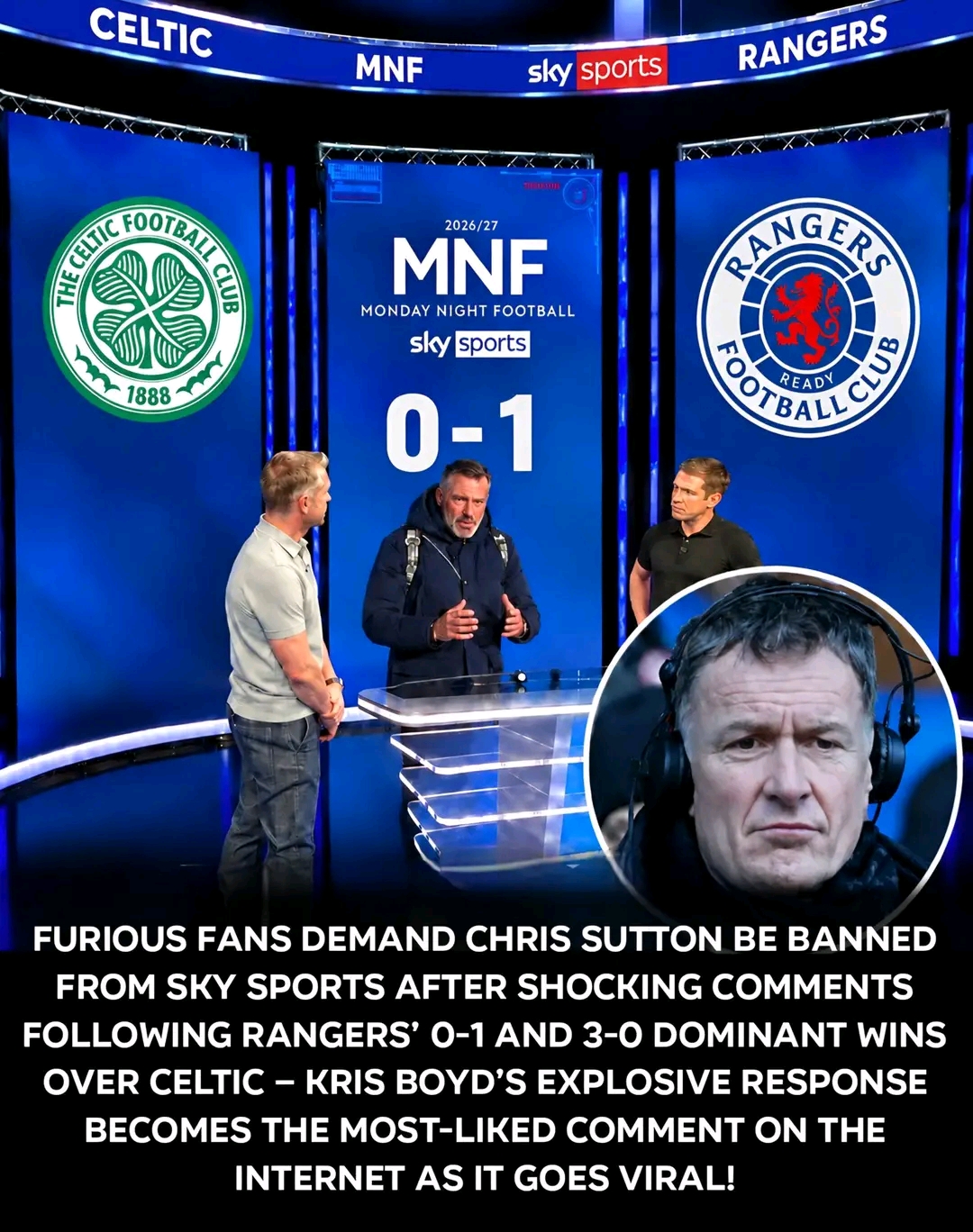
Scottish football has no shortage of rivalries that spill off the pitch and into the studio, but few are as reliably combustible as the one between Chris Sutton and Kris Boyd. This week, the pair are once again the centre of attention after a reportedly heated on-air exchange on Sky Sports, with social media buzzing about a confrontation described as involving a “reckless and disrespectful” comment about Celtic and its supporters. Before getting into what’s actually known and what isn’t, it’s worth understanding why this story has spread so fast — because Sutton and Boyd have been doing this dance, in one form or another, for
The most recent flashpoint, as described in coverage circulating online, centred on a comment made by Boyd that was characterised as reckless and disrespectful toward Celtic and its fanbase. Sutton, by most accounts, did not let it slide — he was portrayed as visibly frustrated and pushed back firmly, in a moment that reportedly left the rest of the Sky Sports panel taken aback.
It’s important to be honest about the limits of what’s verifiable here. The specific wording of what Boyd said hasn’t been published anywhere I can find, nor has the exact language Sutton used in response. There’s no timestamped clip, no named programme, and no direct quotation from either man attached to the reporting. What exists is a secondhand description of a tense studio moment and the online reaction it generated — which is a real phenomenon worth writing about, but a different thing from a confirmed, quote-by-quote account of what was said.
That distinction matters, particularly with two working broadcasters whose comments get picked over by two of the most engaged fanbases in British football. Whatever the specifics turn out to be, it’s worth treating them as pending rather than settled until a fuller account — a clip, a transcript, a follow-up statement from Sky — actually surfaces.
What makes this story spread as fast as it has is the history behind it. Sutton and Boyd aren’t neutral analysts stumbling into an awkward moment — they are, by design, Sky Sports’ two most identifiably partisan voices on Scottish football, and have been since Sutton joined the broadcaster’s Scottish Premiership coverage ahead of the 2023/24 season specifically to sit alongside Boyd.
Sutton is a former Celtic striker, part of a Parkhead side that won three league titles, three Scottish Cups and a League Cup, and reached a UEFA Cup final during his playing days at the club. Boyd, meanwhile, is one of Rangers’ modern-era cult heroes, a prolific striker whose spells at Ibrox and Kilmarnock made him one of the most recognisable forwards of his generation in Scottish football. When Sutton’s move to Sky was announced, he said as much himself, noting he expected he and Boyd would “have some good discussions throughout” the season — an understatement that has proven true many times over.
Sky’s own framing of the pairing leaned into exactly this dynamic from the start, pitching Sutton’s “forthright opinions” alongside Boyd’s own reputation for outspoken punditry. In other words, the tension between them isn’t an unfortunate side effect of the job. It’s close to the entire premise of putting them in the same studio.
Anyone who’s watched Sky’s Scottish football coverage over the past couple of seasons will recognise the shape of this week’s story, because versions of it have played out before — usually more good-natured, occasionally sharper.
There was the moment during build-up coverage ahead of a Ross County fixture when Boyd needled Sutton over an incident involving Celtic’s Reo Hatate going down easily under minimal contact from an opponent. Boyd sarcastically noted the incident hadn’t made the highlights reel; Sutton, notably, didn’t dig in defensively but conceded the point outright, agreeing Hatate had gone down too easily, before turning the needle back toward Rangers with a pointed reference to a Rangers player’s own theatrics from the previous weekend’s Old Firm derby. It’s the kind of exchange that shows the pair are capable of ribbing each other and still landing on genuine agreement — the sparring doesn’t always mean acrimony.
There was also the moment, during Celtic’s build-up to being presented with the league trophy at Parkhead, when Sutton produced a giant cardboard cut-out of Boyd — who wasn’t part of the panel that day — and mockingly announced to camera that his absent colleague had “wanted to come and celebrate Celtic’s title success,” needling him further with a sarcastic nod to Boyd’s well-known “Rangers are coming” rallying cry. Fellow pundit James McFadden piled on, joking it was the most sense Boyd had spoken all season. It was good-humoured mockery of an absent colleague, but rooted in the same underlying dynamic: their allegiances are never far from the surface, and both men, and their colleagues, treat that openly as part of the entertainment.
Boyd’s absence from Sky’s on-field celebrations after Celtic’s title win in a different season also became its own small story, with his non-appearance during the Rugby Park party noted and discussed by supporters — another example of how closely followers of both clubs track not just what these pundits say, but where they are and aren’t present.
Not every past controversy involving this pair, or involving Sutton specifically, has stayed in good-humoured territory. Sutton in particular has a well-documented history of pundit outbursts that have crossed from provocative into genuinely contentious. One notable case saw him accuse specific named individuals of being “snakes” inside a football club’s dressing room following a manager’s sacking — comments serious enough that the club in question reportedly considered legal action in response. That’s a useful data point for understanding Sutton’s broadcasting style more broadly: he has, at various points in his post-playing career, shown a willingness to make pointed, personally targeted claims on air that go well beyond standard match analysis, and that have generated real consequences rather than just social media noise.
Boyd, for his part, has weathered his own share of organised fan backlash. At one stage, a Celtic supporter launched a petition calling for Sky to remove him specifically from coverage of Celtic matches not involving Rangers or Kilmarnock, arguing the broadcaster had a responsibility to field a more balanced panel. That petition prompted a counter-campaign from Rangers supporters, in the opposite direction, calling for Boyd to be given a pay rise instead. Both petitions gathered thousands of signatures, illustrating just how polarising his on-air presence already was well before this week’s incident — he is, by any reasonable measure, one of the most argued-about figures in Scottish football broadcasting, independent of any single flashpoint.
Sutton’s feuds haven’t been limited to Boyd, either. He has a long-running, semi-theatrical rivalry with former Motherwell midfielder Stephen Craigan from his time working across the wider UK broadcast landscape, a dynamic that at one point extended to a pre-planned, tongue-in-cheek “tackle” on Sutton by Craigan during a broadcast intro — evidence that Sutton’s on-screen persona has always leaned into confrontation as part of the entertainment product, for better or worse.
Understanding why a vague, detail-light story like this week’s exchange can still generate a wave of reaction requires understanding just how closely both fanbases monitor Sky’s coverage. Celtic and Rangers supporters don’t just watch matches; they watch the build-up, the half-time analysis, and the post-match discussion with something close to forensic attention, particularly when it comes to pundits with a direct playing history at either club.
That scrutiny cuts in both directions. When Boyd makes a claim perceived as unfair to Celtic, Celtic supporters are primed to react immediately and vocally — as the earlier petition campaign demonstrated. Equally, when Sutton is seen to overstep in defending his old club or attacking Rangers, Ibrox supporters have shown themselves just as quick to organise and complain. Sky, by employing both men prominently and pairing them together as often as it does, has effectively built a coverage model that guarantees this kind of periodic flashpoint — the tension is a feature of the format, not a bug that occasionally slips through.
It’s also worth noting that Sky’s roster around Sutton and Boyd includes other former players with direct club ties — Neil Lennon and James McFadden among them — which only deepens the sense, for many viewers, that the broadcaster’s Scottish football panel is less a neutral analytical body and more a rotating cast of rival club legends who happen to now share a studio. That structural choice shapes how viewers interpret every heated exchange: not as a breakdown of professional standards, necessarily, but as an extension of exactly the rivalry the panel was built to represent.
None of this history confirms what actually happened in this week’s specific incident, and it shouldn’t be read as doing so. It’s entirely possible that Boyd said something that genuinely crossed a line by any reasonable standard, and that Sutton’s response was a justified defence of his former club and its supporters. It’s also possible — and this happens routinely in the fast-moving world of football content aggregation — that a fairly ordinary, in-character exchange between two pundits who are contractually and professionally accustomed to sparring has been amplified, stripped of context, and repackaged as a bigger controversy than the original moment actually was.
Without the actual clip or a direct quotation from either man, it’s genuinely difficult to know which of those is closer to the truth. What can be said with more confidence is that this is far from the first time these two have clashed on air, that their dynamic has ranged from affectionate ribbing to serious allegations over the years, and that both fanbases have a well-established track record of mobilising quickly whenever either man is perceived to have gone too far regarding the other’s club.
If this incident is going to develop into something more substantial than a fast-moving social media moment, a few things would typically follow: Sky Sports issuing some form of statement or clarification, a clip of the actual exchange surfacing and being widely shared, or Boyd or Sutton addressing it directly in a follow-up appearance or interview. Any of those would allow for a much more grounded assessment of what was actually said and whether it merits the reaction it’s generating.
Until then, the safest conclusion is a modest one: two pundits with a long, well-documented history of sparring over Celtic and Rangers have done so again, this time in a way that’s generated more heat online than usual — and Scottish football’s most engaged supporters, as they always do, have noticed immediately. Whether this particular flashpoint proves to be more serious than the many that have preceded it, or simply the latest entry in an already long list, is something only the fuller details — whenever they emerge — will be able to answer.