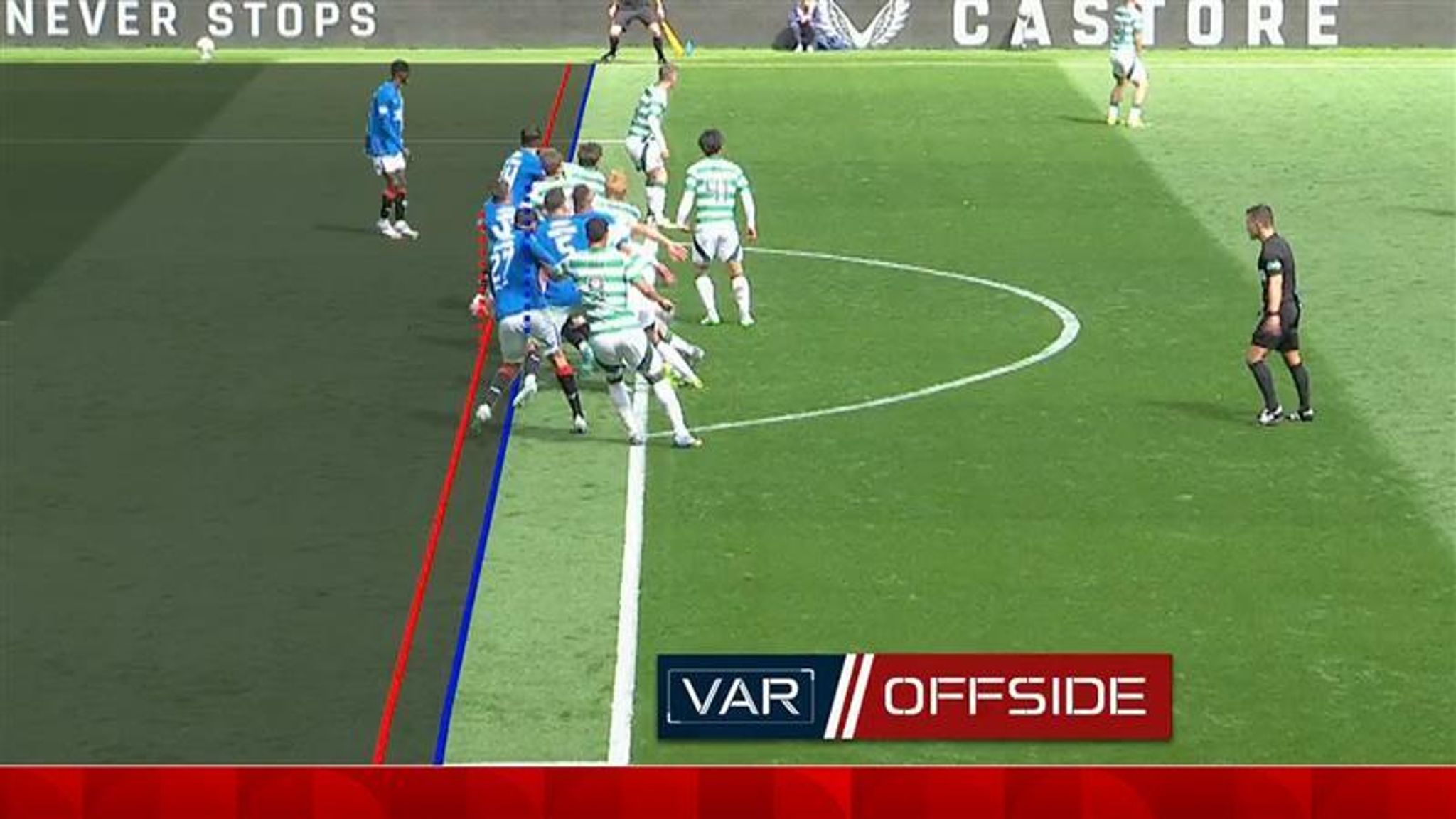
Nicolas Raskin put Rangers ahead against Celtic in the Scottish Premiership only for the goal to be ruled out for offside by VAR.

The Old Firm rarely passes quietly, and even a fixture with no title at stake carries the weight of history, pride and a fanbase that treats every decision as a verdict. When Rangers hosted Celtic at Ibrox in the Scottish Premiership on 4 May 2025, the standings said little. Celtic had already secured the championship a week earlier with a win over Dundee United, and they arrived in Govan holding a 17-point lead over their oldest rivals. Nobody needed the result to settle anything. Rangers wanted to protect their record in the fixture, and Celtic wanted to avoid handing them a third consecutive Old Firm win.
The afternoon produced a 1-1 draw, a match the reports describe as cagey, with two goals and two contentious offside calls. The first came in the 25th minute. Nicolas Raskin, Rangers’ Belgian midfielder, powered a header home from a James Tavernier corner and put Rangers ahead, only for VAR to rule the goal out for offside.
To understand why one disallowed goal mattered, it helps to picture the context. Celtic, under Brendan Rodgers, had done the hard work already. Their title win over Dundee United had confirmed them as champions, leaving the visit to Ibrox as a chance to finish the league programme with pride intact. A 17-point cushion over Rangers is a measure of how the season had gone: Celtic had been the more consistent side over the long haul.
For Rangers, whose team was led by Barry Ferguson, the situation was different. The club was in a period of transition, and the season had not delivered what supporters expected. Ferguson’s side still had reasons to want something from the game. Beating Celtic is never a small thing at Ibrox, and Rangers had won the previous two Old Firm meetings. A third straight victory would have been a meaningful statement in a season otherwise short of them.
That is why the atmosphere, even with the title gone, carried an edge. The Old Firm is a fixture where the result matters regardless of the table, because the two clubs measure themselves against each other before anyone else.
Rangers began with intent. Within two minutes they almost took the lead. Tavernier’s corner found Leon Balogun, whose close-range header clipped the crossbar. It was the kind of moment that lifts a home crowd, an early sign that Rangers were going to make Celtic work at set pieces.
That set the tone for the opening quarter of an hour. Rangers had shown they could trouble Celtic from dead-ball situations, and Tavernier’s delivery, as it has been for years, was the main source of danger. Celtic had to defend the box with discipline, and the early Balogun chance suggested that discipline would be tested
Then came the moment at the heart of this story. In the 25th minute, another Tavernier set piece dropped into the penalty area, and Raskin met it with a powerful header that beat the goalkeeper and hit the net. Ibrox reacted the way a stadium does when its team takes the lead against Celtic.
Raskin is a midfielder who has built his Rangers reputation on energy, pressing and a willingness to arrive late in the box. Scoring from a corner in an Old Firm would have been a defining moment of his time in Glasgow. For a few seconds, that is exactly what it was.
But the celebrations came with an asterisk that only a screen could remove. VAR had a look at the buildup, and the outcome was that the goal did not stand. The reason was offside against Raskin, who had strayed beyond Celtic’s defensive line at the moment the ball was delivered into the area.
Offside from a corner is a subtle thing, and it often surprises casual viewers. Under the laws of the game, there is no offside offence when a player receives the ball directly from a corner kick. That matters because it explains why the situation here needed careful reading. The issue was not the corner delivery itself being played to a player already offside in the strict sense; the reports describe Raskin as having strayed beyond Celtic’s defensive line as the ball came into the box, and the officials judged that position to be an offence in the phase of play that followed.
The practical lesson is that set pieces are not a free pass. Once the ball is in play and moves on, whether through a flick, a knock-down or a scramble, players’ positions are judged against the line at the relevant moment. A player who drifts beyond the last defender, even by a small margin, can find that a goal has been erased. The margins involved in such decisions are often measured in centimetres, and they rarely look like anything to the naked eye.
Video Assistant Referees exist to correct clear errors in decisions that lead to goals, among other categories. In the case of offside, the process is largely factual: officials work from camera footage to establish where the relevant players were at the moment the ball was played, and whether the player in question was involved in the play.
That process removes much of the subjectivity from a call, but not the drama. For supporters in the stadium, the wait is the hardest part. A goal is scored, a roar goes up, and then the referee’s hand goes to his ear. For the seconds that follow, the celebration hangs unresolved. When the decision comes back against the home side, the mood changes at once.
Rangers supporters, like fans of any club, have plenty of experience of VAR decisions going both ways, and the conversation around them in Scottish football has been persistent for years. Referees in Scotland have faced heavy scrutiny during that time, especially in Old Firm matches, where every borderline call is treated as evidence for one side’s grievance or the other’s. What matters here is that the decision was made on the basis of position: Raskin was beyond the defensive line.
Losing a goal to VAR can deflate a team, but Rangers kept pushing. They continued to work the ball into dangerous areas, and their reward came before the break. In the 44th minute, Mohamed Diomande played a pass that Vaclav Cerny dummied superbly, letting it run through to Cyriel Dessers. The Nigerian striker finished past Viljami Sinisalo in the Celtic goal to put Rangers ahead, this time for real.
The goal was a study in movement and awareness. Cerny’s dummy took out defenders and opened the path, and Dessers, whose value to Rangers has always been his instinct in front of goal, did the rest. It was an ideal moment for the hosts, arriving just before half-time, and it meant that the earlier disappointment had been repaid with a lead that counted.
Rangers went into the interval in front, and there was an argument that the disallowed Raskin goal had only delayed the inevitable. The half had shown that Rangers could create danger from both set pieces and open play, and that Celtic, despite their comfortable position in the table, were not dominating.
The second half brought the equaliser, and with it the second major VAR decision of the afternoon. Twelve minutes after the restart, Adam Idah’s shot took a deflection and found its way past Liam Kelly in the Rangers goal. The flag had gone up initially, and the goal was first ruled out for offside.
VAR then intervened in the opposite direction. After a review, the decision was overturned, with Daizen Maeda judged not to have impeded Kelly’s line of sight when Idah’s effort went in. The goal stood, and the score was 1-1.
This is the part of the story that gives the whole afternoon its symmetry. In the first half, VAR had taken a goal away from Rangers because of a player’s position. In the second, it gave a goal to Celtic after a player who was in an offside position was ruled not to have interfered with play. The two decisions rested on different questions: one on whether a player was beyond the line at a key moment, the other on whether an offside-positioned player had actually affected the goalkeeper. Both were made on the video evidence, and both were the kind of call that leaves one set of supporters furious and the other quietly relieved.
The Maeda decision deserves a closer look, because it is one of the most argued-over areas of the offside law. A player in an offside position is only penalised if he becomes involved in active play. Involvement includes interfering with an opponent, for example by obstructing the goalkeeper’s line of vision or challenging for the ball.
Whether a player has blocked a goalkeeper’s view is a judgement, not a measurement, and it invites disagreement. A goalkeeper who is beaten by a deflection can look as if he has been unsighted, but officials must decide whether the attacker’s position actually affected his ability to see or reach the ball. In this case, the review concluded that Maeda had not impeded Kelly’s line of sight, and the goal was allowed.
Rangers supporters may well have felt that the two decisions sat awkwardly next to each other, and that is an understandable reaction in the emotion of an Old Firm. But the reports frame the two calls as being reached through different criteria, which is why they did not contradict each other in the letter of the law.
With the scores level, the match opened up a little as it moved into its closing stages, and it was Celtic who came closest to a winner. In the last minute of stoppage time, Maeda found himself through on goal with a glorious opportunity to take all three points. He tried to round Kelly, but the Rangers goalkeeper made himself big and stopped the attempt with his legs.
It was a save that mattered enormously. A Celtic winner in the dying seconds, after all the drama of the afternoon, would have been a cruel ending for Rangers. Instead, Kelly’s intervention preserved the draw and denied Celtic the last-gasp victory that so often defines Old Firm derbies.
The 1-1 draw left the table unchanged in its essentials. Celtic, already champions, kept their 17-point lead over Rangers. But the result carried more meaning than the numbers suggest. Celtic had been prevented from beating Rangers, and Rangers, for their part, had seen a third consecutive Old Firm win slip away. The match was described in reports as a cagey derby, and the two goals and the disallowed effort were the moments that broke the tension.
For Rangers, there was a mix of encouragement and frustration. They had scored a legitimate goal through Dessers, created chances from set pieces, and been kept out by fine margins. They had also been on the wrong end of an offside decision that cost them a goal in the first half, and a review that gave Celtic their equaliser in the second. Ferguson’s side left with a point that could be read either as a fair reflection of a balanced game or as an opportunity missed.
For Celtic, the draw was a comfortable end to an afternoon in which they did not need to prove anything. They had won the league, and holding Rangers at Ibrox was a decent way to close out the head-to-head season. Idah’s equaliser was a useful reminder of the striking options available to Rodgers, and Maeda’s late chance showed the threat Celtic can still pose in transition.
Back to the player at the centre of the headline. Raskin’s goal was disallowed, and that is how the record will show it, but it would be a mistake to treat the moment as a failure. He had timed his run and connected cleanly with a Tavernier corner, the kind of contribution that midfielders with an eye for the box provide. The offside call is a reminder that the difference between a goal and a disallowed goal can be a matter of a few centimetres of positioning.
It also shows why offside remains one of the sport’s most emotive subjects. Even with technology, the outcome depends on a line drawn on a frozen frame, and the human reaction to that line is rarely calm. A player who has scored in an Old Firm, felt the stadium erupt and then been told that it does not count experiences an unusually sharp swing of emotion. Raskin, like any professional, would have had to reset quickly, and Rangers did that by scoring a legitimate goal before half-time.
Old Firm matches are remembered for their flashpoints, and the disallowed Raskin header became one of the talking points of this one. It carried all the ingredients of a modern derby storyline: a set piece, a powerful finish, a crowd on its feet, and a video review that reversed the outcome. Combined with the later decision that allowed Idah’s equaliser to stand, it made the afternoon a case study in how VAR shapes big matches.
Supporters of both clubs will interpret the decisions through their own loyalties, as they always have. What the record shows is straightforward: Raskin’s goal was ruled out for offside, Dessers scored a valid opener, Idah’s equaliser survived a review, and Kelly denied Maeda at the death. The result was 1-1, and the title was already Celtic’s.
In a fixture defined by extremes, it was, by Old Firm standards, a measured ending. But the moment in the 25th minute, when a header hit the net and a stadium roared, before a screen took it all away, remains the image that sums up the afternoon