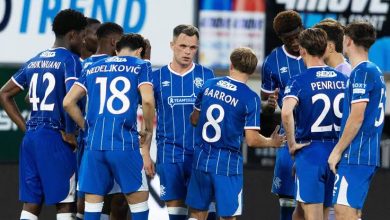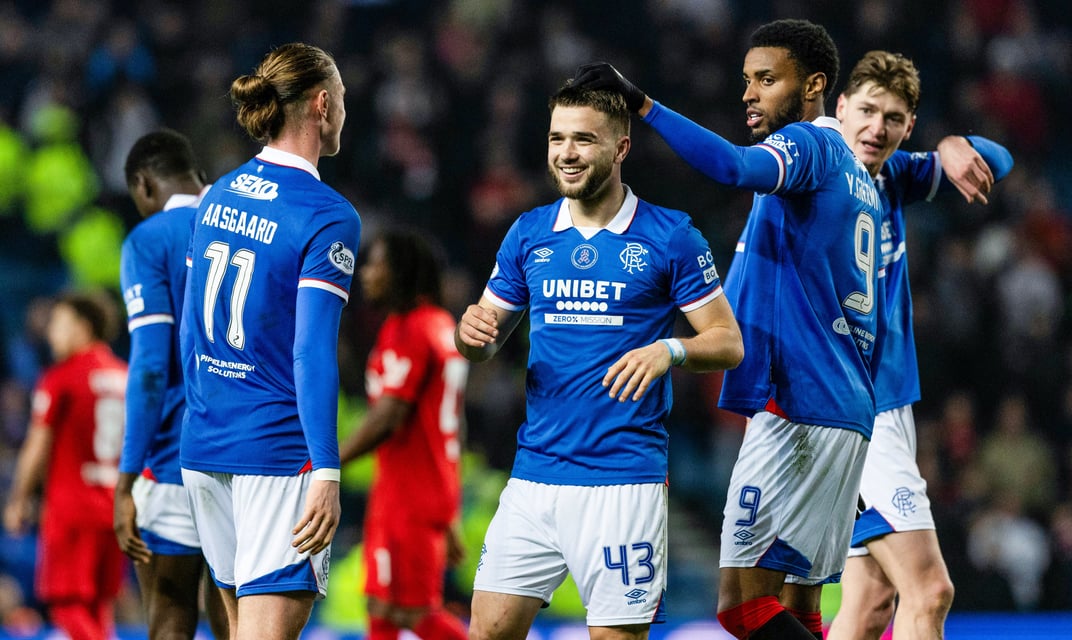
Few sentences unsettle a fanbase like this one: a club will not extend a key player’s contract, and he is heading for free agency. For Rangers supporters, a report that Nicolas Raskin will not be offered an extension and will become a free agent in 2027 touches a raw nerve. Raskin is one of the best players in the squad, a Belgium international whose profile has grown steadily, and the idea of losing him for nothing runs against every instinct about how a club should manage its assets.
The claim comes from Ibrox News, which reported that Rangers will not extend the midfielder’s deal. I could not read the piece, so I can’t say who its sources were or how firm the claim is. What I can do is set it against what has been reported about Raskin’s situation over the past year, and that picture is more complicated than the headline suggests.
Nicolas Thierry Yvan Raskin was born in Liège on 23 February 2001 and came through the youth systems at Standard Liège, Anderlecht and Gent. He made his professional debut at Gent at 16, in a 3-0 win over Sint-Truiden in February 2018, and became the first player born in the 21st century to appear in the Belgian league. He returned to Standard in January 2019 and spent four years there before moving to Glasgow.
Rangers signed him on 31 January 2023, in a deal reported at around £1.5 million plus bonuses, though other outlets put the fee nearer £1 million. He arrived on a four-and-a-half-year contract, and the Rangers Review reported that it carries an additional year. That structure matters, because it explains why the date on which his deal ends has been argued about ever since.
By the time of the Wikipedia record I found, Raskin had 101 appearances and 11 goals for Rangers, and 19 caps and two goals for Belgium, where he has been a senior international since 2025. He can play as a number six or a number eight, and the Rangers Review described him as consistently one of the team’s most important players across a near three-year stint in which he worked under five managers.
That last point is worth pausing on. Rangers have been through a turbulent period on the touchline, and Raskin has been a constant. Managers have come and gone, systems have changed, and he has remained a fixture of the squad, which helps explain why supporters watch his contract status so closely
The headline says 2027. Much of the recent reporting says 2028. That discrepancy is central to how far the story should be trusted.
In February 2026, the Rangers Review reported that Raskin’s deal does not expire in summer 2027, as many had assumed, but in summer 2028. It said the contract he signed in January 2023 was a 4.5+1-year agreement, so the club’s option for the extra year had pushed the end date back. The article was explicit that this meant he was not out of contract in 18 months’ time, as some supporters had feared.
Other outlets did not always follow that reading. A Football Insider piece from the same month described his contract as set to expire in 2027, and argued that this had encouraged suitors because the summer would be Rangers’ last chance to sell for a significant fee. Later Football Insider reporting changed the picture, saying Raskin would enter the final 18 months of his contract in the new year and that a new deal was unlikely before June 2028. That points to a 2028 expiry. A Yahoo Sports piece from around the end of the summer window said he had two years left on his deal, which also points to 2028.
So the reporting splits. Some accounts use 2027 and others 2028. There are a few possible explanations. Journalists may be counting from different assumptions about whether the extra year has been triggered. Some may be using the older, widely repeated date. Or the Ibrox News report may know something the others do not, such as a change to the terms. I can’t tell which, and a careful reader shouldn’t pretend to.
The practical consequence is large. If the deal ends in 2028, Rangers have another season of leverage, and a decision not to extend now is a much less alarming thing than a decision that sends a player to free agency next summer.
To understand why an extension matters, look at what happened to Raskin over the last year. The interest was constant.
In the winter window, reports named several clubs. Football Insider said Tottenham and Leeds United were long-term admirers, and that he was a target for a number of sides across Europe, including in the Premier League. Danny Rohl, then Rangers manager, was reported to have been prepared to block a mid-season exit because of Raskin’s importance to his starting eleven. He stayed.
The summer brought more of the same. Raskin was called up by Belgium for the World Cup, and Rangers announced the selection in May. His group included Iran, Egypt and New Zealand. Belgium’s midfield was crowded, with Kevin De Bruyne, Amadou Onana, Youri Tielemans, Hans Vanaken and Axel Witsel among those selected, so his place was not guaranteed, but he impressed at the tournament according to FootballTransfers.
A move nevertheless failed to materialise. Reports linked him with Real Betis, Bologna, Atalanta and Hull City at various points, and Besiktas were the most concrete suitor late in the window. Rangers rejected a Besiktas loan offer that fell short of their valuation, and Football Insider reported they would want upwards of £10 million. An earlier claim that a deal with Besiktas was agreed turned out to be false, according to FootballTransfers. Raskin missed two Rangers matches at the end of August amid the speculation, and Derek McInnes, now in charge, brought him back into the squad afterwards.
By the end of the Scottish window, Raskin was still at Ibrox. Football Insider reported that Rangers would block any move from the Saudi Pro League until January, with Al Ittihad among the reported interested parties. A Yahoo Sports piece described him as content enough to carry on in Glasgow after multiple failed bids
Raskin has been open about a difficult spell at the club. According to the Rangers Review, he described the period under Russell Martin as really hard, and said he was still working to get back to his best physically and mentally. He also said he had read a lot of things that were wrong and had chosen to stay quiet, focusing on getting back into the team.
He did not want to leave when Besiktas showed interest during an earlier window, the same report said, and he was later reintegrated into Martin’s side. That detail cuts against a simple story of a player desperate for the exit. It suggests a professional who has had frustrations but has also shown loyalty to the club.
Take the headline at face value. A club deciding not to extend a contract can mean several different things, and they are not equivalent.
A decision to wait. clubs often hold off on new terms until they know what the market will offer. If a player is likely to be sold, there is little point tying him to a new long-term contract at higher wages, especially when a new deal could complicate a sale. Football Insider’s reporting framed things this way, saying a new deal was unlikely before June 2028. That is closer to “not yet” than “never.”
A decision to cash in. If a club expects to sell, letting the contract run down is a strategy in itself. The player’s value falls as the expiry date approaches, but the club keeps a valued performer for the season and can still sell in a later window. The risk is that the fee shrinks.A decision to let him go. This is what “free agent” implies. It would be the most damaging reading, because it means giving up a fee entirely on a player valued at around £10 million by the club’s own reported standards.
The headline’s phrasing leans toward the third reading, and I can’t confirm from the material I have that this is what the report says. Without the article, the more cautious interpretation is that Rangers have chosen not to open extension talks at this point.
There is a financial logic to why a club might not extend, and it applies to Rangers’ situation regardless of the exact expiry date.
A player with a long contract is an asset that holds its value. A player with a year left is worth much less to a buyer, who knows the selling club has weakened leverage and that the player could walk for nothing. That is why Football Insider argued that clubs were encouraged by the 2027 date, expecting to get Raskin more cheaply.
For Rangers, that creates a genuine dilemma. Cash for Raskin would be valuable, and the £10 million figure suggests they know what he is worth. But losing him would leave the squad short of a player who has been among its best performers, and Football Insider noted that Rangers could not go out and replace him if he left when no other window was open.
A new contract would solve one problem, the fee risk, but it would create others. It would mean higher wages for a player who might still want to leave, and it could reduce Rangers’ flexibility if a strong bid arrives. Clubs frequently prefer to keep a player on existing terms rather than lock in a raise, particularly when there is a chance he will move on within a year.
There is also the question of what Raskin wants. A player who feels he has outgrown a club may see an extension as a trap, since a longer contract makes it harder to push for a move. A player who is happy might welcome one. Reports suggest he had his heart set on a summer move after the World Cup, but that he was content enough to remain when none came. That is not a picture of a player ready to commit long term, and it may be part of why extension talks would not be straightforward
If Raskin did reach the end of his deal without an extension, the mechanics are well known. Once a contract expires, a player is free to sign anywhere without a fee being paid to his old club. Under FIFA’s general framework, players in the final months of a deal can typically agree terms with other clubs in advance, which means a club can lose a player before the contract technically ends. Details vary by association and league, so I won’t state specifics for Scotland that I haven’t verified.
For the player, free agency usually means a larger signing-on payment and better wages, since the new club has saved a transfer fee. For the selling club, it means no income. That asymmetry is why clubs generally try to sell players in the last year of a deal rather than lose them for nothing.
Derek McInnes has reintegrated Raskin into the team and, according to Football Insider, insisted the Belgian is keen to keep starring for his side. From a manager’s perspective, a player of Raskin’s quality is worth keeping while the club competes, and the contract question is a matter for the board.
That tension between sporting and financial priorities runs through every club. The manager wants his best players available, and the executives want to protect the balance sheet. Raskin, as the club’s longest-serving player according to a Yahoo Sports piece, sits at the centre of that tension.
The honest answer is to be careful. A headline saying a club will not extend a player’s contract and that he will be a free agent in a given year makes strong claims. The contract end date is disputed across reputable outlets, and the Rangers Review reported a 2028 expiry backed by the terms of the 4.5+1-year deal. If that is right, a report of a 2027 free agency would be based on an outdated date.
That does not mean the underlying story is wrong. It is entirely plausible that Rangers have no plans to offer an extension now, and Football Insider reached a similar conclusion for a 2028 expiry. What may be wrong is the timing, and the timing changes how urgent the situation is.
There is also the ordinary caution that applies to any transfer report. Football coverage moves quickly and is full of claims that later prove false, and FootballTransfers pointed out that an earlier Besiktas agreement report turned out to be untrue. A single headline is not a decision by the club.
Raskin’s situation is a case study in the modern selling-club dilemma. Rangers have a player who has drawn interest across Europe, performed at a World Cup, and remained the club’s most valuable asset while other pieces of the squad have struggled. They must decide whether to hold him, sell him, or lock him down.
Each path has costs. Holding him without an extension risks losing value. Selling him weakens the team in the short term. Extending him at a higher wage risks committing to a player who might still want out.
The likeliest outcome, based on the reporting, is that the decision will be revisited when the January window opens, with Rangers expected to field more offers. Football Insider expected exactly that. If a strong bid arrives, the contract question may resolve itself, because a sale removes the need for an extension.
-Confirmation of the expiry dte. f Rangers or the player’s representatives clarify whether the deal runs to 2027 or 2028, most of the alarm or reassurance follows from that.
-January interest. Reports suggest more offers are coming. The size of any bid relative to the reported £10 million figure will show how Rangers value him.
-Raskin’s form. A strong season would raise his price. A poor one would do the opposite.
Any public comment from the club. Clubs rarely discuss contract strategy openly, but a statement from the manager or the sporting department could change the picture.
The headline is stark, and it may be accurate in spirit while being uncertain in its details. Rangers reportedly have no plan to extend Raskin’s contract at present, and that would fit with reporting that a new deal was unlikely before June 2028. What is not established is that he is leaving for free in 2027, since the balance of reporting I found puts the end of his contract in 2028.
For supporters, the sensible reading is that the club is playing a waiting game with a valuable player. The risk in that strategy is real, because a shrinking contract weakens a selling club’s hand. But it is not yet the crisis the phrase “free agent” implies. If the January window brings a serious bid, Rangers will have to decide whether the money is worth the loss of a midfielder who has been central to their recent seasons. Until then, Raskin remains a Rangers player, and the question of his future remains open.