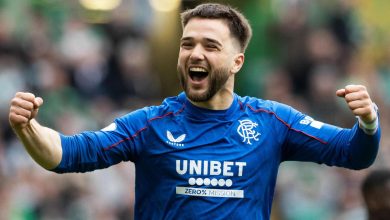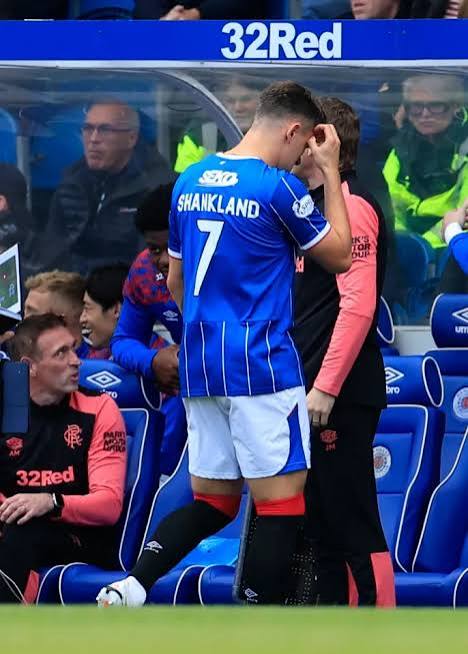
There are injuries that simply cost a team a player for a few weeks, and then there are injuries that reshape a season. For Rangers, the news that captain Lawrence Shankland faces three to four months on the sidelines with a torn hamstring falls firmly into the second category. It strips Derek McInnes of his most senior forward and on-field leader at precisely the moment his side is trying to close a title gap on Celtic, and it does so in a way that carries an uncomfortable sense of déjà vu for the player himself
Shankland’s injury occurred during Rangers’ 1-0 win over Motherwell at Ibrox. He pulled up early in the game and had to be withdrawn, with his replacement, Ryan Naderi, going on to score the only goal of the match — a small consolation for Rangers on the day, but one that did little to soften the blow of losing their captain in the process.
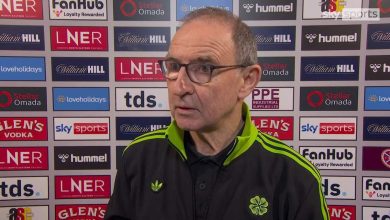
At the time, the severity wasn’t immediately clear, and the initial hope was that it might be nothing more than tightness. Speaking before Wednesday’s Premiership visit of St Mirren, however, Derek McInnes confirmed the worst had been realised: Shankland has a hamstring tear, and it is expected to keep him out for a significant stretch of the
The manager was direct about both the diagnosis and the uncertainty still surrounding it. He confirmed Shankland had undergone a scan which showed a 2cm tear, and drew a direct parallel to an injury the striker suffered previously — one that occurred when both McInnes and Shankland were together at Hearts the previous January.
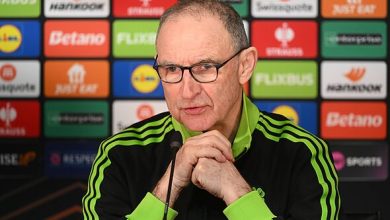
McInnes explained that Shankland was in London getting a follow-up ultrasound scan, specifically to help determine, in consultation with a specialist, whether surgery is required or whether the injury can instead be left to heal naturally, in the same way the earlier Hearts injury was managed. Asked to put a timeframe on the recovery, McInnes offered a range rather than a fixed date: best case scenario is around three months, with the worst-case scenario stretching to four.
That range matters. A best case of three months would likely see Shankland back in contention in the second half of the season, potentially in time for some of the run-in’s biggest fixtures. A worst case of four months pushes his return significantly later, and depending on how the surgical decision goes, could end up being even longer if complications arise. McInnes was careful not to overpromise either way, which is the sensible approach for a manager who has already seen this exact injury play out once before with the same player.
The parallel to Shankland’s time at Hearts is not incidental — it is central to understanding both the medical situation and the way McInnes is approaching it. Shankland suffered what was described as a similar tear in the same area during his time at Tynecastle, sidelining him for roughly three months at the time. Having gone through the recovery process with the player once already, as his manager at that club, McInnes has a level of first-hand familiarity with how this specific injury tends to behave in Shankland’s case — which is presumably part of why he felt comfortable offering as detailed a timeline as he did, despite the scan results still being finalised.
There is a difficult side to this familiarity, too. A recurrence of the same type of injury, in the same area, can sometimes point to an underlying vulnerability rather than simple bad luck — a pattern that could raise longer-term questions about how the injury is managed and prevented from happening a third time, even after this recovery is complete. Nothing in the reporting suggests panic on that front, but it’s a reasonable point for Rangers’ medical staff to be thinking about as they plan Shankland’s rehabilitation and eventual reintegration.
One detail McInnes offered sheds some light on the mechanism behind the tear. He noted that Shankland’s output had been particularly high in the match immediately prior to the Motherwell game, played on an artificial surface at Falkirk. McInnes suggested that switching from a 4G pitch to a grass surface in quick succession can sometimes leave a player more vulnerable to this kind of injury — the different surface interacting differently with muscles that had just been put through a heavy workload.
Importantly, McInnes stressed there was no single obvious moment of impact or action in the Motherwell game itself that triggered the tear. By his account, Shankland felt fine heading into the match, was not aware of doing anything specific that caused the problem, and simply felt the injury pull up during play. That description — a gradual pull rather than a dramatic collision or awkward landing — is consistent with the kind of soft-tissue injury that often results from cumulative load rather than a single accident, which loops back to McInnes’s point about the surface change potentially playing a role.
Context makes this injury sting even more for Rangers. Before pulling up against Motherwell, Shankland had been directly involved in the outcome of his previous two matches, contributing decisively to wins away at Aberdeen and at Falkirk. He was, in other words, in the middle of a productive run of form right before the injury struck — not returning from a lean spell, but hitting his stride as Rangers’ central attacking focal point.
The injury also arrives at a moment when Rangers’ striking options were already stretched thin. Portuguese forward Youssef Chermiti has been ruled out for a lengthy period after suffering anterior cruciate ligament damage, meaning Rangers have now lost their two most senior strikers in relatively quick succession. That leaves McInnes working with a striking department built around Ryan Naderi — the youngster who has stepped up impressively in recent weeks, including scoring the winner against Motherwell straight off the bench — alongside new signing Kevin Kelsy and fringe option Bojan Miovski.
It is not, on paper, a threadbare group. But it is a young and unproven one to be relying on without the senior presence and know-how that a captain and established goalscorer like Shankland provides, particularly heading into a stretch of the season that includes the most high-pressure fixtures on the calendar.
Perhaps the sharpest edge to this story is the timing relative to Rangers’ fixtures against Celtic. Shankland’s injury means he is set to miss the Old Firm double-header against Celtic entirely — both the League Cup quarter-final and the league fixture at Parkhead that followed a week later — fixtures in which Rangers went on to complete a double over their fiercest rivals regardless. There is a reasonable argument that Rangers’s business against Celtic was concluded successfully even without their captain, which speaks well of the squad’s depth in the moment, but it also means Shankland was absent for two of the biggest results of Rangers’ season so far, unable to contribute to or lead the team through either occasion.
He will also miss Scotland’s Nations League campaign entirely, ruling him out of representing his country under new head coach Sébastien Pocognoli in the Belgian’s first matches in charge. Shankland had been part of Scotland’s World Cup squad and would have been expected to feature prominently in the early stages of the new manager’s tenure. Missing that entire window is a significant blow to his international career at a time when a new coaching regime is actively assessing who fits into its plans — the kind of absence that can cost a player momentum even once he’s fully recovere
It’s worth pausing on exactly what kind of player, and captain, Rangers are missing for this stretch. Former Rangers midfielder Andy Halliday, speaking on BBC Sportsound, made the point plainly when reflecting on the win over Motherwell: had Shankland been on the pitch for the full ninety minutes rather than being forced off early, Halliday suggested he would likely have walked away with a couple of goals himself. It’s a small aside, but a telling one — even Rangers’ teammates and former players clearly rate his continued presence as a difference-maker in matches Rangers are already creating plenty of chances in.
That comment also points to a broader theme in Rangers’ performances since the injury: the team has, by most accounts, continued to create good chances and control matches even without their captain, but has occasionally lacked the clinical edge in front of goal that an experienced, in-form finisher like Shankland provides. Naderi’s emergence has papered over some of that gap impressively, but there’s a difference between a breakout run of form from a young striker finding his feet and the consistent, battle-tested output of an established international captain in peak scoring touch.
Beyond the goals, there is the leadership dimension. Shankland arrived at Rangers in the summer of 2026 having previously captained Hearts, and was entrusted with the armband at Ibrox relatively quickly — a strong statement of the regard in which he is held within the dressing room and by the coaching staff. A captain’s presence on the pitch, particularly through the kind of high-tension fixtures Rangers have just navigated against Celtic, is not something easily replaced by a younger squad, even one performing well collectively.
There’s also a squad-building dimension to this story worth noting. Chermiti’s long-term absence already prompted Rangers to move into the market, spending in the region of £9 million to sign Venezuelan international Kevin Kelsy from Portland Timbers as a replacement forward option. That signing, made in direct response to one long-term striker injury, will now take on even greater significance with Shankland also sidelined — Kelsy suddenly finds himself needed much sooner and much more heavily than may have originally been planned when he was brought in.
Whether Rangers look to bolster the position further during any available transfer window will likely depend on how Naderi and Kelsy perform across the coming weeks, and on the club’s read of how quickly Shankland’s recovery is genuinely progressing. A three-month best case would see him back in the picture relatively soon relative to the length of a full season; a four-month worst case, especially if surgery becomes necessary, would extend his absence considerably further and might change that calculation.
The immediate next step is straightforward, if unresolved: Shankland’s follow-up ultrasound scan in London will inform, alongside specialist consultation, whether he needs surgery or whether the injury can heal through conservative management, mirroring the approach taken with his earlier Hearts injury. That decision alone could meaningfully shift where in the three-to-four-month range his actual recovery lands.
In the meantime, Rangers move forward without their captain and top-line finisher through what was always going to be a demanding stretch of fixtures, leaning on Naderi’s continued development, Kelsy’s integration, and Miovski’s contribution from the fringes of the squad. The early signs — a completed Old Firm double over Celtic, achieved without Shankland on the pitch for either fixture — suggest the squad has more depth and resilience than the captain’s absence alone might imply. But sustaining that form over three or four months without their most experienced forward, through what remains a tightly poised title race, will be a considerably tougher test than a single week’s worth of good results against a fierce rival.
For Shankland personally, this is a frustrating rerun of a setback he has already lived through once, in familiar territory, with a manager who has seen him come back from it before. The hope inside Ibrox will be that history repeats itself in the best possible way: a recovery that lands on the shorter end of the given timeframe, and a captain who returns in time to have a genuine say in how Rangers’ season, and their pursuit of the Scottish Premiership title, ultimately plays out.