Celtic manager Martin O’Neill explains why he thinks Auston Trusty was wrong


Some results are remembered for the football and others for a single decision. Celtic’s 2-2 draw away to Hearts falls into the second category. It was a meeting between two clubs in the title race, played at Tynecastle with the hosts leading the Scottish Premiership, and it produced plenty of good football. But the conversation afterwards focused on one moment: the red card shown to Auston Trusty when Celtic were ahead.
Celtic interim manager Martin O’Neill was clear about how he saw it. He said Trusty should not have been sent off in the 2-2 draw away to Hearts, and that the dismissal was the second game in a row in which Celtic had finished with ten men. His argument was not a rant. It was a specific, reasoned case about the ball, the angle and the cover, and it deserves a careful examination
To understand the weight of the moment, it helps to recall how Celtic got here. Martin O’Neill returned to the club as manager in January 2026, taking charge until the end of the season. He marked that return with a 4-0 win over Dundee United in January 2026. He came in as a familiar figure, a man who had won trophies at Celtic in his first spell, and with the task of steadying a campaign that had lost momentum.
He brought help. According to a FotMob feature on his return, his two assistants, Shaun Maloney and Mark Fotheringham, were hired to lead training on a day-to-day basis, and the intensity had returned to Celtic’s game. That was the picture heading into Edinburgh: a team rediscovering its edge, facing the league leaders on their own ground.
Hearts, for their part, were top of the table. Yahoo Sports described them as fellow title contenders, and O’Neill had said in the build-up that he hoped to have new faces at the club by the time Celtic faced them. The fixture therefore carried real significance for the championship race, well beyond the usual pride of a Saturday
O’Neill’s own account of the match is the most reliable guide to its shape. Speaking to BBC Scotland, he called it a tough game, as he had expected, and said Celtic scored a fine goal and were in reasonable control. Hearts then got an equaliser and the game was in the balance. He went on to say that Celtic then scored a wonderful goal to retake the lead, and that the sending off had a major part to play in the final twenty minutes.
That sequence matters. Celtic were 2-1 up, with the game in their control after a strong goal, when the red card arrived. Yahoo Sports summarised it in the same terms: O’Neill said the Trusty sending off had a major effect when they were leading 2-1. Whatever happened after, the manager’s belief is that the decision changed the direction of the match.
Hearts, in the reports, took full advantage of the extra man. A Celtic fan-site match report described how they pushed bodies forward and aimed deliveries into the Celtic box, knowing that space would open up as tiredness set in. Celtic defended with effort, but a side down to ten men in the final stretch of a hard match is under sustained pressure. Hearts levelled to make it 2-2, and the point that Celtic left with was, in O’Neill’s view, one they should have been better placed to improve
The fan-site report gives the fullest description of the moment, and it should be read with the caution that applies to any account written from one club’s perspective. According to that report, the incident arose from a loose passage in transition, with Trusty stepping across his man as the ball broke beyond him. Referee Steven McLean initially showed a yellow card, which the report says matched the flow of play as it happened.
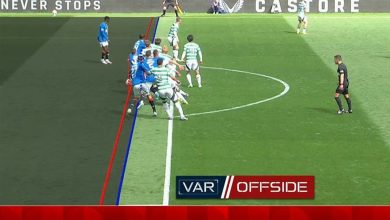
Then VAR intervened. The report says John Beaton, the video assistant referee, sent McLean to the pitchside monitor, and the punishment was upgraded to a red card.
From Celtic’s viewpoint, the key facts were geometric. The Hearts attacker, named in the report as Pierre Landry Kaboré, was moving away from goal, and his touch pushed the ball wider rather than towards the box. The report adds that Dane Murray was also recovering across, which changed the picture of danger and, in Celtic’s eyes, the need for the harshest sanction.
The manager’s reasoning was compact. He said he had seen the incident back and did not see it. Then he offered a self-deprecating aside, wondering if he had been out of the game too long or had misread the rules. That was a rhetorical flourish, and it made the underlying point sharper: an experienced manager who has studied the laws for decades could not find the offence.
His two substantive objections were these. First, the ball that was played was going away from goal. Second, Celtic had a man round on the cover. He concluded that it was not a red card, and while accepting that the matter was gone, he insisted it had played a massive part in the result. He also praised his players, saying they had fought magnificently again.
The Celtic fan-site report captured the tone of the response, describing O’Neill as not hiding his anger and calling the decision remarkable. It also noted that O’Neill’s frustration went beyond one call, since Celtic had now finished successive matches with ten men, each time after VAR involvement. That last detail is useful context. The previous game in that run was Celtic’s Europa League match away to Bologna, where, according to Yahoo Sports, Reo Hatate received a second yellow card in the first half, and Celtic drew 2-2.
I can’t say from the sources which offence the officials cited for Trusty’s dismissal. The report says the yellow was upgraded to a red after review, but does not spell out the reasoning, and the referee’s official explanation was not something I could find. Still, the laws of the game give a framework that helps in reading the manager’s argument.
When a player commits an offence that denies an opponent an obvious goal-scoring opportunity, the sanction can be a red card. To decide whether an opportunity was obvious, officials are guided by several factors: the distance between the offence and the goal, the general direction of play, the likelihood of keeping or gaining control of the ball, and the location and number of defenders. That framework is general knowledge of how the rule works, and I’m offering it as background, not as a claim about what the officials actually decided.
Look at O’Neill’s points against it. The direction of the ball was away from goal, which speaks to the second factor. The presence of a covering defender speaks to the fourth. Both are the types of considerations a review would weigh in deciding whether a goal-scoring opportunity was genuinely obvious. A manager who highlights them is not making a random complaint, and the argument is one that referees and analysts regularly debate.
The intervention of VAR is the second layer of the story. The video assistant referee is meant to correct clear and obvious errors, and in the case of red cards the review covers serious foul play, violent conduct and denying a goal-scoring opportunity, among other matters. In this case, the on-field decision was a yellow, and the review changed it to a red.
That is the kind of situation that produces the most heated reaction. When a referee makes a call in real time and then a review reverses it, supporters and managers often feel that an intervention has overridden the feel of the game. A challenge that looked like a yellow at full speed can appear differently on a slowed replay, and the lengthy examination of a moment that unfolded in a fraction of a second can lead to a harsher verdict.
Scottish football has had a running debate about the use of VAR since its introduction, and this incident added fuel. O’Neill did not say the technology should be abandoned. His point was narrower: that in this instance, the decision was wrong on the facts
The immediate cost was the result. Celtic lost their numerical advantage and, ultimately, the lead. But O’Neill’s frustration, as the fan-site report noted, extends further.
A red card brings a suspension, and that removes a player for upcoming fixtures. The fan-site report said that with matches coming quickly and rotation already limited, another suspension adds strain to a defensive group that has barely had time to recover. It also observed that Dane Murray had been thrown in at short notice after an injury to Kieran Tierney, which meant the back line had no chance to settle into a rhythm.
Those details reflect a genuine squad-management problem. Central defenders work best in partnerships built over time, and losing one at a stroke, particularly in the middle of a busy schedule, forces reshuffles that can weaken the whole unit. Even if the card were later rescinded, which the sources do not say happened, the practical damage of missing a game or more is difficult to undo
The most interesting part of O’Neill’s response is the suggestion of a trend. Celtic had finished two consecutive matches with ten men, and both dismissals involved VAR. For a manager, that sequence can start to look like a pattern, especially when he believes the second decision was wrong.
It is worth being careful here. Two red cards in two matches do not establish bias, and the first, Hatate’s second yellow at Bologna, was a separate matter, given in a European competition and by a different set of officials. Reasonable observers will disagree about whether either decision was justified. What can be said is that the run of events affected how Celtic approached each game, how they used their energy, and how much they had left in the final stages
O’Neill’s tone in the interview is worth noting. He was critical without being bitter. He accepted that the matter was over. He gave credit to the Hearts performance, calling it a tough match he had anticipated. And he spoke warmly about his own side, praising their resolve.
That balance suits a manager of his experience. He returned to Celtic in an interim capacity, with the season’s objectives still open, and had little to gain from a prolonged quarrel with officials. What he did want was to make his position clear, and to make it in a way that would be difficult to dismiss as mere frustration. By anchoring his argument in the direction of the ball and the presence of cover, he made a case that could be tested against the footage
A fair account must acknowledge the other side. Hearts, as league leaders at home, would presumably argue that a defender stepping across an attacker as he breaks through has committed a genuine foul, and that the review was right to look at it seriously. They would say that a player challenging from behind in that manner risks a heavy sanction, whatever the direction of the ball. I couldn’t find Hearts’ official view in the sources, and I am not putting words in anyone’s mouth, but the point is a reminder that decisions like this rarely have a single obvious reading.
There is a general principle at work. Officials asked to judge the seriousness of a challenge look at the contact, the intent and the consequence, and the same incident can look like a routine foul from one angle and a serious one from another. That is why VAR reviews, even when they follow the protocol correctly, can leave both sets of supporters convinced they were wronged.
The context of the match adds to its significance. With Hearts at the top and Celtic in pursuit, every dropped point matters. A 2-2 draw preserved the leaders’ position and left Celtic with ground still to make up. O’Neill’s argument that the red card played a massive part in the result is, in effect, an argument that Celtic lost two points they might have secured.
Whether that is right cannot be proved. It is impossible to know how the last twenty minutes would have gone at eleven against eleven. But the manager’s belief that it changed the game is a reasonable one, given that Celtic held a lead and lost it after playing with a man fewer.
Incidents like this are part of the texture of any league season. Managers, players and supporters complain about decisions, and officials do their best in fast-moving matches. Technology has reduced some errors and introduced new sources of argument, particularly around the interpretation of degrees of seriousness.
What sets this episode apart is the clarity of the manager’s objection. He did not say the referee was biased, and he did not claim a conspiracy. He said the ball was going away from goal and a covering defender was there, and that those facts meant it was not a red card. That is an argument about the application of the law, and it puts the burden on those who disagree to explain why those factors were not
For Celtic, the practical task is to move on. The result was a draw, not a defeat, and the team showed resolve in holding on with ten men. O’Neill’s praise for his players suggests a group that has responded well to his arrival and is competing hard in every match
The challenge is to keep that going while managing the consequences of the sending off, which include a suspension and a strained defence. It also involves reinforcements, an issue O’Neill raised in the days before the game, when he said he was hopeful that new signings would arrive. A thin squad is more vulnerable to disciplinary setbacks, and fresh faces would ease the burden.
The headline is simple: Martin O’Neill believes Auston Trusty was wrongly shown a red card against Hearts. The reasoning behind it is more detailed. The ball was going away from goal, a Celtic defender was covering, and the sanction came after a VAR review that upgraded an initial yellow. On his account, that combination did not amount to a sending off, and it had a major effect on a match Celtic were controlling.
Whether officials, neutral observers or Hearts supporters agree is another matter, and the sources I found do not settle it. What they do show is a manager making a measured and specific case, a team that fought to salvage a point, and a decision that will be debated for as long as the two clubs meet.
O’Neill himself accepted that it was gone. But he was equally clear about its impact. In his words, it was not a red card, and it played a massive part in the result