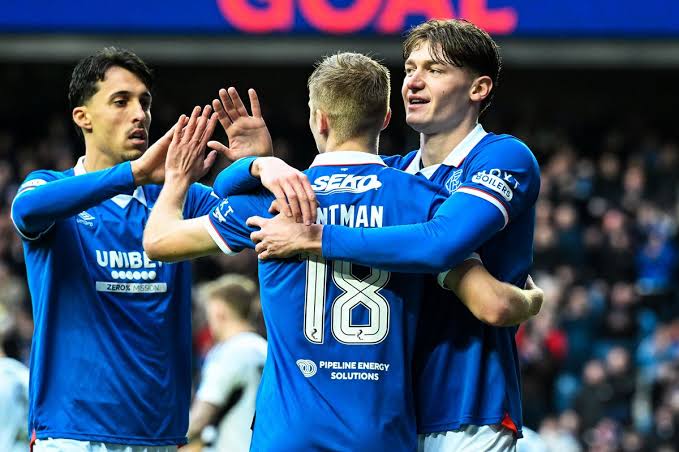
Every football academy has produced a version of the same story. A gifted teenager arrives with a reputation as the next one through the door. There is a debut, a goal, a few months of excitement. Then the path narrows, through injuries or a loan that does not work out, and a whisper starts that the problem is not the body or the circumstances but the player himself. Once a label like that attaches, it is difficult to remove.
Alex Lowry knows this story from the inside. The 23-year-old, now on loan at Motherwell from Wycombe Wanderers, has spoken about the accusations of laziness that followed him during and after his time at Rangers. The Rangers Review’s account describes a talented midfielder fighting back against labels of laziness, and its headline gives the essence of the interview: accused of being lazy at Rangers, he is now proving people wrong.what
The twist is in how he tells it. Lowry does not rage against critics or claim he was misjudged in every respect. He offers a balanced reading of where the perception came from, admits that some of it may have had a basis, and lays out what he has changed. It is an unusually self-aware account from a young player, and it deserves a careful look.
Lowry was born on 23 June 2003 in Uddingston. He joined the Rangers academy at ten and progressed through the age groups to the B team, before making his first-team debut in January 2022 in a Scottish Cup tie against Stirling Albion. Motherwell’s profile of him says he scored on that debut, and that his involvement grew through the remainder of the season. He played in the Scottish Premiership and was on the bench for the Ibrox squad in their Europa League matches, including the final against Eintracht Frankfurt, and he scored his first league goal against Hearts.
He is an attacking midfielder who can also play from the left. Motherwell manager Alfred Johansson describes him as a technically gifted footballer who enjoys being on the ball and being creative. In an era when clubs prize midfielders who can receive under pressure and play the incisive pass, that is a valuable profile. It also happens to be the profile most likely to draw the criticism Lowry has faced, because the most creative players often look the least
The early promise did not translate into a steady rise. The start of the 2022-23 season was difficult for Lowry, who picked up an injury that affected his involvement. He made his Champions League debut against Ajax in November but played only seven senior matches over the season.
Injuries recur in the coverage of his career. Glasgow World describes off-field issues and injury problems as hampering his development, including a bad knee injury sustained in a B team match that kept him out for months, and a severe recurring back problem while playing in England’s third tier. These are serious physical setbacks. A knee injury in a young player’s formative years can disrupt training, conditioning and match rhythm for a long time, and a recurring back complaint can make consistency almost impossible.
Then came the loan to Hearts. He went to the Edinburgh club for the 2023-24 season. Motherwell’s account has him playing 17 games, scoring once and providing four assists, with the spell cut short midway through the season when he was sidelined for a number of weeks. The BBC’s version says the loan ended after 12 starts, and Glasgow World says the Jambos terminated it early. The numbers differ between outlets, most likely because of how starts and substitute appearances are counted, but the outcome is not in dispute: the loan ended before it was meant to.
The Rangers Review says the unsuccessful loan spell at Hearts was the point where his career stalled, with a perception that it was largely down to the player’s attitude. That is the crux of the issue. A player returns early from a loan, and observers reach for an explanation. Attitude is the easiest one, because it is invisible and unfalsifiable. Nobody can prove it either way from a distance.
In January 2025, Lowry left Rangers for Wycombe Wanderers. He made 34 appearances for the Chairboys and scored three goals. That looks like a reasonable return for a first stint in English football, and it kept him playing after the disappointment of the previous year.
The record, though, shows a difficult finish. Lowry scored three goals in 24 appearances for the League One club last season but last featured on Boxing Day 2025. That final outing was a 4-0 defeat away at Luton Town, and he did not play for Wycombe at all in 2026. Whatever the reason, whether injury, form or selection, it left him without competitive football for months, which is a difficult place for any young midfielder to be.
Lowry needed a route back. It arrived at the end of July. Motherwell announced that he had joined on a season-long loan from Wycombe for the 2026-27 season, bringing him back to Scotland after just over a year in England.
The timing gave the move added significance. Motherwell were still mourning the loss of Jens Berthel Askou, the manager who led them to a fourth-place finish before leaving for French side Toulouse in May. New boss Alfred Johansson was given the task of keeping that momentum alive, and he saw Lowry as part of the answer. He called it a great opportunity for player and club, and said Lowry’s knowledge of Scottish football and experience here could prove vital over the next twelve months. He also said the club’s staff had been meticulous in scouting him.
Lowry sounded delighted to be back. He said it was great to be back up the road, and noted that everyone in Scottish football knew Motherwell were an outstanding team the previous year. He added that after speaking to the manager, it was already clear Johansson had his own ideas, and that the identity of the team was visible even at an early stage. He said he felt he could add to an already strong squad and was looking forward to kicking on.
There was one small hurdle. Lowry was ineligible for Motherwell’s Conference League qualifying second-leg tie away to Havnar Bóltfelag, though the club took a two-goal advantage from the first leg. It was a minor delay to his debut, and once past it, he has settled quickly.
The Rangers Review describes the 23-year-old as thriving at Fir Park, a key man in Motherwell’s campaign so far with two goals scored. That is a strong start for a player who had barely played for nine months, and it suggests that a combination of regular football, a clear tactical plan and a change of scene has done what he needed.
It also gives his comments extra weight. A player who says he is proving people wrong is more convincing when the evidence is visible on the pitch
Lowry’s remarks, made to a Motherwell documentary, begin with the environment in which he grew up. He said that coming through at Rangers means a lot of scrutiny from a young age, that you are in the limelight straight away, and that more eyes are on what you do. He accepted that this can affect people, and that it probably affected him at certain points in his life.
Anyone who has watched a teenager break into a big club will recognise the description. A player in that position is not just a footballer but a public figure. Every training-ground rumour, every substitution and every quiet performance becomes material. Where a player at a smaller club might be allowed to develop in relative peace, a Rangers academy graduate is judged as if he were already a finished product.
He was open about how he has coped. As he has grown older, he said, he has realised that as long as he is happy and the people around him are happy, life becomes much easier. He has come off social media, and says that when he was younger he would look at what was written and get down about it. Now, in his words, the priority is to focus on his football, enjoy it and live a quiet, pleasant life.
There is wisdom in that. The modern footballer receives an endless stream of commentary, and it is rarely constructive. Stepping away from it is one of the most practical steps a young player can take, and Lowry seems to have done so deliberately.
The most striking part of the interview is the direct response to the accusation. Lowry said he could see both sides of it, and explained that he has a kind of relaxed posture and demeanour that can come across as lazy.
It is a fair point, and one that football has long struggled with. Some of the most gifted midfielders in the game’s history have been accused of not trying, simply because their ability makes everything look effortless. A player who glides into space, plays with his head up and does not appear to strain can seem less committed than a teammate who chases every ball with visible intensity. Yet the reverse is also true: a player who looks relaxed but does not track back or press can rightly be criticised. The label is easy to apply and hard to test.
Lowry then made his case. He said that if you speak to the boys at the club, they would probably say he works really hard, and that previous coaches would say the same. He insisted he does his best day in and day out.
But he also gave ground. He said that as he has got older he has placed more emphasis on working harder, doing more in the gym and being more professional, and that when he was younger he might have relied on his ability to get him out of trouble. That is a meaningful admission. It concedes that talent alone had been carrying him at times, and that he has since done something about it.
His stated approach is direct: head down and prove them wrong, shifting the narrative towards the idea that he does work hard and is a team player. And he was realistic about the process, describing it as a matter of changing the narrative game by game and week by week and seeing where it ends up
It is worth asking how much of the laziness story was ever grounded in fact. Nobody outside the club can answer that with certainty, and this article does not try to.
What the record does show is a series of physical and circumstantial obstacles. A serious knee injury, a recurring back problem, an early end to a loan and a long spell out of the team at Wycombe are all documented. Each of those could explain a stalled career without any reference to attitude.
At the same time, Lowry himself acknowledges that his demeanour might have created a wrong impression, and that he may have leaned too heavily on natural ability when he was younger. Those two things are consistent. It is possible for a player to be injured, unlucky and sometimes complacent all at once, and for the label to have captured only a sliver of the truth.
That is why his current approach makes sense. The best response to an unfair or partly fair reputation is not argument but evidence: consistent work rate, fitness and performances that speak for themselves
Regular minutes. After months without playing for Wycombe, he needs match rhythm more than anything. A creative midfielder cannot rediscover his best form on the bench.
A defined identity.Lowry praised the clarity of Johansson’s ideas after only a few conversations. A player who has been through disruption often benefits from a coach with a firm plan, because it removes ambiguity about his role.
A calmer spotlight. Motherwell are ambitious, and this season includes European qualifiers, but the scrutiny is different from the constant attention at Ibrox. Lowry has said pressure affected him at times, and a quieter setting may allow him to concentrate on his game.
Familiar terrain. The move takes him back to Scottish football, which the club says he knows well. That reduces the adjustment period and lets him focus on performance.
Lowry’s story is not an isolated one. Rangers, like other big clubs, produce more talented young players than can win places in the first team, and many face a decision about how to build careers elsewhere. The path frequently involves loans, spells in lower divisions and long periods of proving that early promise was real.
What separates those who succeed from those who drift is rarely raw talent alone. It is usually a mix of resilience, professionalism and the right environment at the right moment. Lowry’s comments suggest he has grasped this. His references to gym work, professionalism and ignoring outside noise describe habits that any coach would want to see in a young midfielder.
There is also a lesson for the wider game about how quickly reputations form around young players. A mistaken label can shape a player’s opportunities for years, and undoing it takes far longer than creating it. Clubs and supporters would do well to remember that a relaxed style is not the same as a lack of effort, and that injuries have consequences that do not show up in a match report.
Two goals is a good start but a small sample. The test is whether Lowry can sustain it across a long season. Several markers will show whether the revival is real.
Alex Lowry’s message is clear and remarkably calm. He has been called lazy, he can see why some people thought so, and he intends to change minds through what he does on the pitch. He accepts that scrutiny at a club like Rangers left its mark, he has taken steps to protect himself from it, and he has committed to working harder and being more professional.
The early evidence is encouraging. He is playing regularly, scoring goals and working under a manager who values what he does well. Whether that becomes a lasting revival is something only time can show, and he is realistic about that himself. But the direction of travel is positive, and his attitude, the very thing that was questioned, appears to be the strongest part of his case