Two penalties decided Rangers’ match with Falkirk at Ibrox. The first, awarded to Falkirk after a VAR review, put the visitors in front and sent a ripple of anger around the stadium. The second, awarded to Rangers in the 99th minute and retaken after another VAR intervention, won them the game. In between sat a statement from the Scottish FA that tried to explain the first of them and ende up fuelling a debate instead.
Rangers won 2-1, went top of the Premiership for the first time this season, and extended their unbeaten run to 15 games. But the afternoon will be remembered as much for how the decisions were made as for the football
The Scottish FA’s explanation was short. It said that VAR had intervened for holding and shirt pulling by the Rangers player Rommens. That single sentence settled a question that had been puzzling viewers: which Rangers defender had been penalised? Many in the ground and watching on television had assumed it was Emmanuel Fernandez, who had also been involved in the build-up. The guidance named Tuur Rommens, and named the offence as a pull of the shirt.
The wording came to light during a BBC Sportsound discussion, where it was read to the studio. The former Rangers midfielder Andy Halliday had already said he thought the decision was soft if it was against Fernandez and even softer if it was against Rommens. When the explanation was read out, he reacted with a short, blunt response that he completely disagreed.
So the statement answered the factual question but not the argument. It told people what the officials had seen. It did not persuade many of those watching that what they had seen was a penalty
The incident came midway through the first half. Falkirk’s Ethan Ross was attacking a looping cross inside the Rangers area and went to ground after a tussle with Rommens. Referee Ryan Lee, who had a clear view, let play go on. The ball ran through to Jacob Murrell, and the attack continued without a whistle.
VAR, in the person of Duncan Nicolson, then drew Lee’s attention to the contact. The referee went to the pitchside monitor, looked again, and gave a penalty. Murrell scored it in the 37th minute, sending a right-footed shot into the bottom-left corner past Ivor Pandur. It was Falkirk’s only shot of the first half, and it gave them a lead that the balance of play did not justify.
Murrell’s goal was his eighth in eight games, a streak that underlines why Falkirk, who arrived at Ibrox on a six-match winning run, had been such a difficult proposition.
The criticism of the decision came from two directions, and it helps to separate them.
Halliday’s objection was about severity. In his view, the contact was the kind of thing that happens many times in a match and does not normally result in a penalty. His argument was not that no foul occurred but that the threshold for punishing it had been set too low.
Rory Loy, another former Ibrox player, raised a different concern. He argued that Rommens’ involvement had not stopped the Falkirk attacker from getting to the ball, and that the cross had landed where it was intended. If the pull had no effect on the outcome of the attack, he said, there was not enough for a penalty. He also questioned the timing of the review. If the referee did not see enough at the time to stop play, why should a later replay change that? He called it a strange decision overall.
Those two critiques represent the heart of the debate. One is about how much contact is too much. The other is about whether VAR should reach back into an attacking move for something that did not obviously change the result of the play
To judge whether the intervention was justified, it helps to remember what the VAR system is meant to do. Video officials are supposed to correct clear and obvious errors, and to catch serious missed incidents. In the penalty area, that means a foul that the referee has missed and that meets the threshold of a clear mistake.
That threshold is where arguments begin. Holding and shirt pulling sit on a spectrum, from a brief tug that does not interfere with the player to a grab that visibly impedes him. Referees have been instructed to be firmer on holding in the box, particularly at set pieces and crosses, and the governing body has been explicit that players who grapple rather than compete for the ball will be punished.
That instruction was repeated earlier this season when the SFA’s head of refereeing, Willie Collum, addressed a different penalty against Rangers, given for an off-the-ball block by Vanja Dragojević. Collum’s message then was that this was a problem for the players to sort out, and he said captains across the league had backed the approach. The Falkirk decision fits the same direction of travel. Whether the specific contact was enough is a separate question, but the intervention was consistent with the line the officials have been given
The penalty was not the only call to go against Rangers before the final whistle. In the second half, Findlay Curtis appeared to level the match when he finished calmly from a cutback by Ryan Naderi. The goal brought a roar of relief from the crowd, but it did not stand. VAR concluded that the ball had crossed the byline in the build-up, and the goal was disallowed.
That decision was less contentious than the penalty. A ball going out of play is a matter of fact rather than interpretation, though it still came after several seconds of action and required a long replay to confirm. For Rangers, though, it added to the sense that the technology was working against them.
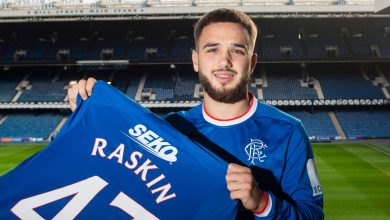
The home side kept pressing. A deflected shot from Curtis struck the crossbar, and Nico Raskin missed several chances, according to one report. Rangers were creating enough to win the match, but the finishing and the decisions were not going their way.
Just as it seemed that Rangers might run out of time, they found a way back. Kevin Kelsy scored a late equaliser for Falkirk, according to Press Association coverage, a detail that confuses the picture slightly since it came against the run of play. I haven’t seen a clear account of the exact minute or the build-up, so I will not describe it in detail. What matters is that the match was level at 1-1 with seconds to go, and Falkirk, who had been defending resolutely, were within touching distance of a point.
That detail deserves a note of caution. Different outlets have described the late sequence in different ways, and not all of them agree on how the equaliser came about or who scored it. The simplest reading is that Falkirk levelled late and Rangers were pushed to find a winner in added time
The finale was as dramatic as anything earlier in the afternoon. Rangers were awarded a penalty in added time, and Ryan Naderi stepped up to take it. Falkirk goalkeeper Scott Bain saved his first attempt. That should have been the end of it, with the match heading for a draw
Instead, VAR intervened again. The officials judged that Bain had left his goal line before the kick was taken, which meant the penalty had to be retaken. Naderi took it a second time and scored, in the 99th minute, to win the match 2-1.
It is a neat irony. The same system that had given Falkirk a penalty and disallowed a Rangers goal now gave Rangers a second chance from the spot. The retake followed the laws of the game, which require the goalkeeper to keep at least one foot on the line until the ball is kicked, and VAR is now used to enforce that. But to Falkirk’s players and supporters, it will have felt like a cruel twist.
One report also described the result as Rangers’ tenth consecutive Premiership win. Other coverage framed it as the end of a week in which Rangers collected maximum points from three league games. I have not been able to reconcile those two descriptions, so I would treat the exact length of the winning run with care until it is confirmed.
After the match, Derek McInnes gave a revealing interview. He said that the game lasts 90-odd minutes for a reason and that you have to keep going. He added that he would like his team to win more comfortably, but that there is a resilience in the group
He also spoke about the dressing room. McInnes described his players as a likeable bunch and said he preferred to like them, adding that he really loves this team. He said he liked how the players are with each other, and that they all feel connected to getting the win. In his words, that matters when things are going badly, because it is not only technique and ability that carry a side through.
Notably, McInnes did not use the post-match platform to criticise the officials. He said he had no issue with the scoreline, believed Rangers deserved to win, and suggested the statistics would heavily favour his team. That restraint is worth noting, given the club’s history of strongly worded statements about refereeing. The win, and the way it was achieved, may have lowered the temperature.
He also revealed what he told his players at half-time. They spoke about continuing much of what they had done and about not letting negative thoughts into their heads. That message appears to have worked. The second-half performance was about patience and persistence rather than panic
For Falkirk, manager John McGlynn was gracious in defeat. He conceded that his side would have been fortunate to take anything from Ibrox and said that Rangers deserved to win. That is a generous assessment from a manager whose team had been seconds from a point, and it reflects the one-sided nature of much of the play.
It also reflects a broader point. Falkirk had won six matches in a row coming into the game. They were not an easy opponent, and their organisation and efficiency, particularly with the penalty, were impressive. But for long stretches they were pinned back, and the manager knew it.
Stepping back, the match offers a useful case study in how VAR shapes modern football. Four significant decisions turned on video review in a single afternoon: the penalty for Falkirk, the disallowed goal for Rangers, the saved penalty that was ordered to be retaken, and the retaken penalty itself. Each was defensible under the laws, and each produced a different emotional reaction depending on which team’s supporters you asked.
The common thread is that the technology does not remove judgement. It moves it. A referee who would once have made a call in real time now makes it after watching replays, and the officials in the video room have to decide when to intervene. That creates the possibility of inconsistency, because two similar incidents can be treated differently depending on the thresholds applied by different people on different days.
For the Scottish FA, the challenge is to build trust in that process. Explaining decisions, as it did in this case, is one way to do that. Having the head of refereeing discuss controversial incidents on the VAR Review Show is another. But explanation is not the same as agreement, and decisions that divide experts will continue to divide supporters.
The episode also touches on a longer-running relationship. Rangers have had a difficult history with the Scottish FA over officiating and discipline. In June 2025 the club was fined £3,000 after a commentator on its television channel called a decision “corrupt,” and Rangers responded with a statement challenging the consistency of the governing body’s rules. More recently, the club criticised the reinstatement of VAR officials after a cup final error, in which the SFA acknowledged a penalty should have been given for a pull on Vaclav Cerny.
Against that backdrop, a penalty decision against Rangers at Ibrox, followed by a statement and a pundit row, could easily have triggered another round of public criticism. That it did not may be a sign that the club’s attention is elsewhere. With a title race under way and the team playing well, the incentive is to keep the focus on the pith.
It may also be that Rangers have had enough decisions go their way to take the long view. Earlier this season, Collum acknowledged that officials got a decision wrong in Rangers’ favour against St Mirren, when Fernandez stood on an opponent’s foot and no penalty was given. Over a season, the calls tend to even out, though few supporters ever feel that they do.
The consequences of the result are significant. Rangers lead the Premiership by two points, with Celtic able to reclaim top spot if they beat Hearts on Sunday. The margins between the leading sides are slim enough that a single point could change the picture.
For McInnes, the win demonstrates the quality he has talked about. A team that can take a punch, fall behind to a contested penalty, have a goal disallowed, concede late and still win is a team with real character. But the manager has also been honest that he would prefer to win more comfortably, and that is worth taking seriously. Relying on late goals is a thrilling way to win, but it carries risk over a full season.
The performance also highlights the finishing issue. Rangers created enough chances to have won earlier, with Curtis hitting the bar and Raskin missing several opportunities. If those chances are taken, the match is not decided by VAR decisions in added time. That will be part of the conversation as the club looks at its attacking options for January
The Scottish FA’s statement did what it was meant to do. It told us that VAR had intervened for a shirt pull by Tuur Rommens on Ethan Ross, and that the referee had gone to the monitor and given a penalty. What it could not do was settle whether that was the right decision. Halliday and Loy, two voices who know the game from the inside, thought it was not.
In the end, the argument was overtaken by events. A goal disallowed, a penalty saved and retaken, and a winner in the 99th minute turned a day of grievance into a day of celebration. Rangers are top, unbeaten in 15, and led by a manager who says he loves his team.
That does not mean the debate will go away. The next VAR Review Show will go through the Rommens incident, and the question of how much contact is enough will keep returning. But for now, the verdict on the Scottish FA’s statement is that it was clear about what happened and silent about whether it was right. At Ibrox on Saturday, the rest of the story was written by the players