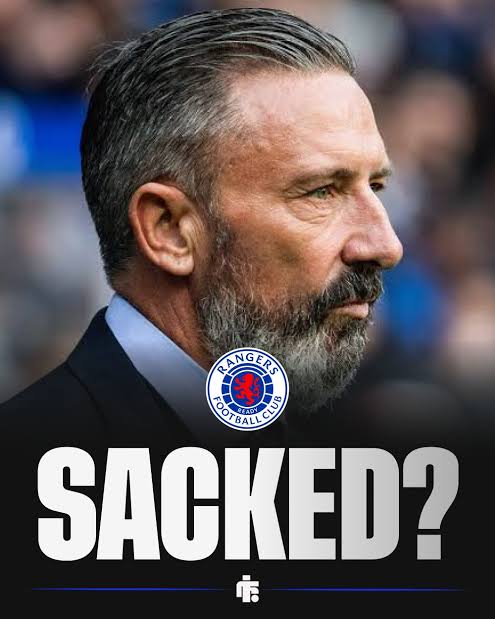
Rangers’ Conference League exit to Jablonec has pushed a question that’s been simmering for weeks into open, urgent territory: is Derek McInnes the wrong man for the job, or a good manager caught in a genuinely difficult situation not entirely of his own making? Here’s the case on both sides.
The numbers alone make an uncomfortable read. McInnes has won just two of his seven games in charge of Rangers since arriving from Hearts, a return that would be concerning at any club and looks especially stark at one of Rangers’ size and expectation. Add to that a Conference League exit that leaves the club without European football beyond August for the first time since 2017, and the statistical case against him is straightforward enough on its own.
Beyond the numbers, there’s a deeper concern being voiced by critics: that the underlying performances have been genuinely poor, not just the results. One assessment of the Jablonec defeat described Rangers as never offering anything in an attacking sense, lacking control, lacking aggression, and defensively disjointed throughout — a performance bad enough that finding anything positive to say about it was described as nearly impossible. That same critique noted the result wasn’t even particularly shocking, given how unconvincing Rangers had already looked in the first leg at Ibrox despite winning it.
Fan sentiment has hardened quickly. A poll conducted after the earlier Europa League exit to Jagiellonia Bialystok found 22 percent of Rangers supporters believed the manager was the problem and should be sacked immediately, with a further 28 percent stopping short of demanding his removal while still holding him primarily responsible — meaning exactly half of respondents laid the blame chiefly at McInnes’s door even before the Jablonec humiliation compounded matters further. Forum sentiment among the fanbase has, if anything, hardened further since, with posters describing the situation as beyond saving and arguing the job is simply too big for him.
Former players have added real weight to the sacking case. Andy Halliday placed the Jablonec exit alongside Rangers’ most notorious European humiliations — Kaunas, Progres Niederkorn — and stated bluntly that McInnes’s job would come under threat as a result. That’s not fan forum noise; that’s a former Ibrox player, with genuine insight into the standards expected at the club, making the case in public.
There’s also a structural argument for a change: the churn. Rangers have cycled through managers with startling frequency in recent seasons — Russell Martin dismissed the previous year, Danny Rohl before him — and the argument runs that continuing that cycle, however uncomfortable, may simply be the pattern Rangers’ ownership under Andrew Cavenagh has shown itself willing to follow when results don’t arrive quickly enough. Cavenagh and the 49ers Enterprises group have already demonstrated, with Martin’s exit, that they won’t hesitate to pull the trigger on a manager who isn’t delivering.
The counter-argument starts with a simple observation: there have been no actual reports suggesting the 49ers are considering sacking McInnes. Whatever the temperature of fan and media discourse, the ownership group itself appears, for now, willing to give him time — a stance rooted partly in hope that he can rediscover the form that defined his final campaign at Hearts, where he produced genuinely impressive results before making the move to Ibrox.
The stronger version of this argument goes further, suggesting that sacking McInnes would treat the symptom while ignoring the disease. One widely shared take on the Jablonec exit framed it explicitly this way: the constant churn of managers and players is what’s actually harming Rangers, and dumping McInnes now would simply continue that same destructive pattern rather than break it. On this reading, McInnes may be a genuinely good manager who has walked into the wrong situation — a club with unrealistic expectations of instant success layered on top of an enormous, still-unsettled squad rebuild, arriving mid-transition rather than at a natural clean slate.
That context matters enormously to this side of the debate. McInnes has openly acknowledged the scale of turnover his squad has absorbed — twelve new signings already this summer, with further arrivals like Kevin Kelsy and Kim Min-su still bedding in, the latter’s Rangers debut confirmed only hours before the Jablonec defeat itself. Assembling a coherent, cohesive squad capable of performing under pressure from that much simultaneous change was always going to take time that a hostile early-season run doesn’t allow for. The fan poll cited above, while showing real frustration with McInnes, also found 27 percent of supporters believed recruitment — not coaching — was the primary issue, with a further 22 percent putting the responsibility on players failing to execute rather than on the manager’s own decisions.
There’s also the matter of what a change would actually solve in the short term. Rangers are reportedly still without a clear alternative lined up, beyond persistent, largely fan-driven speculation about a Steven Gerrard return — speculation that has resurfaced now that pressure on McInnes is mounting, but which stems from discussions Gerrard held with the 49ers after Martin’s departure, discussions in which he ultimately concluded the timing wasn’t right for him to return to Ibrox. Nothing in current reporting suggests that calculation has changed. A managerial change conducted in haste, without a genuinely superior option ready to step in immediately, risks compounding instability rather than resolving it — particularly with no European football left to provide any margin for a new appointee to find his feet.
Finally, there’s the argument from cent history and reputation. This is, after all, a manager who built a genuinely impressive body of work over nearly eight years at Aberdeen, ending a 19-year trophy drought with a League Cup win and turning the Dons into a consistent second force in Scottish football — credentials that, at the time, made him a manager Rangers themselves twice tried to appoint before he finally said yes. That track record doesn’t guarantee success at Ibrox, but it’s a legitimate reason for caution before discarding him after only seven matches.
For now, at least, the practical reality favors patience over upheaval. Reports consistently indicate no imminent plans within Rangers’ ownership to make a change, and the club’s dressing room and infrastructure remain in the early, fragile stages of a rebuild that a managerial change would only further disrupt. But patience has visible limits, and those limits are being tested in real time. McInnes has already acknowledged that even a shoot-out win over Jablonec would only have “papered over cracks” in a deeper performance issue — an admission that suggests he himself recognizes how precarious the underlying picture remains, whatever the ownership’s current stance on his job security.
The trip to Aberdeen — the club where he made his name — now carries an outsized significance that goes well beyond three league points. Continued alignment with the second half of this debate, that McInnes deserves time to build something sustainable, depends heavily on results starting to arrive soon. Another poor performance and result there would give real momentum to the argument that no amount of context excuses what’s currently happening on the pitch, regardless of how sympathetic the underlying circumstances may be.